Image (Credit): Actual image of the exoplanet 2M1207b (red) around its star 2M1207A. (European Southern Observatory)
“What new discoveries from the James Webb space telescope (JWST) can I tell my nine-year old about?”
-The one question put to Google’s Bard AI program, which was designed to rival Microsoft’s ChatGPT. In response, Bard stated the JWST took the very first pictures of an exoplanet, which was incorrect. The first image of an exoplanet can be seen above, taken by the European Southern Observatory’s Very Large Telescope back in 2004. The exoplanet, called 2M1207 b, is a gas giant about five times the mass of Jupiter. Following the erroneous feedback, the stock of Google’s parent Alphabet dropped about $100 billion in value. Below is an image from another exoplanet spotted by the JWST last year, called HIP 65426 b, which is about six to eight times the mass of Jupiter.
Image (Credit): First direct image of an exoplanet by the JWST. The exoplanet, called HIP 65426 b, is about 6 to 8 times the mass of Jupiter and only 15 to 20 million years old. The Earth is about 4.5-billion-year-old Earth. (NASA/ESA/CSA, A Carter (UCSC), the ERS 1386 team, and A. Pagan (STScI))
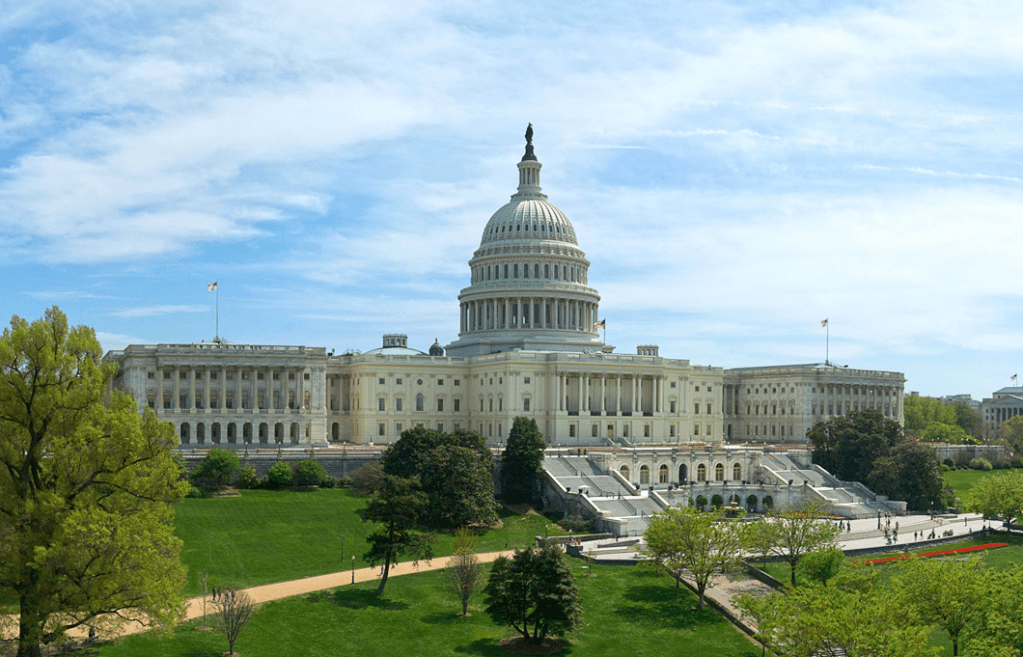
Image (Credit): U.S. Capitol Building. (U.S. Capitol Police)
The House Committee on Science, Space, and Technology, which oversees NASA’s programs, may have a chance to get some things done this year. Earlier in the week, New York Congressman George Santos stepped down from the Committee on Science, Space, and Technology as well as the House Committee on Small Business. With all of the problems following this man, his presence on either committee would have been a pure distraction.
The House Committee on Science, Space, and Technology has a broad jurisdiction beyond just NASA:
The Committee on Science, Space, and Technology has jurisdiction over all energy research, development, and demonstration, and projects thereof and all federally owned or operated non-military energy laboratories; astronautical research and development, including resources, personnel, equipment, and facilities; civil aviation research and development; environmental research and development; marine research; commercial application of energy technology; National Institute of Standards and Technology, standardization of weights and measures and the metric system; National Aeronautics and Space Administration; National Science Foundation; National Weather Service; outer space, including exploration and control thereof; science scholarships; scientific research, development, and demonstration, and projects therefor. The Committee on Science, Space, and Technology shall review and study, on a continuing basis, laws, programs, and Government activities relating to non-military research and development.
Given the Artemis program as well as the other NASA endeavors currently underway, the Committee should be focusing as much time as possible on space missions rather than bogus resumes and lies to the public.
We need a serious Congress if we are going to conduct serious science and space exploration. Let’s hope Washington DC can keep its focus on the real stars (rather than the political black holes that can suck in all light and common sense).
Image (Credit): Former NASA astronauts Robert Behnken, left, and Douglas Hurley, right, and are seen after being awarded the Congressional Space Medal of Honor by Vice President Kamala Harris during a ceremony in the Eisenhower Executive Office Building. (NASA/Joel Kowsky)
On behalf of President Joe Biden, Vice President Kamala Harris awarded former NASA astronauts Douglas Hurley and Robert Behnken the Congressional Space Medal of Honor Tuesday for their bravery in NASA’s SpaceX Demonstration Mission-2 (Demo-2) to the International Space Station in 2020. Hurley and Behnken are the first recipients of the honor since 2006 and accepted the awards during a televised event in Washington.
Scientists using NASA’s new James Webb Space Telescope say they’ve been able to get a closer look at an asteroid that also hosts just the fifth ring system to be discovered in our solar system (the others circle Saturn, Jupiter, Uranus and Neptune). Astronomers initially discovered the rings in 2013 while watching Chariklo occult, or pass in front of, a distant star. To their surprise, two other smaller objects also appeared to pass in front of the background star for an instant. These turned out to be two thin rings around Chariklo.
In 2008, HR8799 was the first extrasolar planetary system ever directly imaged. Now, the famed system stars in its very own video. Using observations collected over the past 12 years, Northwestern University astrophysicist Jason Wang has assembled a stunning time lapse video of the family of four planets — each more massive than Jupiter — orbiting their star. The video gives viewers an unprecedented glimpse into planetary motion.
Image (Credit): JWST image of the central region of the Chamaeleon I dark molecular cloud. (NASA, ESA, CSA)
George Will, political commentator, wrote an article for his Washington Post column this week that praised the James Webb Space Telescope (JWST). I am accustomed to his conservative politics and baseball trivia, but he was showing a whole new side in this piece. He was almost giddy in his praise of the telescope. I guess no one can avoid being fascinated with the images we have seen since July of last year, as well as what we are learning from these images. The universe has plenty of secrets to share.
Mr. Will was just as impressed with the engineering that went into the JWST, noting that:
To function, each mirror must, after being hurled into space on a shuddering rocket, retain this exquisite precision: If each mirror were the size of the continental United States, each should not vary more than 2 inches from perfect conformity with the others.
That is impressive.
It is just nice to see astronomy bleeding into everyday conversations, which is what is needed given the rest of the Earth-bound news these days. Yes, it is time to look up and look back in time to understand our place in the universe. Talk about science, be it astronomy or engineering, should replace the political talk from time to time.
There is nothing new under the sun when it comes of silly politicians, but the night sky always has something new to share with us. We just have to pay attention.
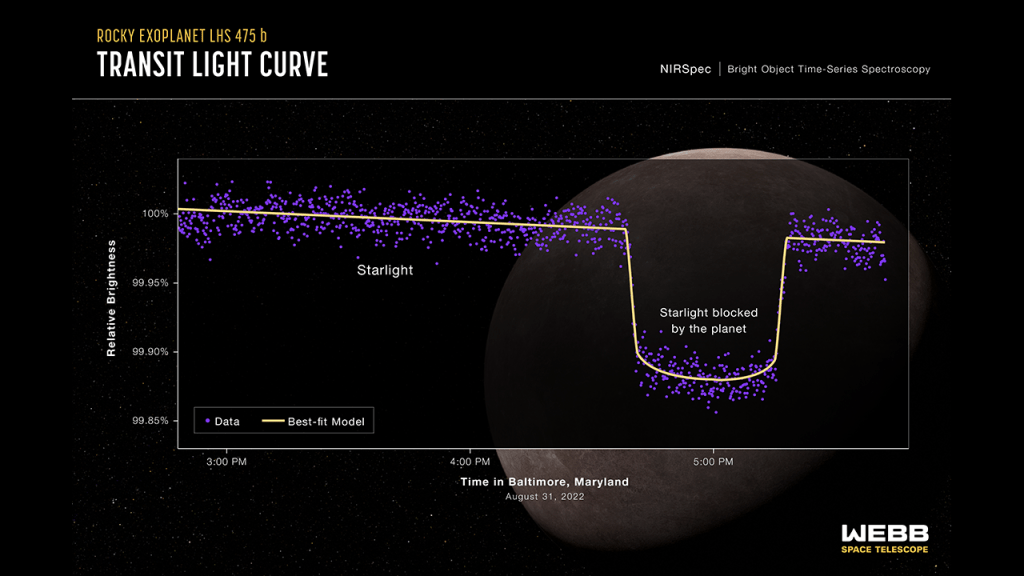
Researchers confirmed an exoplanet, a planet that orbits another star, using NASA’s James Webb Space Telescope for the first time. Formally classified as LHS 475 b, the planet is almost exactly the same size as our own, clocking in at 99% of Earth’s diameter. The research team is led by Kevin Stevenson and Jacob Lustig-Yaeger, both of the Johns Hopkins University Applied Physics Laboratory in Laurel, Maryland.
Russia will send up a new capsule next month to bring back three space station crew members whose original ride home was damaged, officials said Wednesday. The two Russians and one American will stay several extra months at the International Space Station as a result of the capsule switch, possibly pushing their mission to close to a year, NASA and Russian space officials told reporters.
In the space around Jupiter, a torus of plasma created and fed by Io’s volcanic emissions grew significantly richer between July and September of last year and persisted until December, showing the moon underwent a spate of volcanic activity that released a huge amount of material. For something that’s just a little bit bigger than Earth’s Moon, Io is an absolute beast of volcanism. It’s bristling with volcanoes, with around 150 of the 400 known volcanoes erupting at any given time, creating vast lakes of molten lava.