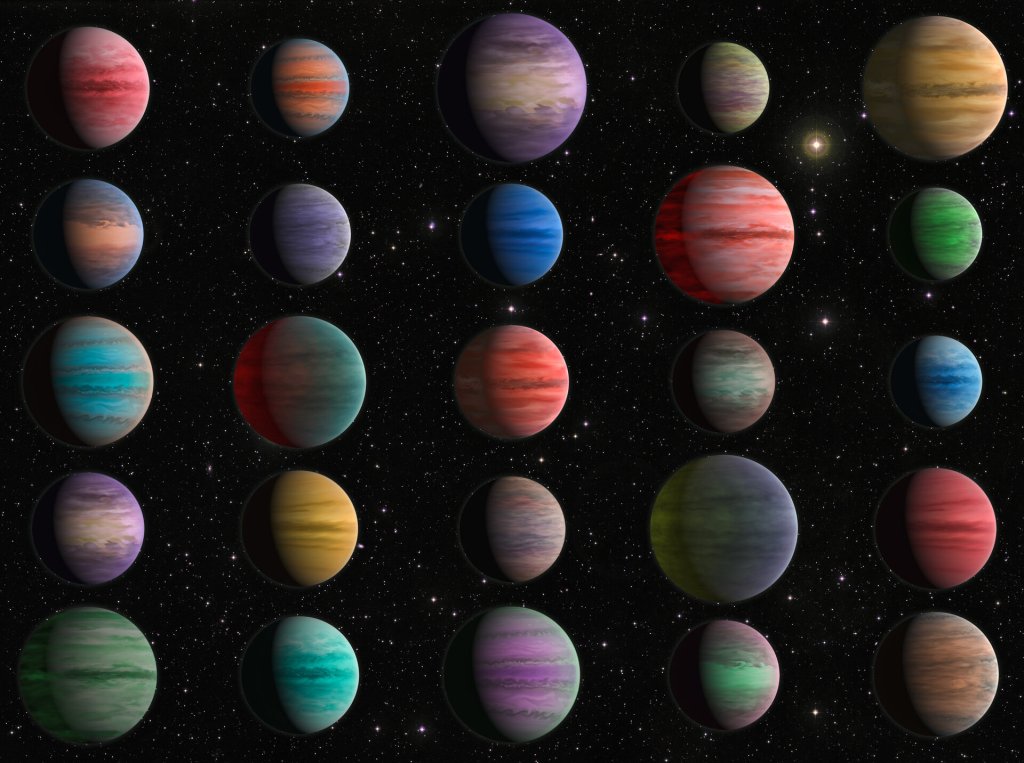
Image (Credit): Artist’s rendering of 25 hot Jupiters captured by the NASA/ESA Hubble Space Telescope that have been analysed by an international team of astronomers, enabling them to answer five open questions important to our understanding of exoplanet atmospheres. (ESA/Hubble, N. Bartmann)
“We are interested in understanding the diversity and atmospheric compositions of planets between the size of Earth and Neptune…“‘Super-Earths’ and ‘mini-Neptunes’ are the most common types of planets in our galaxy. But we only have a few examples of atmospheric measurements from these types of planets.”
-Statement by Johanna Teske, a staff scientist at the Carnegie Institution of Washington who is co-leading a Webb observation team with Natasha Batalha at NASA’s Ames Research Center in Northern California. She was discussing the James Webb Space Telescope’s role to better understand exoplanets. Her comments and more are included in a NASA news article, “Exoplanets: What NASA Will See with the Webb Telescope.”
Image (Credit): The new James Webb Space Telescope Forever stamp. (U.S. Postal Service)
“It is like humanity just got a brand-new pair of eyeglasses for the distant universe…We are suddenly seeing that those green areas on the tops of trees are actually made of thousands of individual leaves. We suspected it, but we are now seeing it for the first time.”
Image (Credit): The Cartwheel Galaxy, located about 500 million light-years away, as captured by the JWST. (NASA, ESA, CSA, STScI)
This week’s picture is one of the latest images from the James Webb Space Telescope (JWST). It shows the Cartwheel Galaxy, which is about 500 million light-years away. The Hubble’s view of this same galaxy is provided below.
NASA’s James Webb Space Telescope has peered into the chaos of the Cartwheel Galaxy, revealing new details about star formation and the galaxy’s central black hole. Webb’s powerful infrared gaze produced this detailed image of the Cartwheel and two smaller companion galaxies against a backdrop of many other galaxies. This image provides a new view of how the Cartwheel Galaxy has changed over billions of years.
The Cartwheel Galaxy, located about 500 million light-years away in the Sculptor constellation, is a rare sight. Its appearance, much like that of the wheel of a wagon, is the result of an intense event – a high-speed collision between a large spiral galaxy and a smaller galaxy not visible in this image. Collisions of galactic proportions cause a cascade of different, smaller events between the galaxies involved; the Cartwheel is no exception.
The collision most notably affected the galaxy’s shape and structure. The Cartwheel Galaxy sports two rings — a bright inner ring and a surrounding, colorful ring. These two rings expand outwards from the center of the collision, like ripples in a pond after a stone is tossed into it. Because of these distinctive features, astronomers call this a “ring galaxy,” a structure less common than spiral galaxies like our Milky Way.
The bright core contains a tremendous amount of hot dust with the brightest areas being the home to gigantic young star clusters. On the other hand, the outer ring, which has expanded for about 440 million years, is dominated by star formation and supernovas. As this ring expands, it plows into surrounding gas and triggers star formation.
Image (Credit): An image of the Cartwheel Galaxy taken with the NASA/ESA Hubble Space Telescope. (ESA/Hubble & NASA)
Using the James Webb Space Telescope (JWST), Scottish astronomers at the University of Edinburgh believe they have spotted a galaxy that is about 35 billion light-years away, showing us the galaxy as it would have appeared 235 million years after the Big Bang. This would make it the most distant galaxy ever captured by astronomers.
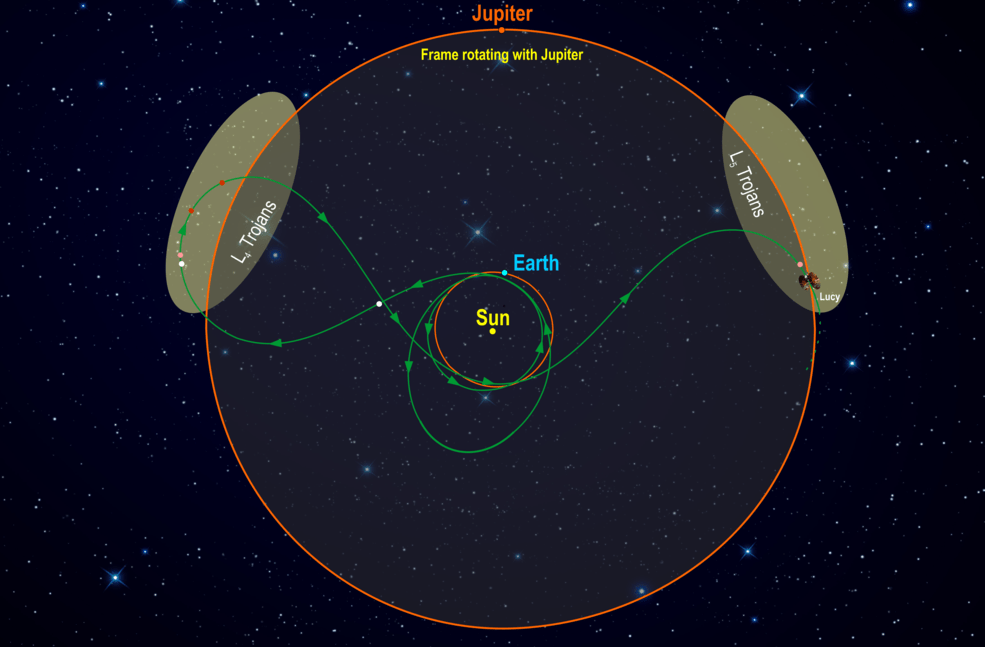
Image (Credit): This diagram shows Lucy’s orbital path in green after her October 2021 launch to visit the Trojan asteroids. (Southwest Research Institute)
Last week I noted some of the mission priorities in the James Webb Space Telescope’s (JWST) first year. Those priorities were listed under “Exoplanets and Disks.” I thought I would highlight a few more, this time from the “Solar System Astronomy” list. Here are five more priorities:
Pluto’s Climate System with JWST;
The Moons of Uranus: A NIRSpec Investigation of Their Origins, Organic Constituents, and Possible Ocean World Activity;
A Pure Parallel Survey of Water in the Asteroid Belt;
DiSCo-TNOs: Discovering the Composition of the Trans-Neptunian Objects, Icy Embryos for Planet Formation; and
JWST Observations of Lucy Mission Targets.
Each of these priorities come with an explanation of the mission. For example, here is a little more about NASA’s Lucy mission from the JWST proposal:
The Lucy spacecraft – to be launched at approximately the same time as JWST – will perform the first ever in situ exploration of the Jupiter Trojan asteroids. Trojans are the largest population of solar system bodies currently unvisited by spacecraft, and revealing their composition and formation history is the key to untangling disparate hypothesis for the early dynamical evolution of the entire solar system.
Understanding these enigmatic bodies requires not just the high spatial resolution imagery and spectroscopy that will be afforded by Lucy, but also the superb near- and mid-infrared spectroscopy of which JWST is uniquely capable. The high signal-to-noise, high spectral resolution, and extended wavelength coverage beyond the capabilities of Lucy will allow JWST to sensitively probe the organic, carbonate, and silicate components of the surfaces of the Trojans. Meanwhile, the Lucy spectra and images will place these observations into their geological and historical context, greatly extending the scientific utility of both the JWST observations and the Lucy visit. Together these observations will paint a rich picture of this population, allowing us to trace connections with other bodies studied remotely and in situ across the solar system.
Lucy was launched last October and is expected to encounter its first Trojan asteroid until August 2027. You can find the full mission timeline here.



 Our Awesome Universe