Image (Credit): The Hubble Space Telescope. (NASA/ESA)
This week’s image is the Hubble Space Telescope, still going strong after more than 32 years. It left the Space Shuttle Discovery’s cargo bay on April 25, 1990. With all of the attention on the James Webb Space Telescope (JWST), it’s important to remember this dependable space telescope that brought us so many amazing images over the years, including those shown below.
Given the concern over the recent concerns about a micrometeroid impacting the JWST, let’s not forget that the Hubble had a few growing pains as well. Most importantly, it had to deal with a flawed mirror that required astronauts to visit the space telescope so they could add five pairs of corrective mirrors. More than three years had passed before the astronauts could make this correction. So the current issues with the JWST are pretty minor by comparison.
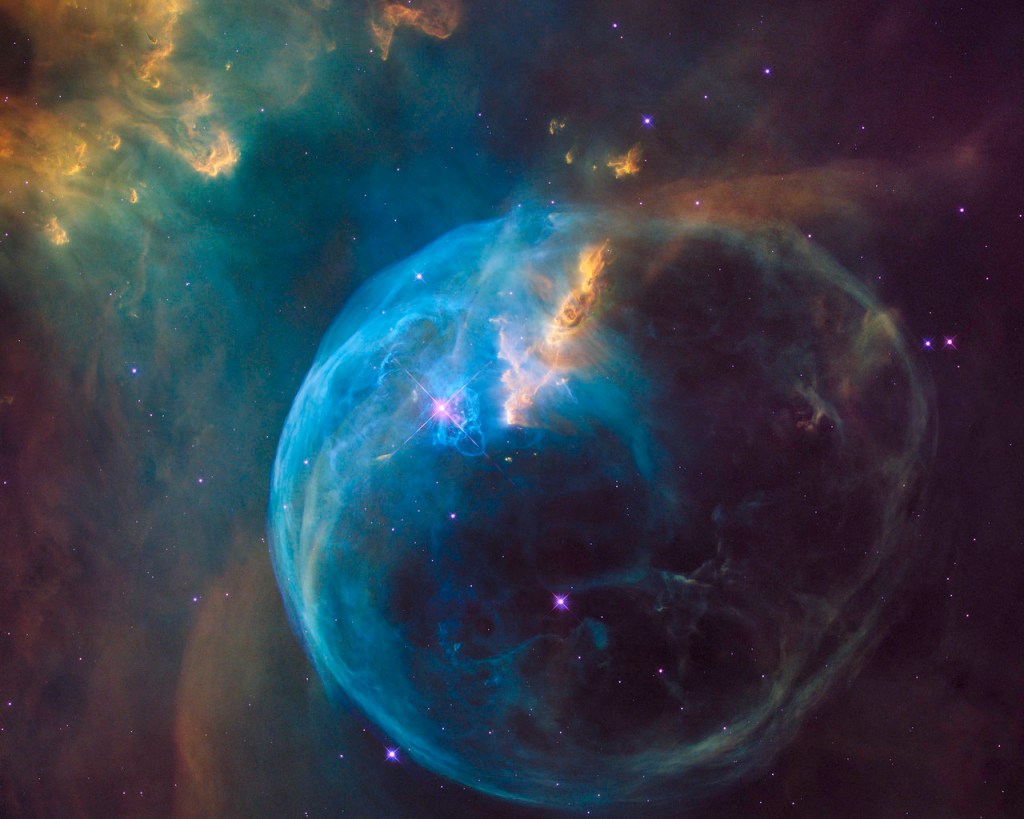
Image (Credit): The Bubble Nebula, also known as NGC 7635, located 8 000 light-years away. (NASA/ESA)
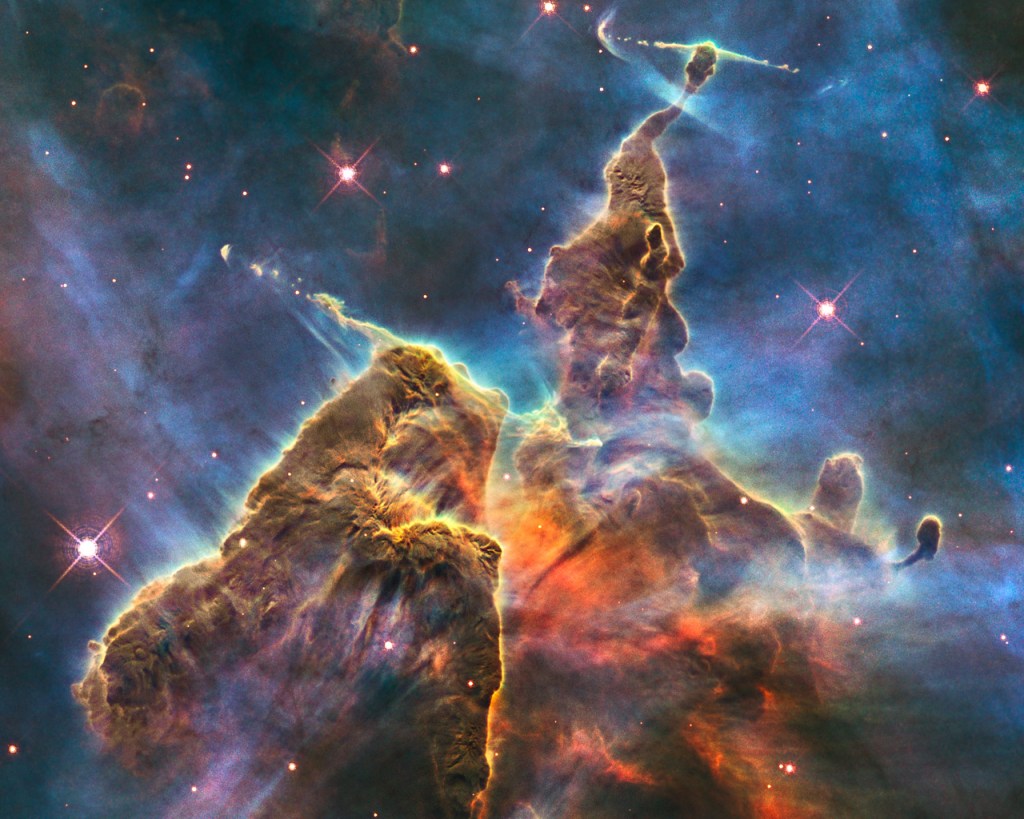
Image (Credit): A pillar of gas and clouds within the stellar nursery called the Carina Nebula, located 7500 light-years away in the southern constellation of Carina. (NASA/ESA).
Image (Credit): The eight plants of our solar system. (NOVA)
If you are looking for space series beyond the Moon, PBS has a few more shows for you. With the James Webb Space Telescope releasing the first photos next week, now is the time to brush up on the mission with a NOVA special. And check out the earlier NOVA piece on the planets as well. Dates and times may vary by region.
How did NASA engineers build and launch the most ambitious telescope of all time? Follow the dramatic story of the James Webb Space Telescope—the most complex machine ever launched into space. If it works, scientists believe that this new eye on the universe will peer deeper back in time and space than ever before to the birth of galaxies, and may even be able to “sniff” the atmospheres of exoplanets as we search for signs of life beyond Earth. But getting it to work is no easy task. The telescope is far bigger than its predecessor, the famous Hubble Space Telescope, and it needs to make its observations a million miles away from Earth—so there will be no chance to go out and fix it. That means there’s no room for error; the most ambitious telescope ever built needs to work perfectly. Meet the engineers making it happen and join them on their high stakes journey to uncover new secrets of the universe.
Among the stars in the night sky wander the eight-plus worlds of our own solar system—each home to truly awe-inspiring sights. Volcanoes three times higher than Everest, geysers erupting with icy plumes, cyclones larger than Earth lasting hundreds of years. Each of our celestial neighbors has a distinct personality and a unique story. In this five-part series, NOVA will explore the awesome beauty of “The Planets,” including Saturn’s 175,000-mile-wide rings, Mars’ ancient waterfalls four times the size of any found on Earth, and Neptune’s winds—12 times stronger than any hurricane felt on our planet. Using unique special effects and extraordinary footage captured by orbiters, landers and rovers, we’ll treat viewers to an up-close look at these faraway worlds. We’ll stand on the dark side of Pluto, lit only by the reflected light of its moons, watch the sun set over an ancient Martian waterfall, and witness a storm twice the size of Earth from high above Saturn. And, we’ll reveal how each of them has affected our own planet: Earth.
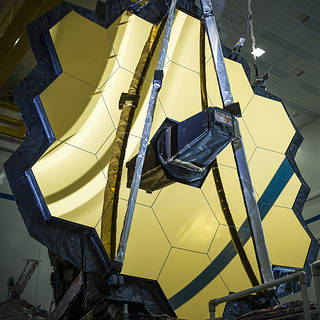
Image (Credit): James Webb Space Telescope mirrors. (NASA)
“It’s really hard to not look at the universe in a new light and not just have a moment that is deeply personal…It’s an emotional moment when you see nature suddenly releasing some of its secrets, and I would like you to imagine and look forward to that.”
Image (Credit): Artistic image with the JWST mirrors. (NASA)
NASA recently announced, in partnership with the European Space Agency and the Canadian Space Agency, that the first photos from the James Webb Space Telescope will be released from NASA’s Goddard Space Flight Center via a televised broadcast beginning at 10:30 a.m. EDT on Tuesday, July 12, 2022. The first images will also be posted here.
All of this follows the recent micrometeroid incident. NASA has been pretty quiet since reporting on the initial damage, though the pictures appear to be arriving as expected, so that is good news.
In terms of any future repairs to the JWST, a NASA Q&A with Paul Geithner, the deputy project manager – technical for James Webb Space Telescope, gives us some idea about the difficulties of such a mission:
Q: Webb was not designed to be serviced, but could it eventually be repaired or refueled during a robotic service mission?
Paul: Conceivably, some robotic servicing of Webb could be possible. A robot could grapple Webb at the same place where it was attached to the Ariane launch vehicle, which is the launcher interface ring on the Sun-facing spacecraft bus, and then add fuel to its propulsion tank. Given that Webb is an exquisitely sensitive infrared observatory, and much of it is at cryogenic temperatures, opportunities and benefits of servicing are limited.
Image (Credit): Artist’s image of the James Webb Space Telescope. (NASA)
NASA reports that the James Webb Space Telescope (JWST) was hit by a micrometeroid last month. The tweet from NASAWebb stated:
In late May, Webb sustained a dust-sized micrometeroid impact to a primary mirror segment. Not to worry: Webb is still performing at a level that exceeds all mission requirements.
A second story explained how NASA tested the JWST for just such instances, though the final sentence was a little more worrisome:
Webb’s mirror was engineered to withstand bombardment from the micrometeoroid environment at its orbit around Sun-Earth L2 of dust-sized particles flying at extreme velocities. While the telescope was being built, engineers used a mixture of simulations and actual test impacts on mirror samples to get a clearer idea of how to fortify the observatory for operation in orbit. This most recent impact was larger than was modeled, and beyond what the team could have tested on the ground.
And this sentence is also worrisome:
Since launch, we have had four smaller measurable micrometeoroid strikes that were consistent with expectations and this one more recently that is larger than our degradation predictions assumed.
The $10 billion space telescope, which is still working to become operational, is not expected to share images until mid-July. Unlike the Hubble Space Telescope, NASA cannot send astronauts out to the JWST to make periodic repairs. The JWST currently sits in the L2 Lagrange point about 1 million miles away. All NASA can do now is try to compensate for the damage as best it can.






 Our Awesome Universe