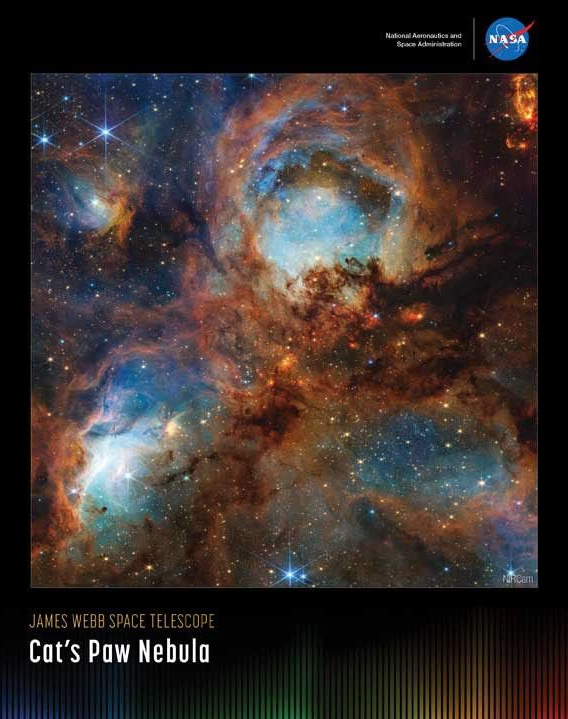
Image (Credit): NASA’s JWST poster showing the Cat’s Paw Nebula. (NASA, ESA, CSA, STScI; Designer: Elizabeth Wheatley (STScI))
This week’s image highlights a NASA poster that you can download (in a variety of versions). It shows the Cat’s Paw Nebula (NGC 6334) as captured by the James Webb Space Telescope (JWST).
Here is a short summary of what you are seeing from NASA:
Located approximately 4,000 light-years away in the constellation Scorpius, the Cat’s Paw Nebula offers scientists the opportunity to study the turbulent cloud-to-star process in great detail. Webb’s observation of the nebula in near-infrared light builds upon previous studies by NASA’s Hubble and retired Spitzer Space Telescope in visible- and infrared-light, respectively.
With its sharp resolution, Webb shows never-before-seen structural details and features: Massive young stars are carving away at nearby gas and dust, while their bright starlight is producing a bright nebulous glow represented in blue. It’s a temporary scene where the disruptive young stars, with their relatively short lives and luminosity, have a brief but important role in the region’s larger story. As a consequence of these massive stars’ lively behavior, the local star formation process will eventually come to a stop.
For more details and videos, visits the NASA page on the Cat’s Paw Nebula, which helps to commemorate the third anniversary of the JWST.
This time last year I highlighted a paper that discussed a possible exomoon circling an exoplanet called WASP-49Ab located about 635 light-years away . It was spotted by the European Southern Observatory’s Very Large Telescope in Chile.
Well, now the James Webb Space Telescope (JWST) has provided data related to another possible exomoon orbiting a hot Jupiter-like exoplanet called WASP-39b. It is located about 700 million light-years away.
In a Scientific American article titled “Have Astronomers Finally Found an Exomoon?” we learn that a paper is being released shortly outlining the argument for this potential “hypervolcanic exomoon.” This presumed IO-like exomoon is being cooked by the parent sun.
Recent infrared spectroscopy from the James Webb Space Telescope (JWST) has spurred analyses of common volcanic gases such as carbon dioxide (CO2), sulfur dioxide (SO2), alongside alkali metals sodium (Na I) and potassium (K I) surrounding the hot Saturn WASP-39 b. We report more than an order-of-magnitude of variability in the density of neutral Na, K, and SO2 between ground-based measurements and JWST, at distinct epochs, hinting at exogenic physical processes similar to those sourcing Io’s extended atmosphere and torus. Tidally-heated volcanic satellite simulations sputtering gas into a cloud or toroid orbiting the planet, are able to reproduce the probed line-of-sight column density variations. The estimated SO2 flux is consistent with tidal gravitation predictions, with a Na/SO2 ratio far smaller than Io’s. Although stable satellite orbits at this system are known to be < 15.3 hours, several high-resolution alkali Doppler shift observations are required to constrain a putative orbit. Due to the Roche limit interior to the planetary photosphere at ~ 8 hours, atmosphere-exosphere interactions are expected to be especially important at this system.
It is a dense summary, but also a hopeful finding that may lead to more focused searches for exomoons.
The addition of exomoons to the list of new discoveries will only increase the chances that some form of life can be found among he many solar systems we can study. Interestingly enough, we are still probing our own solar system’s moons with the same hope.
Image (Credit): Sagittarius B2 as captured by the JWST. (NASA, ESA, CSA, STScI, Adam Ginsburg (University of Florida), Nazar Budaiev (University of Florida), Taehwa Yoo (University of Florida); Image Processing: Alyssa Pagan (STScI))
This week’s busy image from the James Webb Space Telescope (JWST) shows the Sagittarius B2 molecular cloud, which is about 26,000 light-years away.
Stars, gas and cosmic dust in the Sagittarius B2 molecular cloud glow in near-infrared light, captured by Webb’s NIRCam (Near-Infrared Camera). In this light, astronomers see more of the region’s diverse, colorful stars, but less of its gas and dust structure. Webb’s instruments each provide astronomers with important information that help build a more complete picture of what is happening in this intriguing portion of the center of our galaxy.
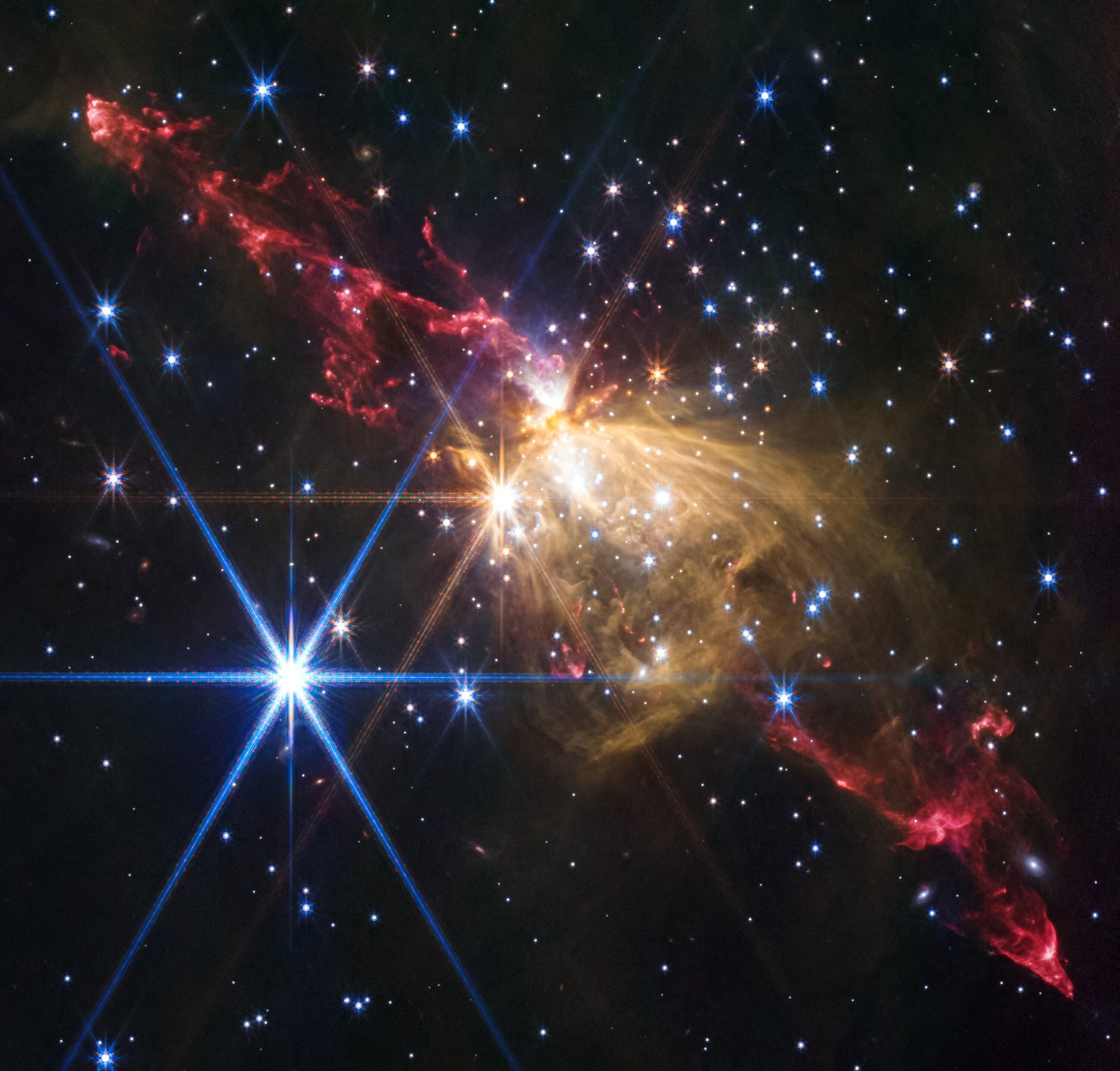
This week’s image from the James Webb Space Telescope (JWST) shows a stellar eruption called Sharpless 2-284 (or Sh2-284), which is located about 15,000 light-years away. The image provides a beautiful and delicate combination of colors.
We didn’t really know there was a massive star with this kind of super-jet out there before the observation. Such a spectacular outflow of molecular hydrogen from a massive star is rare in other regions of our galaxy. Massive stars, like the one found inside this cluster, have very important influences on the evolution of galaxies. Our discovery is shedding light on the formation mechanism of massive stars in low-metallicity environments, so we can use this massive star as a laboratory to study what was going on in earlier cosmic history.
A team of Pennsylvania State University researchers has a unique take on mysterious red dots first observed by the James Webb Space Telescope. Initially thought to be tiny, crimson galaxies, the red dots are now proposed to be a new and exotic class of celestial object: a hybrid of a black hole and a star, which researchers have dubbed “black hole stars.”
The University of Virginia Occultation Group, astronomy undergraduates who observe and track asteroids and small planets, make most of their observations locally. But they also travel around the country and the world to catch glimpses of heavenly objects, from high-priority asteroid/minor planets and the dwarf planet Pluto to the distant Kuiper Belt object Arrokoth. They observe stellar occultations, which occur when asteroids and minor planets pass in front of distant stars, via telescope. The Group studies some asteroids that later will be studied by close spacecraft fly-bys, and seek out asteroids that may pose a threat to the planet.
Since September 14, 2015, when the Laser Interferometer Gravitational-Wave Observatory (LIGO) made the first-ever direct detection of gravitational waves, the observatory has been making history. Cornell astrophysicists Saul Teukolsky and Larry Kidder earned a share in the 2016 Special Breakthrough Prize in Fundamental Physics – a $3 million award – for their contributions to the project. Now, on the 10th anniversary of LIGO’s first discovery, the LIGO-VIRGO-KAGRA team has announced a black hole merger similar to its first detection. However, thanks to a decade’s worth of technological advances improving the detector sensitivity, the signal is dramatically clearer, allowing unprecedented tests of General Relativity to be performed.




 Our Awesome Universe