Sidebar: Naming the James Webb Space Telescope

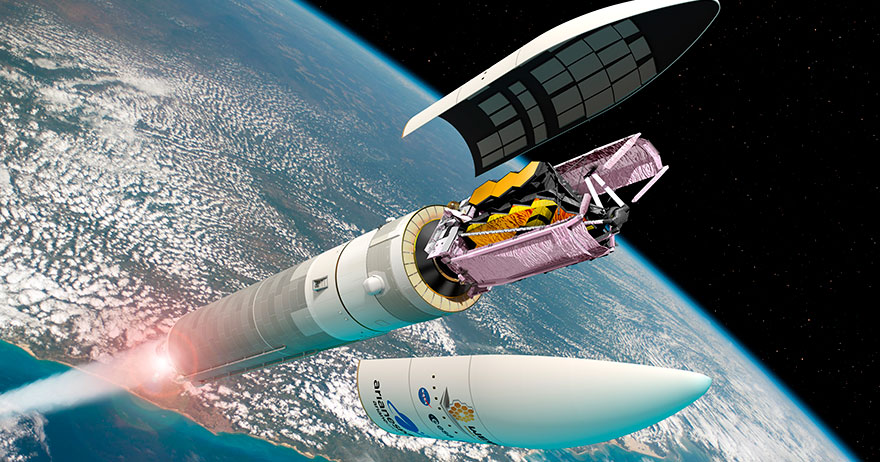
Source: James Webb Space Telescope from NASA.

Now that the James Webb Space Telescope (JWST) is settling in at its new location 1 million miles away, we will be hearing that name for at least a decade every time NASA has new findings related to distant planets. It is worth noting that some people are not so pleased with the spacecraft’s designated name.

A recent article in Scientific American magazine highlighted some resistance to allowing former NASA administrator James Webb’s name to be part of the new space telescope. In the article, “NASA Won’t Rename the James Webb Space Telescope—and Astronomers Are Angry,” we are told that more than 1,200 individuals, “including scientists,” signed a petition asking for a new name. The petition stated that Mr. Webb was in key government positions during a period when gay and lesbian federal employees were fired due to their sexual orientation.  NASA later reported it did not have any evidence to support such a name change and considered the matter closed.

I will admit that I liked the name Hubble for the space telescope being replaced by the JWST. It seemed appropriate to name the telescope after Edwin Hubble, who proved there were galaxies beyond our Milky Way. That is an impressive accomplishment, whereas Mr. Webb was a successful Washington bureaucrat. Maybe another scientist would have been more appropriate.

That said, getting space programs funded is no easy task, so even if they want to name a space telescope after a U.S. Senator I will not issue an objection if that senator can get the job done. And let’s remember that we do have many perfect people for naming rights. Even Edwin Hubble, for all of his great accomplishments, was under a cloud of suspicion regarding a questionable redaction of part of a translation of George’s Lemaître’s 1927 paper that first reported what is today know as Hubble’s Law. While Hubble was eventually cleared of any questionable deeds, had it been raised at the time NASA was naming the space telescope it could have become an issue.

You may recall that NASA has used other questionable names for its missions in the past. For example, the god Apollo has many misadventures involving innocent women. Just ask Cassandra. And Mercury was far from innocent. The pesky god was known for rape and even Pandora’s Box. For some reason, I do not believe any of the gods would pass the test today.

Source: “Pandora” by Charles Edward Perugini, 1839-1918.

Podcast: A New Space Age?

Source: BBC.

If you are looking for a new podcast, or just want to listen to an interesting conversation, I recommend BBC’s recent Inside Science episode about human travel to the Moon and Mars. Titled “A New Space Age?,” the December 30, 2021 episode discusses NASA’s Artemis lunar program, the timetable for travel to Mars, and whether or not we even need to send humans into space.

Dr. Kevin Fong leads a panel of experts to discuss these topics:

— Dr. Mike Barratt, a senior NASA astronaut and medical doctor based at the Johnson Space Center;

— Dr. Anita Sengupta, Research Associate Professor in Engineering at the University of Southern California; and

— Oliver Morton, Briefings editor at the Economist and author of several books on the Moon and Mars.

If you enjoy the conversation, you may want to look around a few of the other episodes as well, such as the December 16, 2021 episode on the James Webb Space Telescope.

What Else Can be Found at Lagrange 2?

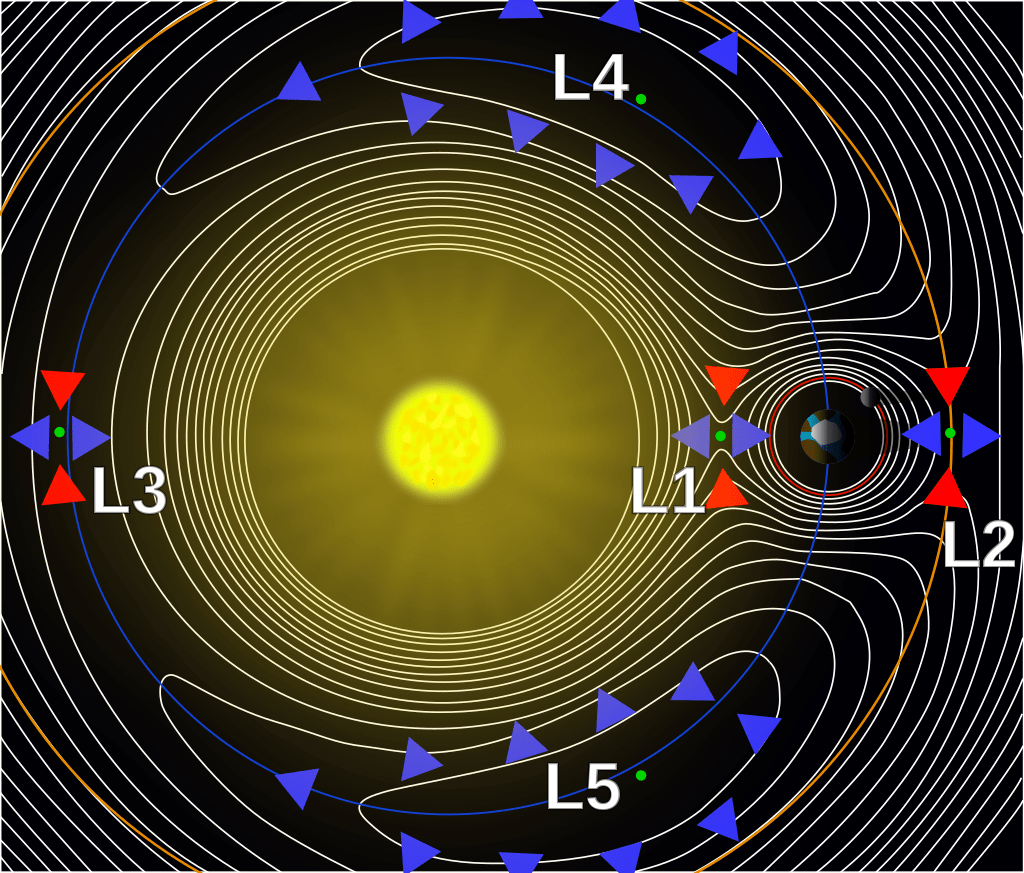
Source: Lagrange Points from Wikipedia.

Now that the James Webb Space Telescope (JWSP) has deployed its 21-foot, gold-coated primary mirror, it is in good shape as it heads for the Sun-Earth’s second Lagrange point, known as L2, which is nearly 1 million miles from Earth. However, it will not be the first spacecraft to park in this spot to conduct a scientific mission.

I looked around to get a good inventory of what was operating, and will be operating, at L2 when JWST arrives and found the best listing on Wikipedia. Here is the inventory:

Past missions at L2:

  • From 2001 to 2010: NASA’s Wilkinson Microwave Anisotropy Probe (WMAP) observed the cosmic microwave background.
  • From 2003 to 2004: NASA’s WIND studied radio waves and plasma that occur in the solar wind and in the Earth’s magnetosphere (now in L1).
  • From 2009 to 2013: The European Space Agency’s (ESA) Herschel Space Observatory sifted through star-forming clouds to trace the path by which potentially life-forming molecules, such as water, form.
  • From 2009 to 2013: The ESA’s Planck spacecraft observatory mapped the anisotropies of the cosmic microwave background at microwave and infrared frequencies, with high sensitivity and small angular resolution. 
  • From 2011 to 2012: Chinese National Space Programs’s Chang’e 2 tested the Chinese tracking and control network (after first serving as a lunar probe).

Current missions at L2:

  • Since 2014: The ESA Gaia probe has been measuring the positions, distances and motions of stars, with a mission to construct a 3D space catalog containing approximately 1 billion astronomical objects (stars, planets, comets, asteroids, quasars, and more).
  • Since 2019: The joint Russian-German high-energy astrophysics observatory Spektr-RG has been conducting a seven-year X-ray survey, the first in the medium X-ray band less than 10 keV energies, and the first to map an estimated 100,000 galaxy clusters.

Of course, there are future missions planned for L2, and plenty of craft operating in L1, L4, and L5. That will be a story or two for another time.

Top 10 Astronomy Stories from 2021

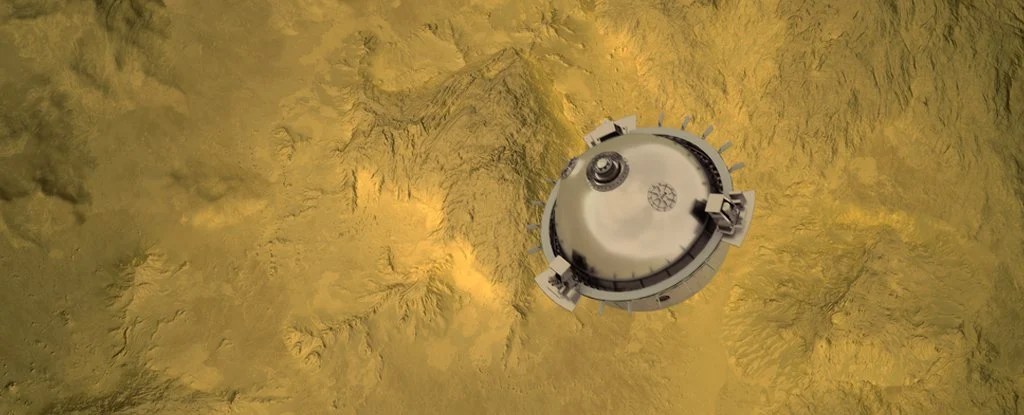
Source: Sciencealert.com webpage – “We’re Going Back to Venus! NASA Announces Two New Missions by 2030.”

Before we get too far into 2022, it is worth considering some of the top astronomy stories from 2021. Space.com put together a nice list that I highlighted below.

  1. Discovery of Comet Bernardinelli-Bernstein: “…It may be 10 times wider and 1,000 times more massive than a typical comet.”
  2. Amateur astronomer discovers a new moon around Jupiter: “The new moon, called EJc0061, belongs to the Carme group of Jovian moons.”
  3. NASA will return to Venus this decade: “…NASA has not launched a dedicated mission to the planet since 1989.”
  4. The sun is reawakening: “In early November, for instance, a series of solar outbursts triggered a large geomagnetic storm on our planet.”
  5. James Webb Space Telescope flies into space: “…JWST is heading to an observational perch located about a million miles from our planet.”
  6. Event Horizon Telescope takes high-resolution image of black hole jet: “The end result is a resolution that is 16 times sharper and an image that is 10 times more accurate than what was possible before.”
  7. Scientists spot the closest-known black hole to Earth: “Just 1,500 light-years from Earth…”
  8. Earth’s second ‘moon’ flies off into space: “…the object, known as 2020 SO, is a leftover fragment of a 1960s rocket booster from the American Surveyor moon missions.”
  9. Parker Solar Probe travels through the sun’s atmosphere: “The probe managed to get as low as 15 solar radii, or 8.1 million miles (13 million km) from the sun’s surface.”
  10. Perseverance begins studying rocks on Mars: “Perseverance is taking its observations from the 28-mile-wide (45 kilometers) Jezero Crater, which was home to a river delta and a deep lake billions of years ago.”

Visit the Space.com website for more details on each of these astronomy science stories.

The James Webb Space Telescope is Off!

It was quite the Christmas present – a new space telescope. NASA’s press release about the launch on December 25, 2021 of the James Webb Space Telescope stated:

The world’s largest and most complex space science observatory will now begin six months of commissioning in space. At the end of commissioning, Webb will deliver its first images. Webb carries four state-of-the-art science instruments with highly sensitive infrared detectors of unprecedented resolution. Webb will study infrared light from celestial objects with much greater clarity than ever before. The premier mission is the scientific successor to NASA’s iconic Hubble and Spitzer space telescopes, built to complement and further the scientific discoveries of these and other missions.

You can follow the progress of this mission via the James Webb Space Telescope Blog.