Pic of the Week: The Lynds 483 Hourglass

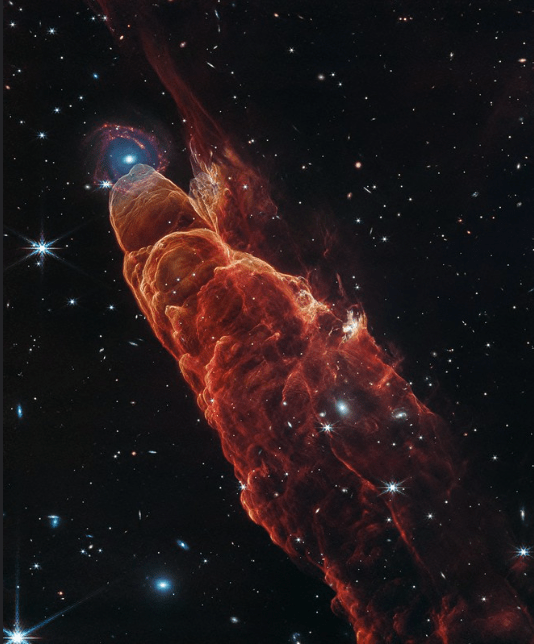
Image (Credit): Lynds 483 as captured by the JWST. (NASA, ESA, CSA, STScI)

This week’s image is from the James Webb Space Telescope. It shows two actively forming stars that are 650 light-years away. The formation is called Lynds 483, or L483, after American astronomer Beverly Turner Lynds, who studied nebulae in the early 1960s.

Here is more information about the image from NASA:

The two protostars responsible for this scene are at the center of the hourglass shape, in an opaque horizontal disk of cold gas and dust that fits within a single pixel. Much farther out, above and below the flattened disk where dust is thinner, the bright light from the stars shines through the gas and dust, forming large semi-transparent orange cones.

It’s equally important to notice where the stars’ light is blocked — look for the exceptionally dark, wide V-shapes offset by 90 degrees from the orange cones. These areas may look like there is no material, but it’s actually where the surrounding dust is the densest, and little starlight penetrates it. If you look carefully at these areas, Webb’s sensitive NIRCam (Near-Infrared Camera) has picked up distant stars as muted orange pinpoints behind this dust. Where the view is free of obscuring dust, stars shine brightly in white and blue.

China is Building Its Own James Webb Space Telescope

Image (Credit): Artist’s rendering of the China Space Station Telescope called Xuntian. (Changchun Institute of Optics, Fine Mechanics and Physics)

Just as we have competition with China for the next human to visit the Moon, we now have competition for the James Webb Space Telescope (JWST).

China has stated it plans to launch the China Space Station Telescope (CSST) in 2026, which should be as powerful as the JWST while having the extra benefit of remaining in Earth orbit. As a result, when compared to the JWST, the CSST will be easier to maintain as well as upgrade.

A Chinese paper on the new telescope noted the following regarding its potential:

It can simultaneously perform multi-band imaging and slitless spectroscopic wide- and deep-field surveys in ten years and an ultra-deep field (UDF) survey in two years, which are suitable for cosmological studies. Here we review several CSST cosmological probes, such as weak gravitational lensing, two-dimensional (2D) and three-dimensional (3D) galaxy clustering, galaxy cluster abundance, cosmic void, Type Ia supernovae (SNe Ia), and baryonic acoustic oscillations (BAO), and explore their capabilities and prospects in discovering new physics and opportunities in cosmology. We find that CSST will measure the matter distribution from small to large scales and the expansion history of the Universe with extremely high accuracy, which can provide percent-level stringent constraints on the property of dark energy and dark matter and precisely test the theories of gravity.

Of course, there is nothing wrong with a little competition. Let’s just hope NASA can get back on track after its latest budget problems as well as its current unstructured reorganization under the new White House. While the agency has other powerful telescopes under development, it doesn’t take much to throw things out of balance.

Pic of the Week: Super Star Cluster Westerlund 1

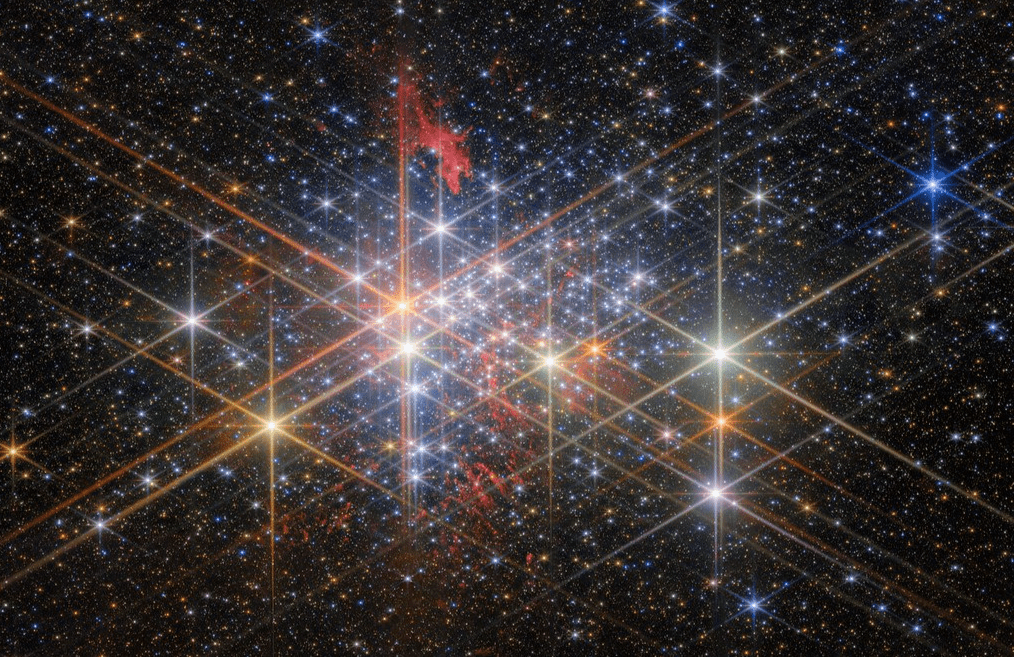
Image (Credit): Super star cluster Westerlund 1. (ESA/Webb, NASA & CSA, M. Zamani (ESA/Webb), M. G. Guarcello (INAF-OAPA) and the EWOCS team)

This week’s image from the James Webb Space Telescope was released late last year. It shows Westerlund 1, a colorful “super star” cluster.  

Here is the description of what you are seeing from NASA:

Super star clusters are young and contain more than 10,000 times the mass of the Sun packed into a small volume. Westerlund 1 is the most massive yet identified in our galaxy, with 50,000 to 100,000 times the mass of the Sun contained within a region less than six light-years across. Still considered an open cluster now, someday it will evolve into a globular cluster – a roughly spherical, tightly packed collection of old stars bound together by gravity.

Super star clusters are one of the most extreme environments in which stars and planets can form. Because our galaxy is past its peak of star formation, and because stars live relatively short lives, only a few of these clusters still exist to give us clues to that past era.

Westerlund 1 has a large, dense, and diverse population of evolved, massive stars. It contains so many massive stars that in a timespan of less than 40 million years, it’ll be the site of more than 1500 supernovas. This cluster is a natural laboratory for the study of extreme stellar physics, helping us learn how the most massive stars in our galaxy live and die, and how stellar winds, supernovae, and other ejected material affect star formation within their environment.

U.S. Postal Service Stamps Highlight JWST Images

Image (Credit): The U.S. Postal Service stamp featuring an image of star cluster IC 348 from NASA’s James Webb Space Telescope. (U.S. Postal Service)

The U.S. Postal Service is honoring NASA again with a set of stamps highlighting images captured by the James Webb Space Telescope (JWST) – star cluster IC 348 (above) and spiral galaxy NGC 628 (below).

Regarding star cluster IC 348, NASA notes:

The wispy curtains filling the image are interstellar material reflecting the light from the cluster’s stars – what is known as a reflection nebula. This scene is located 1,000 light-years from Earth in the constellation Perseus.

Regarding spiral galaxy NGC 628, NASA explains:

Webb’s observations combine near- and mid-infrared light to reveal glowing gas and dust in stark shades of orange and red, as well as finer spiral shapes with the appearance of jagged edges. This galaxy is located 32 million light-years away in the constellation Pisces. 

I would have preferred these stamps were regular first class forever stamps so that they would grace personal letters and birthday cards traveling to every corner of this country, but this is a nice gesture however you look at it.

Image (Credit): The U.S. Postal Service stamp highlighting an image of the spiral galaxy NGC 628 from NASA’s James Webb Space Telescope. (U.S. Postal Service)

Pic of the Week: The Sombrero Galaxy

Image (Credit): Messier 104 (M104) captured by the JWST. (NASA, ESA, CSA, STScI)

This week’s image, released late last year, comes from NASA’s James Webb Space Telescope (JWST). Messier 104 (M104), called the Sombrero galaxy, shines in all its blueness. It is about 31 million light-years away. It would have been interesting to see this galaxy from above (or below, for that matter).

Here is more about the galaxy from NASA:

In Webb’s mid-infrared view of the Sombrero galaxy, also known as Messier 104 (M104), the signature, glowing core seen in visible-light images does not shine, and instead a smooth inner disk is revealed. The sharp resolution of Webb’s MIRI (Mid-Infrared Instrument) also brings into focus details of the galaxy’s outer ring, providing insights into how the dust, an essential building block for astronomical objects in the universe, is distributed. The galaxy’s outer ring, which appeared smooth like a blanket in imaging from NASA’s retired Spitzer Space Telescope, shows intricate clumps in the infrared for the first time.

Note: Below is another view of the galaxy from the Hubble Space Telescope.

Image (Credit): Messier 104 (M104) captured by the Hubble Space Telescope. (This image was created from data from HST program 9714: K. Noll, H. Bond, C. Christian, L. Frattare, F. Hamilton, Z. Levay, and T. Royle (STScI)).