Pic of the Week: The Glow of Cassiopeia A

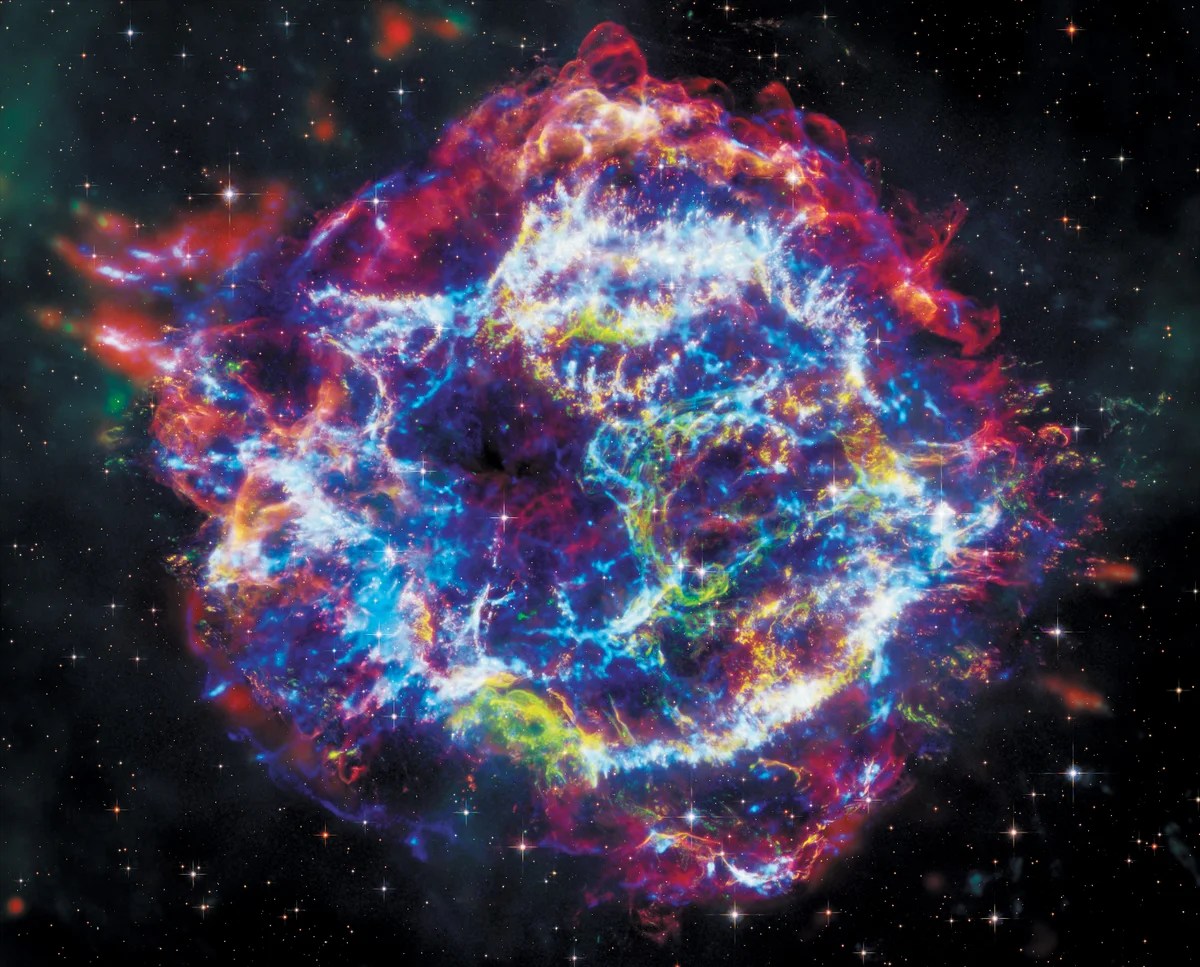
Image (Credit): Cassiopeia A supernova remnant. (NASA/CXC/SAO (x-ray); NASA/ESA/STScI (optical); NASA/ESA/CSA/STScI/D. Milisavljevic et al., NASA/JPL/Caltech (infrared); NASA/CXC/SAO/J. Schmidt and K. Arcand (image processing))

This week’s image was taken by the James Webb Space Telescope (JWST) and highlighted in Scientific American magazine. It shows a colorful supernova remnant called Cassiopeia A, which is about 350 light-years away.

The magazine article notes:

The recent photographs are helping scientists answer some of their most pressing questions about supernovae, such as which types of stars explode in which ways and how exactly those outbursts unfold. “There is a lot of complicated but beautiful physics in understanding how this explosion takes place,” says Purdue University astronomer Danny Milisavljevic, who led the team behind the JWST images…

Astronomers will keep studying Cassiopeia A, although their success makes them eager to turn JWST’s eyes toward some of the other roughly 400 identified supernova remnants in our galaxy. Getting a larger sample will help researchers connect differences in how remnants look and evolve to differences among the stars that produced them.

Pic of the Week: Cosmic Wreath

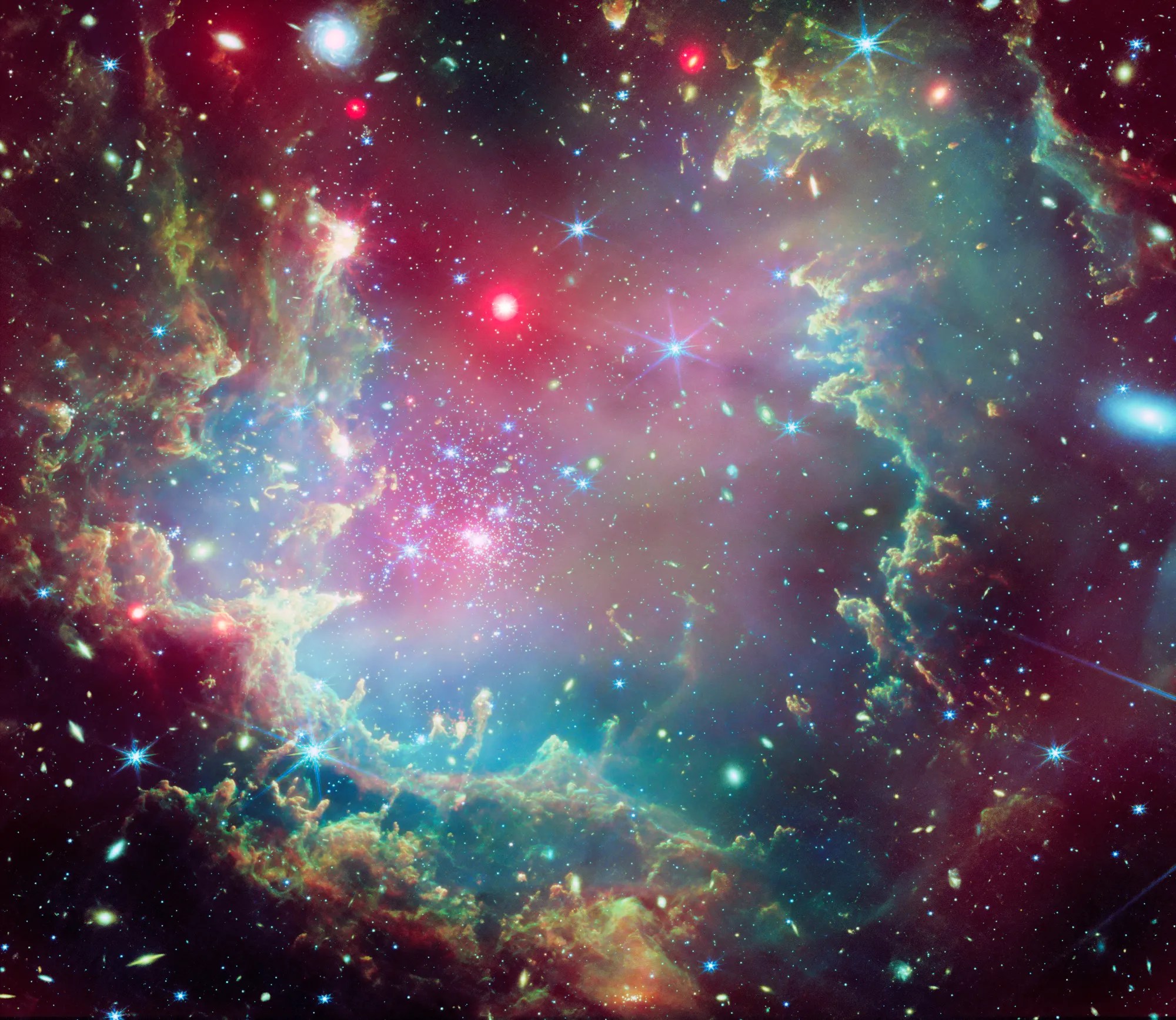
Image (Credit): Star cluster NGC 602. (X-ray: NASA/CXC; Infrared: ESA/Webb, NASA & CSA, P. Zeilder, E.Sabbi, A. Nota, M. Zamani; Image Processing: NASA/CXC/SAO/L. Frattare and K. Arcand)

This week’s image from NASA showing a cosmic wreath is appropriate for the holiday season. It comes from NASA’s Chandra X-ray Observatory and the James Webb Space Telescope.

Here is the full description from NASA:

The [image] depicts star cluster NGC 602 in vibrant and festive colors. The cluster includes a giant dust cloud ring, shown in greens, yellows, blues, and oranges. The green hues and feathery edges of the ring cloud create the appearance of a wreath made of evergreen boughs. Hints of red representing X-rays provide shading, highlighting layers within the wreath-like ring cloud.

The image is aglow with specks and dots of colorful, festive light, in blues, golds, whites, oranges, and reds. These lights represent stars within the cluster. Some of the lights gleam with diffraction spikes, while others emit a warm, diffuse glow. Upon closer inspection, many of the glowing specks have spiraling arms, indicating that they are, in fact, distant galaxies.

Pic of the Week: Quasar RX J1131-1231

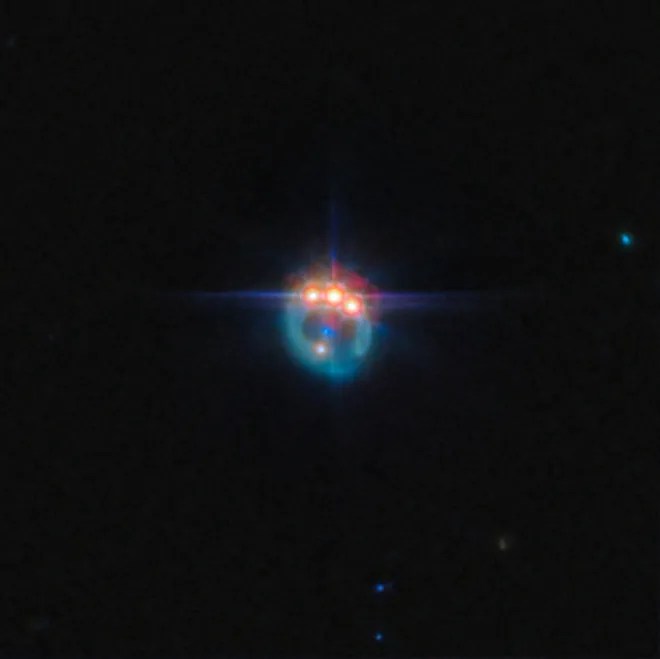
Image (Credit): Quasar known as RX J1131-1231, which is located roughly 6 billion light-years from Earth in the constellation Crater. (ESA/Webb, NASA & CSA, A. Nierenberg)

This week’s image is from the James Webb Space Telescope. It was highlighted in USAToday as one of the best images from 2024. It shows the gravitational lensing of RX J1131-1231, which is a quasar about 6 billion light-years from Earth.

Here is more about the image:

It is considered one of the best lensed quasars discovered to date, as the foreground galaxy smears the image of the background quasar into a bright arc and creates four images of the object. Gravitational lensing, first predicted by Einstein, offers a rare opportunity to study regions close to the black hole in distant quasars, by acting as a natural telescope and magnifying the light from these sources. All matter in the Universe warps the space around itself, with larger masses producing a more pronounced effect. Around very massive objects, such as galaxies, light that passes close by follows this warped space, appearing to bend away from its original path by a clearly visible amount. One of the consequential effects of gravitational lensing is that it can magnify distant astronomical objects, letting astronomers study objects that would otherwise be too faint or far away.

Pic of the Week: The Red Monsters

Image (Credit): The “Red Monsters” as captured by the JWST. (NASA/CSA/ESA, M. Xiao & P. A. Oesch (University of Geneva), G. Brammer (Niels Bohr Institute), Dawn JWST Archive)

This week’s image from the James Webb Space Telescope (JWST) was highlighted by researchers at the University of Bath. It represents three ultra-massive galaxies about the size of our Milky Way from the first billion years of the universe following the Big Bang.

The researchers discuss this in their paper in Nature, Accelerated Formation of Ultra-massive Galaxies in the First Billion Years. The abstract is a bit too technical, but suffice it to say that this is a significant discovery.

As noted in Tech Exporist, Dr. Mengyuan Xiao, lead author of the new study and postdoctoral researcher in the Department of Astronomy at UNIGE Faculty of Science, stated:

These results indicate that galaxies in the early Universe could form stars with unexpected efficiency. As we study these galaxies in more depth, they will offer new insights into the conditions that shaped the Universe’s earliest epochs. The ‘Red Monsters’ are just the beginning of a new era in our exploration of the early Universe.

Pic of the Week: Galaxies Passing in the Night

Image (Credit): Galaxies IC 2163 and NGC 2207. (NASA, ESA, CSA, STScI)

This week’s image showing two galaxies – IC 2163 and NGC 2207 – comes from both the Hubble Space Telescope and the James Webb Space Telescope.

Here is more about the image from Hubblesite.org:

The gruesome palette of these galaxies is owed to a mix of mid-infrared light from NASA’s James Webb Space Telescope, and visible and ultraviolet light from NASA’s Hubble Space Telescope. The pair grazed one another millions of years ago. The smaller spiral on the left, cataloged as IC 2163, passed behind NGC 2207, the larger spiral galaxy at right.

Both have increased star formation rates. Combined, they are estimated to form the equivalent of two dozen new stars that are the size of the Sun annually. Our Milky Way galaxy forms the equivalent of two or three new Sun-like stars per year.

Both galaxies have hosted seven known supernovae, each of which may have cleared space in their arms, rearranging gas and dust that later cooled, and allowed new many stars to form. (Find these areas by looking for the bluest regions).