Study Findings: Detection of Carbon Dioxide and Hydrogen Peroxide on the Stratified Surface of Charon with JWST

Image (Credit): Charon, Pluto’s largest moon, as captures by NASA’s New Horizons spacecraft. (NASA/JHUAPL/SwRI)

Nature Communications abstract of the study findings:

Charon, Pluto’s largest moon, has been extensively studied, with research focusing on its primitive composition and changes due to radiation and photolysis. However, spectral data have so far been limited to wavelengths below 2.5 μm, leaving key aspects unresolved. Here we present the detection of carbon dioxide (CO2) and hydrogen peroxide (H2O2) on the surface of Charon’s northern hemisphere, using JWST data. These detections add to the known chemical inventory that includes crystalline water ice, ammonia-bearing species, and tholin-like darkening constituents previously revealed by ground- and space-based observations. The H2O2 presence indicates active radiolytic/photolytic processing of the water ice-rich surface by solar ultraviolet and interplanetary medium Lyman-α photons, solar wind, and galactic cosmic rays. Through spectral modeling of the surface, we show that the CO2 is present in pure crystalline form and, possibly, in intimately mixed states on the surface. Endogenically sourced subsurface CO2 exposed on the surface is likely the primary source of this component, with possible contributions from irradiation of hydrocarbons mixed with water ice, interfacial radiolysis between carbon deposits and water ice, and the implantation of energetic carbon ions from the solar wind and solar energetic particles.

Citation: Protopapa, S., Raut, U., Wong, I. et al. Detection of carbon dioxide and hydrogen peroxide on the stratified surface of Charon with JWST. Nat Commun 15, 8247 (2024).
https://doi.org/10.1038/s41467-024-51826-4

Study-related stories:

Reuters

Science Alert

Futurism

Pic of the Week: Peeking into Perseus

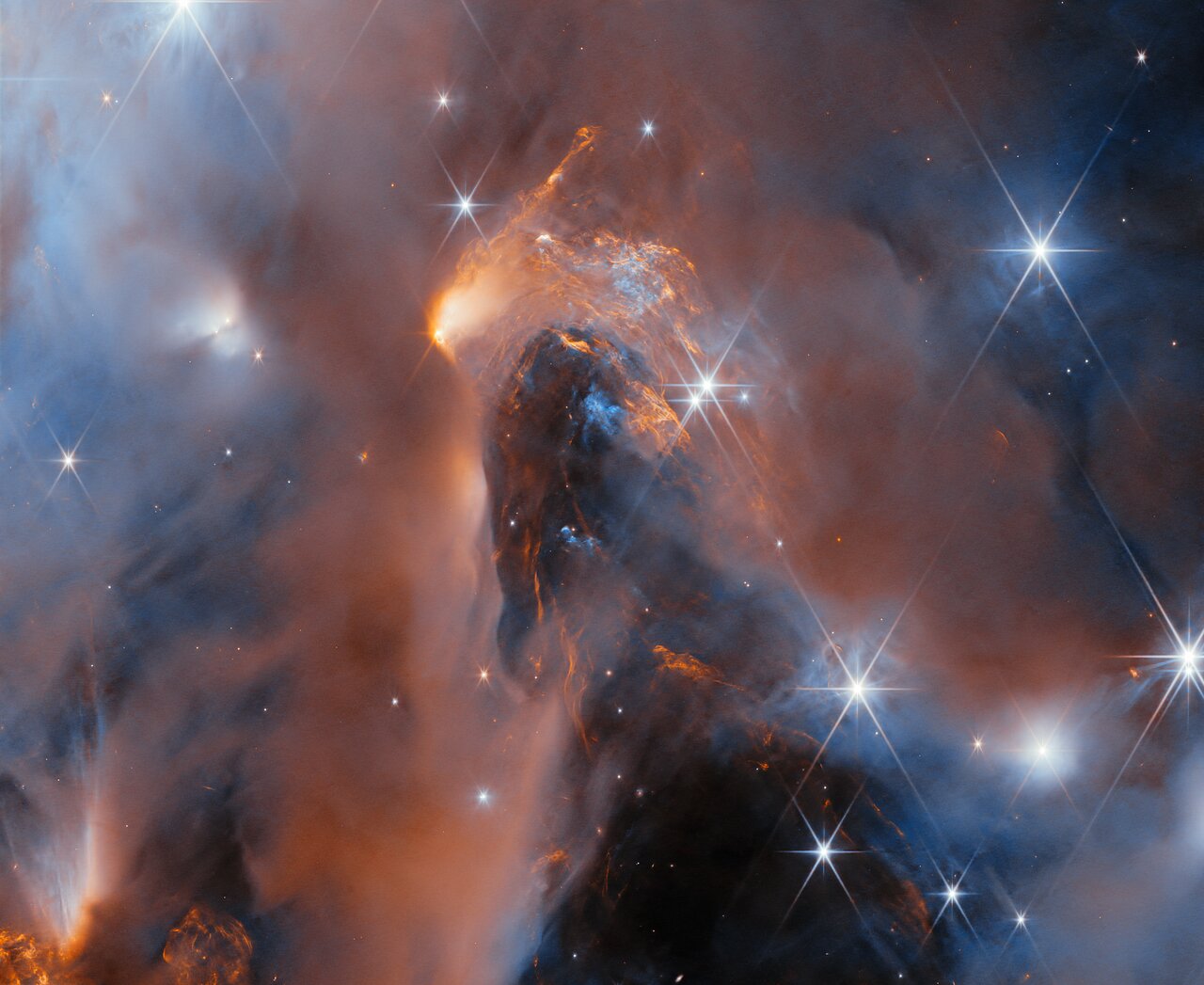
Image (Credit): The star-forming cluster NGC 1333 as seen by the JWST. (ESA/Webb, NASA & CSA, A. Scholz, K. Muzic, A. Langeveld, R. Jayawardhana)

This week’s image of a distant nebula with new stars was captured by the James Webb Space Telescope (JWST). The nebula, NGC 1333, is located in the Perseus molecular cloud, which is about 960 light-years away.

Here is more information on the image from the European Space Agency:

The centre of the image presents a deep peek into the heart of the NGC 1333 cloud. Across the image we see large patches of orange, which represent gas glowing in the infrared. These so-called Herbig-Haro objects form when ionised material ejected from young stars collides with the surrounding cloud. They are hallmarks of a very active site of star formation.

Many of the young stars in this image are surrounded by discs of gas and dust, which may eventually produce planetary systems. On the right hand side of the image, we can glimpse the shadow of one of these discs oriented edge-on — two dark cones emanating from opposite sides, seen against a bright background.

Similarly to the young stars in this mosaic, our own Sun and planets formed inside a dusty molecular cloud, 4.6 billion years ago. Our Sun didn’t form in isolation but as part of a cluster, which was perhaps even more massive than NGC 1333. The cluster in the mosaic, only 1–3 million years old, presents us with an opportunity to study stars like our Sun, as well as brown dwarfs and free-floating planets, in their nascent stages.

Pic of the Week: Galactic Emoji

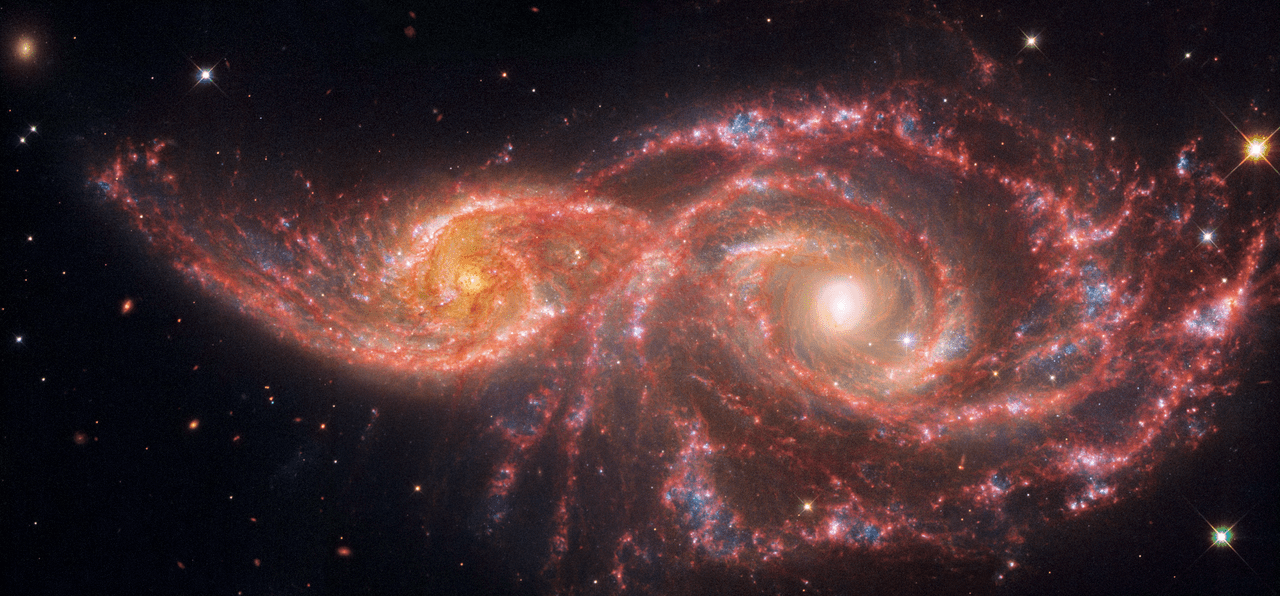
Image (Credit): A composite image of Arp 107.(NASA, ESA, CSA, STScI)

This week’s image comes from the James Webb Space Telescope. It shows two colliding galaxies creating a unique image from the telescope’s viewpoint.

Here is more information about the image from NASA:

Smile for the camera! An interaction between an elliptical galaxy and a spiral galaxy, collectively known as Arp 107, seems to have given the spiral a happier outlook thanks to the two bright “eyes” and the wide semicircular “smile.” The region has been observed before in infrared by NASA’s Spitzer Space Telescope in 2005, however NASA’s James Webb Space Telescope displays it in much higher resolution. This image is a composite, combining observations from Webb’s MIRI (Mid-Infrared Instrument) and NIRCam (Near-Infrared Camera)...Webb has captured these galaxies in the process of merging, which will take hundreds of millions of years. As the two galaxies rebuild after the chaos of their collision, Arp 107 may lose its smile, but it will inevitably turn into something just as interesting for future astronomers to study. Arp 107 is located 465 million light-years from Earth in the constellation Leo Minor.

Space Stories: ESA Drill Going to the Moon, ROMAN Takes on the Ever-changing Universe, and Six New Worlds Discovered

Image (Credit): The Hadley-Apennine region of the Moon photographed during the Apollo 15 mission of 1971. (NASA)

Here are some recent stories of interest.

European Space AgencyEuropean Drill and Mini Lab Secure Ride to the Moon

ESA’s Prospect package, including drill and a miniaturised laboratory, will fly to the Moon’s South Polar region in search of volatiles, including water ice, as part of NASA’s Commercial Lunar Payload Services initiative…NASA has selected Intuitive Machines for a flight opportunity in 2027 that will deepen our understanding of the Moon and answer key questions about where and how volatiles can be found on the lunar surface.V olatiles, such as water ice, are chemical components that easily evaporate or vaporise under certain conditions. Prospect is a suite of instruments that will drill up to at least one metre depth beneath the lunar surface, extract samples, and process them in a mini lab. The combination of robotic drill and sample analysis package aims to identify volatiles trapped beneath the surface at extremely cold temperatures down to –150 °C.

Space Telescope Science InstituteNASA’s Roman Space Telescope to Investigate Galactic Fossils

The universe may seem static, only capable of being captured in still frames, but that is far from the truth. It is actually ever-changing, just not on timescales clearly visible to humans. NASA’s upcoming Roman Space Telescope will bridge this gap in time, opening the way to the dynamic universe. RINGS, the Roman Infrared Nearby Galaxy Survey, will specifically uncover the dynamic universe by searching galaxies for fossils of their formation history. RINGS will also lead scientists to clues about the true nature of dark matter, the mysterious substance that makes up the majority of the mass in our universe. Roman will launch in 2027, prepared to revolutionize how scientists understand our universe and give them access to the vision of the universe as it truly is: changing.

Science DailySix New Rogue Worlds: Star Birth Clues

The James Webb Space Telescope has spotted six likely rogue worlds — objects with planet-like masses but untethered from any star’s gravity — including the lightest ever identified with a dusty disk around it. The elusive objects offer new evidence that the same cosmic processes that give birth to stars may also play a common role in making objects only slightly bigger than Jupiter.

Summer Positions at the Vatican Observatory

Image (Credit): The Vatican Observatory at San Gondolfo, Italy. (Vatican Observatory)

Does a summer studying astronomy in Rome sound interesting? If so, you might want to consider applying to be part of an astronomy program at the Vatican Observatory. The 440-year-old institution will be accepting 25 new applicants for the summer 2025 program.

Next summer’s program is titled “Exploring the Universe with JWST.” Here is a little more detail on the program:

Since the first release of data from the James Webb Space Telescope (JWST) in July 2022, we have witnessed a transformation in astronomy. VOSS 2025 will present a comprehensive overview of the major JWST results in its first three years (2022-2025), covering the four major scientific themes of JWST: (1) First Light and Reionization, (2) Assembly and Evolution of Galaxies, (3) Birth of Stars and Protoplanetary systems, and (4) Planetary Systems and the Origin of Life. In parallel, we will also provide a series of hands-on tutorials for JWST data processing and analysis. VOSS 2025 will convey the excitement of astronomical research in the era of JWST and the skills to pursue research projects spanning a broad range of themes in astrophysics.

The Catholic Church has come a long way since its treatment of Galileo. This observatory is just one example of the Church’s openness to the world around us.

You can read more about the 2023 summer program from the students themselves in this article.