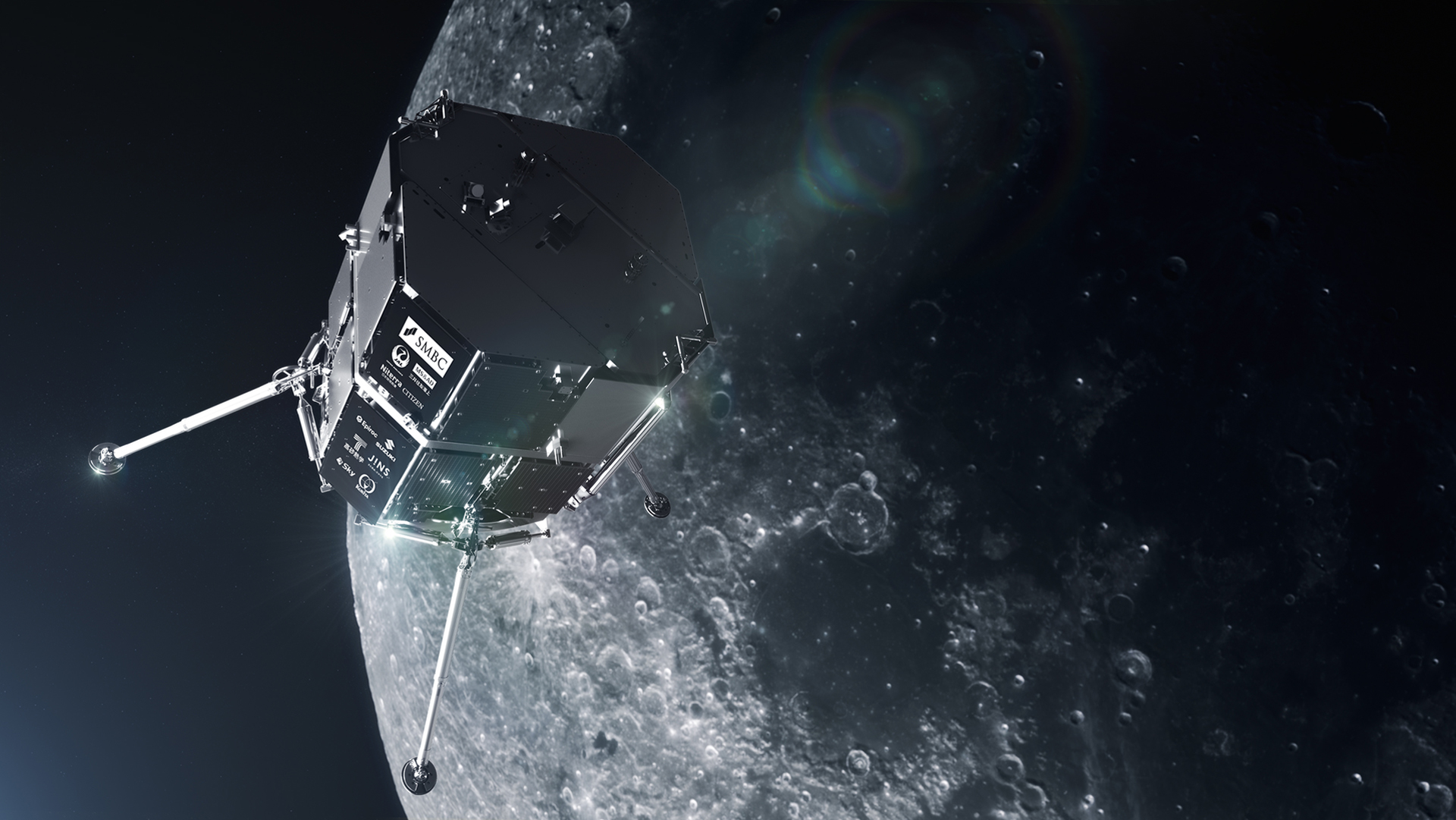
Image (Credit): Artist’s rendering of the Resilience lunar lander approaching the moon. (ispace)
“Given that there is currently no prospect of a successful lunar landing, our top priority is to swiftly analyze the telemetry data we have obtained thus far and work diligently to identify the cause.”
-Statement by Takeshi Hakamada, CEO and founder of Japan’s private space company ispace, in a press release following the failure of the company’s second lunar lander mission to the Moon. The company noted that the lander experienced a “hard landing” when it failed to sufficiently decrease its speed on approach. The mission started back in January when a SpaceX Falcon 9 rocket carried both this mission as well as Firefly Aerospace’s Blue Ghost, which had a successful landing on the lunar surface. The ispace lander was named Resilience – something it will need more of to stay in the space race.
Image (Credit): The four large Unit Telescopes and the four smaller Auxiliary Telescopes that make up the European Southern Observatory’s (USO) Very Large Telescope. (USO)
Here are some recent stories related to astronomy telescopes.
When a study in 2023 crowned Cerro Paranal the darkest observatory site in the world, astronomers must have felt reassured to have chosen the right spot. The 2,635-meter (8,645-foot) mountain in Chile’s Atacama Desert is home to the European Southern Observatory’s (ESO) Very Large Telescope, one of the most advanced and prolific astronomical facilities. But now, if a company named AES Andes (a subsidiary of the U.S. power company AES Corporation) gets its way, Paranal’s observational prowess might soon be history: Light pollution emitted by a proposed industrial “megaproject” could do away with the dark skies over this observatory.
Researchers have finished equipping the Subaru Telescope with a new special “compound eye,” culminating several years of effort. This new eye is an instrument featuring approximately 2,400 prisms scattered across the extremely wide field of view available at the Subaru Telescope’s primary focus, allowing for simultaneous spectroscopic observation of thousands of celestial objects. This unrivaled capability will help researchers precisely understand the formation and evolution of galaxies and the Universe. Among 8-meter-class telescopes, the Subaru Telescope is the most competitive with the largest survey capability in the world. This instrument, the Prime Focus Spectrograph (PFS), will be ready to begin scientific operations in February 2025.
Astronomers have released a set of more than a million simulated images showcasing the cosmos as NASA’s upcoming Nancy Grace Roman Space Telescope will see it. This preview will help scientists explore Roman’s myriad science goals.“We used a supercomputer to create a synthetic universe and simulated billions of years of evolution, tracing every photon’s path all the way from each cosmic object to Roman’s detectors,” said Michael Troxel, an associate professor of physics at Duke University in Durham, North Carolina, who led the simulation campaign. “This is the largest, deepest, most realistic synthetic survey of a mock universe available today.”
Image (Credit): An artist’s rendering of NASA’s Europa Clipper spacecraft over Europa. (NASA/JPL-Caltech)
Another list worth highlighting at year-end covers all of the space missions from 2024. For example, this list from Freethink, “the top 10 space stories of 2024,” includes the launch of the Europa Clipper, China’s Chang’e 6 round-trip to the Moon, and a successful commercial launch to the Moon (Odysseus lunar lander).
Image (Credit): Rocket Lab’s Electron rocket successfully deploying a fourth synthetic aperture radar satellite to Synspective’s Earth-observation constellation. (Rocket Lab)
Earlier this week, Japanese cargo was launched towards space by two commercial companies. Unfortunately, only of the rockets made it into space.
On March 13, US company Rocket Lab launched a payload for Japan’s Synspective, an Earth-imaging company, from its launch site in New Zealand. The launch was successful and the StriX-3 satellite was placed into Earth orbit.
The second launch on the same day by Japan’s Space One, which would have been the first commercial launch by a Japanese firm, ended quickly when the rocket burst into flames just a few seconds after liftoff. The rocket was carrying a mock-up of a government spy satellite.
Space One President Masakazu Toyoda stated, “We will find out the cause as soon as possible and clarify our measures to prevent a recurrence.”
Getting it right may take time, as we are seeing with SpaceX’s Starship. Japan wants to maintain strong launch capabilities in both the public and private sectors, and this is just part of the process to make that happen.
Image (Credit): Photos showing the launch and midair explosion of Space One’s Kairos rocket. (KYODO)
Organic materials discovered on Mars may have originated from atmospheric formaldehyde, according to new research, marking a step forward in our understanding of the possibility of past life on the Red Planet. Scientists from Tohoku University have investigated whether the early atmospheric conditions on Mars had the potential to foster the formation of biomolecules – organic compounds essential for biological processes. Their findings, published in Scientific Reports, offer intriguing insights into the plausibility of Mars harboring life in its distant past.
A galaxy that suddenly stopped forming new stars more than 13 billion years ago has been observed by astronomers.Using the James Webb Space Telescope, an international team of astronomers led by the University of Cambridge has spotted a ‘dead’ galaxy when the universe was just 700 million years old, the oldest such galaxy ever observed.This galaxy appears to have lived fast and died young: star formation happened quickly and stopped almost as quickly, which is unexpected for so early in the universe’s evolution. However, it is unclear whether this galaxy’s ‘quenched’ state is temporary or permanent, and what caused it to stop forming new stars.
Delivering on its promise to transform our understanding of the early universe, the James Webb Space Telescope is probing galaxies near the dawn of time. One of these is the exceptionally luminous galaxy GN-z11, which existed when the universe was just a tiny fraction of its current age. One of the youngest and most distant galaxies ever observed, it is also one of the most enigmatic. Why is it so bright? Webb appears to have found the answer. Scientists using Webb to study GN-z11 have also uncovered some tantalizing evidence for the existence of Population III stars nestled in the outskirts of this remote galaxy. These elusive stars — the first to bring light to the universe — are purely made of hydrogen and helium. No definitive detection of such stars has ever been made, but scientists know they must exist. Now, with Webb, their discovery seems closer than ever before.