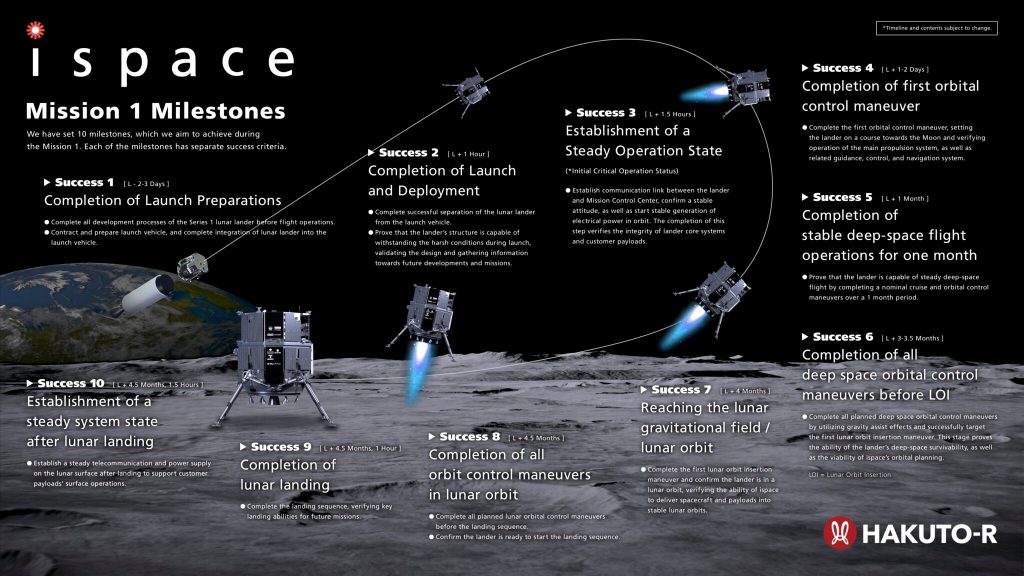
Image (Credit): iSpace mission milestones for the upcoming lunar landing. (iSpace)
While the Orion spacecraft was heading back to Earth, the Japanese HAKUTO-R Mission 1 lunar lander was on its way to the Moon. The name HAKUTO refers to the white rabbit that lives on the moon in Japanese folklore.
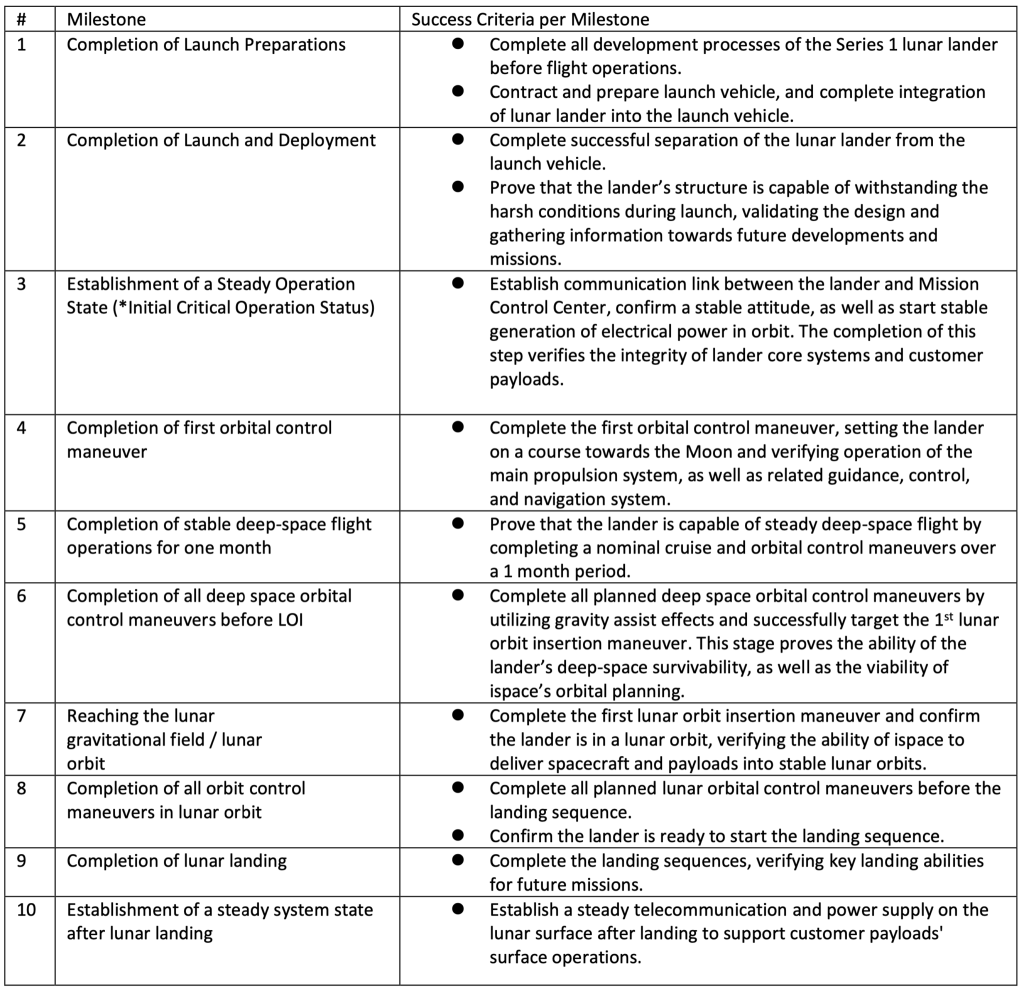
The Japanese private firm iSpace is behind the lunar mission, becoming the first private company to place a lander on the Moon. The lunar lander’s milestones are shown below, with the landing to occur next April.
Both the mission and payload are multinational. Investors in iSpace include the Development Bank of Japan, Suzuki Motor, Japan Airlines, and Airbus Ventures, which the payload includes items from the U.S. (including a NASA satellite looking for water), Canada, Japan (rover), and the United Arab Emirates (rover).
This should be the first of many iSpace lunar missions, demonstrating the role of commercial parties in the ongoing race back to the Moon.
Image (Credit): Milestones for the AKUTO-R Mission 1 lunar lander. (iSpace)
Image (Credit): Graphic showing Lunar Gateway elements from commercial and international partners. (NASA)
Late last week, the White House announced that Japan plans to support the operations of the International Space Station (ISS) through 2030 as well as further collaborate with the United States on the Artemis Lunar Gateway platform that will orbit the Moon.
On November 17, Vice President Kamala Harris stated:
The United States welcomes Japan’s intention to extend its support of International Space Station (ISS) operations through 2030, following the United States’ announcement of our ISS extension one year ago. In addition, our two countries are taking a step forward by reaching an agreement on collaboration on the Lunar Gateway orbiting platform, which will pave the way for the return of humanity to the Moon.
Under a previous agreement that has been expanded further, Japan’s JAXA has promised a number of contributions to the Lunar Gateway, including:
Critical components of the International Habitation (I-HAB) module that will provide the heart of the Gateway space station’s life support capabilities, as well as space for crew to live, conduct research, and prepare for lunar surface activities during Artemis missions. Japan will provide I-HAB’s Environmental Control and Life Support System (ECLSS), thermal control system functions, and cameras.
Batteries for I-HAB, the Habitation and Logistics Outpost (HALO) module, the initial crew cabin for astronauts visiting the Gateway, and the European System Providing Refueling Infrastructure and Telecommunication (ESPRIT) refueling module.
The JAXA HTV-XG spacecraft for launch and delivery of a logistics resupply mission for Gateway, scheduled for no later than 2030.
With the successful start of Artemis I lunar mission, it is good to hear that partner nations are increasing their support for a return to the Moon as well as plans to travel to Mars. While the United States went to the Moon alone last century, the Artemis partnership ensures this century’s return to the Moon is an international project.
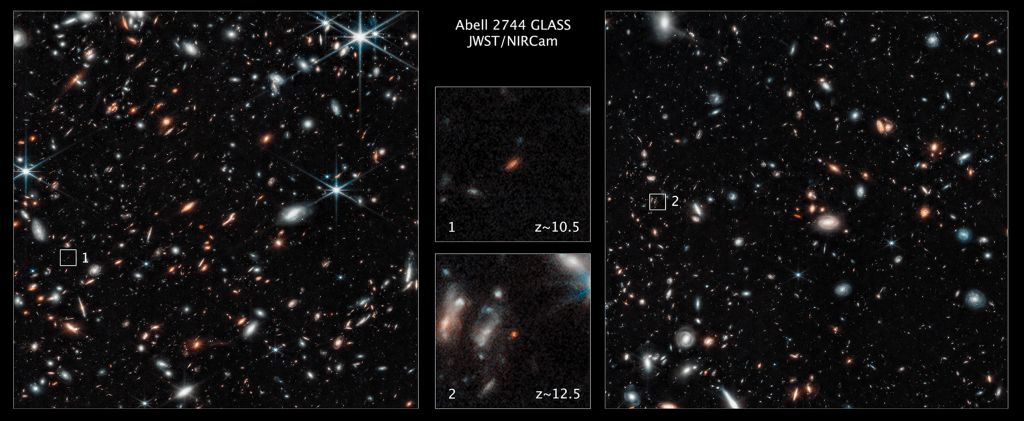
Image (Credit): Two of the farthest galaxies seen to date are captured in these Webb Space Telescope pictures of the outer regions of the giant galaxy cluster Abell 2744. The galaxies are not inside the cluster, but many billions of light-years farther behind it. The galaxy labeled (1) existed only 450 million years after the big bang. The galaxy labeled (2) existed 350 million years after the big bang. Both are seen really close in time to the big bang which occurred 13.8 billion years ago. These galaxies are tiny compared to our Milky Way, being just a few percent of its size, even the unexpectedly elongated galaxy labeled (1). (NASA, ESA, CSA, Tommaso Treu (UCLA), Zolt G. Levay (STScI))
With just four days of analysis, researchers found two exceptionally bright galaxies in the GLASS-JWST images. These galaxies existed approximately 450 and 350 million years after the big bang (with a redshift of approximately 10.5 and 12.5, respectively), though future spectroscopic measurements with Webb will help confirm…“These observations just make your head explode. This is a whole new chapter in astronomy. It’s like an archaeological dig, and suddenly you find a lost city or something you didn’t know about. It’s just staggering,” added Paola Santini, fourth author of the Castellano et al. GLASS-JWST paper.
When Mars was a young planet, it was bombarded by ice asteroids delivering water and organic molecules necessary for life to emerge. According to the professor behind a new study, this means that the first life in our solar system may have been on Mars.
Recently, hundreds of gold-rich stars have been detected by state-of-the-art telescopes worldwide. New simulations of galaxy formation, with the highest resolution in both time and mass, show that these gold-rich stars formed in progenitor galaxies, small galaxies which merged to create the Milky Way…According to the research, most gold-rich stars formed over 10 billion years ago in small, building-block galaxies―known as progenitor galaxies. Some but not all progenitor galaxies experience a neutron star merger, where large amounts of heavy r-process elements are produced and released, enriching that particular small galaxy. The predicted abundance of gold-enriched stars in the final Milky-Way-sized galaxy matches what is actually observed.
Image (Credit): October 5, 2022 departure of a SpaceX Falcon 9 rocket from the Kennedy Space Center in Florida carrying NASA’s SpaceX Crew-5 mission to the ISS. (NASA/Joel Kowsky)
Earlier today, SpaceX Crew-5 successfully departed from NASA’s Kennedy Space Center in Florida on their way to the International Space Station (ISS). The four members on this flight are NASA astronauts Nicole Mann and Josh Cassada, Japan Aerospace Exploration Agency astronaut Koichi Wakata, and Roscosmos cosmonaut Anna Kikina. The population of the ISS will increase to 11 until 3 astronauts return to Earth a few days later.
Here is NASA’s bio on the new crew members:
As commander, Mann is responsible for all phases of flight, from launch to re-entry, and will serve as an Expedition 68 flight engineer. This will be her first spaceflight since becoming an astronaut in 2013. Mann was born in Petaluma, California, and will be the first indigenous woman from NASA in space. She is a colonel in the U.S. Marine Corps, and she served as a test pilot in the F/A-18 Hornet and Super Hornet.
Cassada is the spacecraft pilot and second in command for the mission. He is responsible for spacecraft systems and performance. Aboard the station, he will serve as an Expedition 68 flight engineer. This will be his first flight since his selection as an astronaut in 2013. Cassada grew up in White Bear Lake, Minnesota, and is a physicist and U.S. Navy test pilot.
Wakata will be making his fifth trip to space and as a mission specialist he will work closely with the commander and pilot to monitor the spacecraft during the dynamic launch and re-entry phases of flight. Once aboard the station, he will serve as a flight engineer for Expedition 68. With Crew-5’s launch, Dragon will be the third different type of spacecraft Wakata has flown to space.
Kikina will be making her first trip to space, and will serve as a mission specialist, working to monitor the spacecraft during the dynamic launch and re-entry phases of flight. She will be a flight engineer for Expedition 68.
October 1 is a significant date for two of the world’s largest space agencies.
On this day in 1958, NASA had its first day of operations after being created a few months earlier by President Eisenhower in the National Aeronautics and Space Act of 1958. Here is more about the creation of the Agency as noted by NASA’s History Division:
On this date the National Aeronautics and Space Administration began operation. At the time it consisted of only about 8,000 employees and an annual budget of $100 million. In addition to a small headquarters staff in Washington that directed operations, NASA had at the time three major research laboratories inherited from the National Advisory Committee for Aeronautics-the Langley Aeronautical Laboratory established in 1918, the Ames Aeronautical Laboratory activated near San Francisco in 1940, and the Lewis Flight Propulsion Laboratory built at Cleveland, Ohio, in 1941-and two small test facilities, one for high-speed flight research at Muroc Dry Lake in the high desert of California and one for sounding rockets at Wallops Island, Virginia. It soon added several other government research organizations.
Today NASA has a budget of about $24 billion and approximately 17,000 employees.
And on this day in 2003, the Japan Aerospace Exploration Agency (JAXA) was formed from a merger of three previous Japanese space agencies – the Institute of Space and Astronautical Science, the National Aerospace Laboratory of Japan, and National Space Development Agency of Japan.





 Our Awesome Universe