Image (Credit): Jupiter’s moon Europa. (NASA/JPL-Caltech/SwRI/MSSS/Björn Jónsson CC BY-NC-SA 2.0)
This week’s image is from NASA’s Juno spacecraft orbiting Jupiter and its moons. It is a beautiful image of Europa from the spacecraft’s Junocam. Europa is one of 80 known moons orbiting its host planet.
JunoCam took its closest image at an altitude of 945 miles (1,521 kilometers) over a region of the moon called Annwn Regio. In the image, terrain beside the day-night boundary is revealed to be rugged, with pits and troughs. Numerous bright and dark ridges and bands stretch across a fractured surface, revealing the tectonic stresses that the moon has endured over millennia. The circular dark feature in the lower right is Callanish Crater.
Such JunoCam images help fill in gaps in the maps from images obtained by NASA’s Voyager and Galileo missions. Citizen scientist Björn Jónsson processed the image to enhance the color and contrast. The resolution is about 0.6 miles (1 kilometer) per pixel.
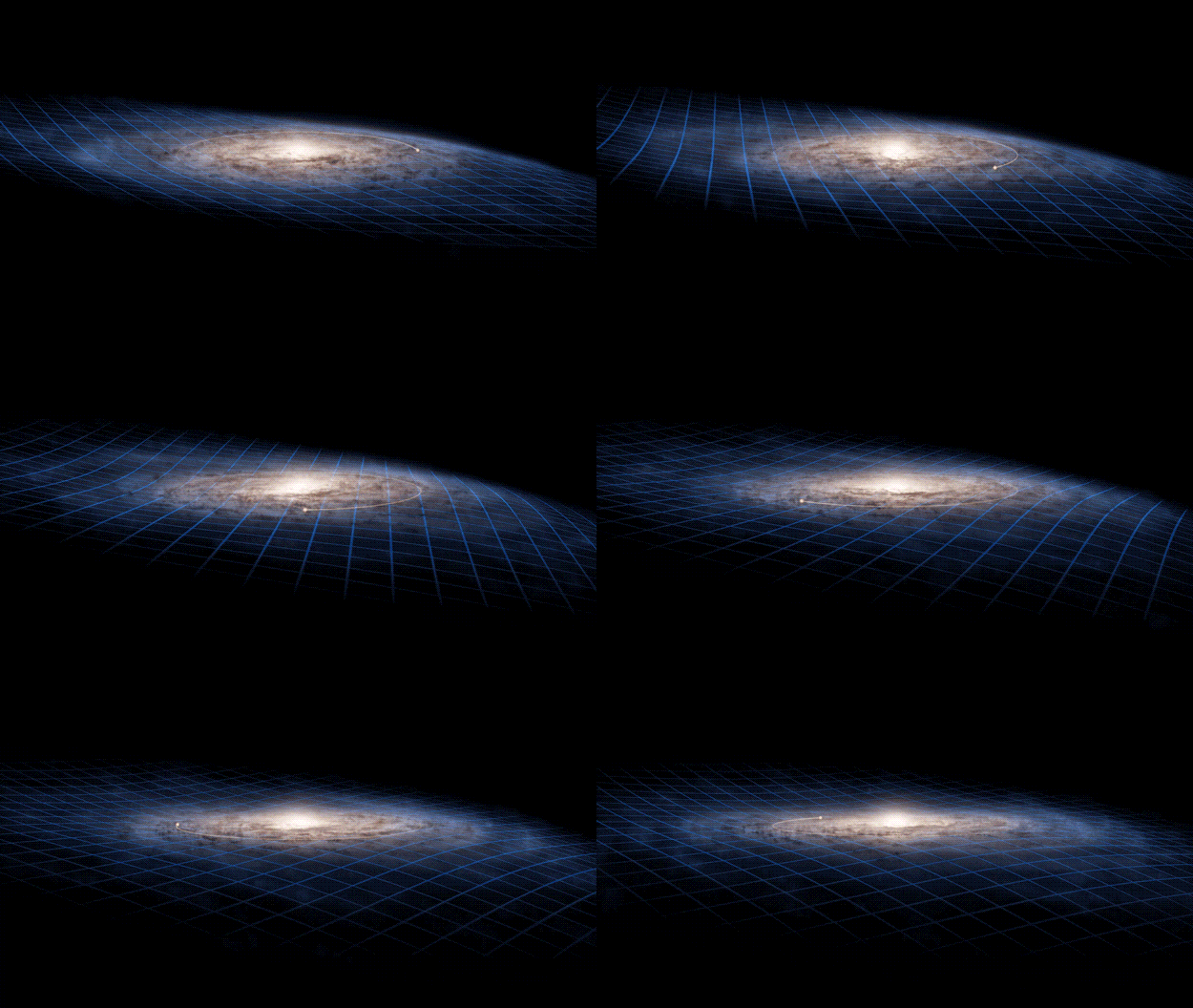
Image (Credit): The position of our Sun as it orbits the Milky Way’s center. (Stefan Payne-Wardenaar)
A recent Big Think story, “5 Consensus Ideas in Astronomy That Might Soon be Overturned,” comes as a good time as we reach further into space and back into time using the James Webb Space Telescope (JWST) and contemplate other telescopes that should come online shortly.
The story highlights these five ideas:
Dark energy is a cosmological constant;
Stars predate black holes;
Jovian planets protect terrestrial ones;
Most of the galaxy is uninhabitable; and
Globular clusters are planet-free.
For instance, regarding the uninhabitable areas of the galaxy, the Big Think story states:
Among its many discoveries, the ESA’s Gaia mission has found that the Milky Way galaxy not only has a warp to its galactic disk, but that the warp in the disk precesses and wobbles, completing a full rotation for roughly every three revolutions of the Sun [shown in yellow above] around the galactic center. Most astronomers assume that regions with too many stellar cataclysms in them, like the centers of galaxies, may be completely uninhabitable. But this picture is far from certain.
It is worth reading through the list and keeping these ideas in mind, and then following the JWST stories as they unfold. I bet you will be able to make a much longer list as old consensus ideas come apart and new ideas quickly follow.
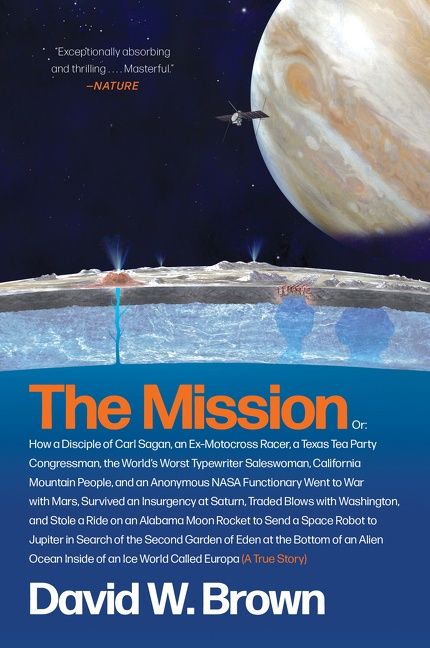
A recent episode of the Astronomy Cast podcast recommended a number of books to read this summer, including David W. Brown’s book The Mission: A True Story. It highlights all the efforts to make the soon-to-be-launched Europa Clipper mission a reality. Below is the book blurb by Harper Collins:
In the spirit of Tom Wolfe and John McPhee, The Mission is an exuberant master class of creative nonfiction that reveals how a motley, determined few expanded the horizon of human achievement.
When scientists discovered the first ocean beyond Earth, they had two big questions: “Is it habitable?” and “How do we get there?” To answer the first, they had to solve the second, and so began a vivacious team’s twenty-year odyssey to mount a mission to Europa, the ocean moon of Jupiter.
Standing in their way: NASA, fanatically consumed with landing robots on Mars; the White House, which never saw a science budget it couldn’t cut; Congress, fixated on going to the moon or Mars—anywhere, really, to give astronauts something to do; rivals in academia, who wanted instead to go to Saturn; and even Jupiter itself, which guards Europa in a pulsing, rippling radiation belt—a halo of death whose conditions are like those that follow a detonated thermonuclear bomb.
The Mission is the Homeric, never-before-told story of modern space exploration, and a magnificent portrait of the inner lives of scientists who study the solar system’s mysterious outer planets. David W. Brown chronicles the remarkable saga of how Europa was won, and what it takes to get things done—both down here, and up there.
I think it is safe to say that every space mission goes through a gauntlet these days and is lucky to remain intact at the other end. The James Webb Space Telescope started in the 1990s and only saw the light of day (on a distant exoplanet) earlier this year. Not everyone may have the stomach for the sausage-making behind these missions, but you may want to read this tale if you are looking for modern-day drama in the halls of government and academia that can lead to something meaningful.
Image (Credit): Jupiter as captured by the JWST. (NASA, ESA, CSA, Jupiter ERS Team; image processing by Ricardo Hueso (UPV/EHU) and Judy Schmidt)
This week’s image once again comes from the new James Webb Space Telescope (JWST), but instead of peering outside of our solar system, it is looking around closer to home. The image above of Jupiter is an amazing shot that shows the planet in all its glory – violent storms, glowing auroras, delicate rings, and orbiting moons. The particulars are labeled in the same image below.
The image came from the JWST’s Near-Infrared Camera (NIRCam), which NASA notes has:
…three specialized infrared filters that showcase details of the planet. Since infrared light is invisible to the human eye, the light has been mapped onto the visible spectrum. Generally, the longest wavelengths appear redder and the shortest wavelengths are shown as more blue. Scientists collaborated with citizen scientist Judy Schmidt to translate the Webb data into images.
This is a whole new way to see our neighborhood worlds as well as the worlds many light years away.
Image (Credit): Jupiter as captured by the JWST with all of the key areas labeled. (NASA, ESA, CSA, Jupiter ERS Team; image processing by Ricardo Hueso (UPV/EHU) and Judy Schmidt)
Image (Credit): Artist’s rendering of Europa orbiting Jupiter. (NASA)
Earlier this year, NASA’s Jet Propulsion Laboratory started assembling the Europa Clipper spacecraft so it is ready for its launch in 2024 (you can find the latest update here). Once it arrives at Jupiter, the spacecraft will have at least 50 flybys to study the Jovian moon and learn more about its inside, outside, and atmosphere.
Extraterrestrial life might exist under all sorts of conditions that humans would struggle to imagine. But we know of one set of conditions in which life flourishes in a multitude of shapes and sizes: the conditions found on Earth. Because we know Earth has the right conditions for life, humans can then sharply narrow down the search for extraterrestrial life by searching only in places that have the conditions that Earth life requires: a source of energy, the presence of certain chemical compounds, and temperatures that allow liquid water to exist. Jupiter’s icy moon Europa seems to be just such a place.
And water exists in abundance, as the NASA graphic shows below.
The Europa Clipper will not make it to Jupiter until 2030, so we have a long wait ahead of us. It also gives us plenty of time to guess about what we will find.
You can follow the status of the Europa Clipper here.
Image (Credit): Illustration comparing water on the Earth and Europa. (NASA)