Space Stories: Curiosity Continues, Exoplanets with Dinosaurs, and Nasty Jupiters

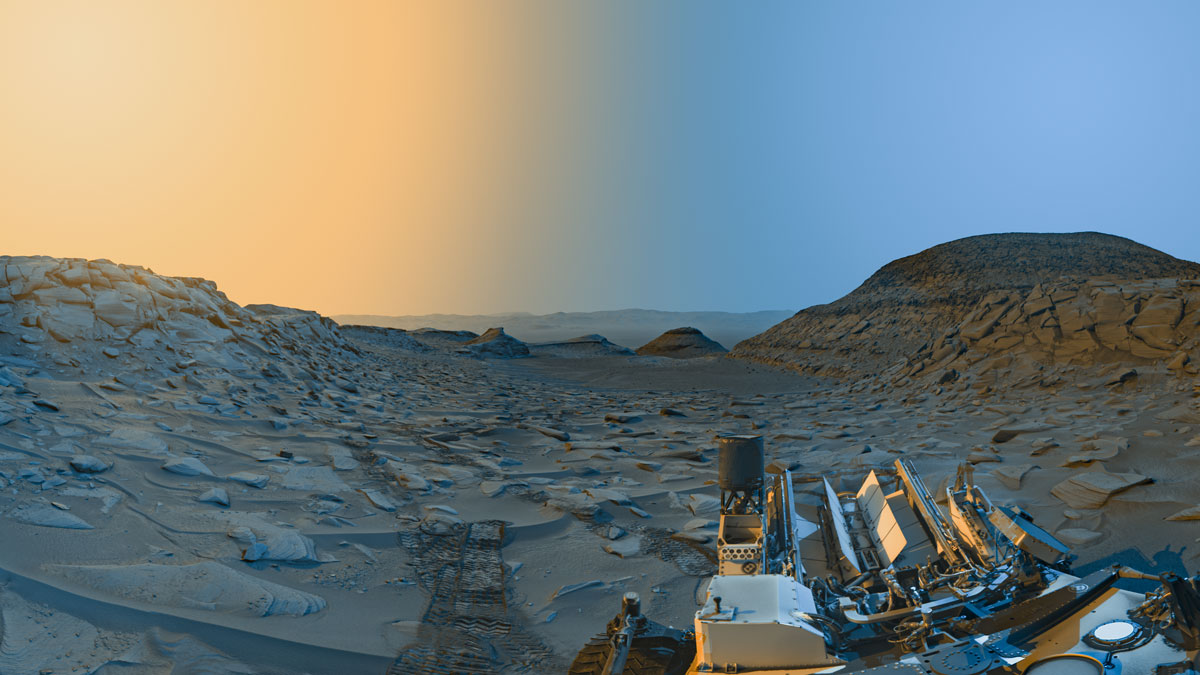
Image (Credit): Curiosity’s view of the Martian surface. (NASA)

Here are some recent stories of interest.

NASA JPL: “NASA’s Curiosity Rover Clocks 4,000 Days on Mars

Four thousand Martian days after setting its wheels in Gale Crater on Aug. 5, 2012, NASA’s Curiosity rover remains busy conducting exciting science. The rover recently drilled its 39th sample then dropped the pulverized rock into its belly for detailed analysis. To study whether ancient Mars had the conditions to support microbial life, the rover has been gradually ascending the base of 3-mile-tall (5-kilometer-tall) Mount Sharp, whose layers formed in different periods of Martian history and offer a record of how the planet’s climate changed over time.

Cornell University: “‘Jurassic Worlds’ Might be Easier to Spot than Modern Earth

Things may not have ended well for dinosaurs on Earth, but Cornell University astronomers say the “light fingerprint” of the conditions that enabled them to emerge here provide a crucial missing piece in our search for signs of life on planets orbiting alien stars. Their analysis of the most recent 540 million years of Earth’s evolution, known as the Phanerozoic Eon, finds that telescopes could better detect potential chemical signatures of life in the atmosphere of an Earth-like exoplanet more closely resembling the age the dinosaurs inhabited than the one we know today.

UC Riverside: “Giant Planets Cast a Deadly Pall

Jupiter, by far the biggest planet in our solar system, plays an important protective role. Its enormous gravitational field deflects comets and asteroids that might otherwise hit Earth, helping create a stable environment for life. However, giant planets elsewhere in the universe do not necessarily protect life on their smaller, rocky planet neighbors. A new Astronomical Journal paper details how the pull of massive planets in a nearby star system are likely to toss their Earth-like neighbors out of the “habitable zone.” This zone is defined as the range of distances from a star that are warm enough for liquid water to exist on a planet’s surface, making life possible.

Look What Lucy Found

Image (Credit): A view of the newly discovered second asteroid behind asteroid Dinkinesh. (NASA/Goddard/SwRI/Johns Hopkins APL/NOIRLab)

NASA’s Lucy spacecraft encountered a surprise last Wednesday as it approached the target asteroid Dinkinesh, located in the asteroid belt. Instead of finding a single asteroid, it found a binary pair. Early data indicated that asteroid Dinkinesh is about 0.5 miles wide and its orbiting partner is only 0.15 miles wide.

Lucy did not have time to stick around, but it captured enough images during its fly by to keep astronomers busy for some time. The spacecraft was flying about 10,000 mph as it passed the pair.

Lucy’s primary mission is the Trojan asteroids (that is, asteroids that share Jupiter’s orbit around the Sun). And why are they of interest? NASA mission page tells us:

Planet formation and evolution models suggest that the Trojan asteroids are likely to be remnants of the same primordial material that formed the outer planets (Jupiter, Saturn, Uranus, and Neptune), and thus serve as time capsules from the birth of our solar system over four billion years ago.

We may have many more surprises before Lucy finishes her 12-year mission.

A Day in Astronomy: Flyby of Asteroid Gaspra

Image (Credit): Asteroid Gaspra as photographed by the Galileo spacecraft. (NASA)

On this day in 1991, NASA’s Galileo spacecraft conducted a flyby of asteroid Gaspra, an asteroid that orbits in the asteroid belt between Mars and Jupiter. The asteroid is about 10.5 miles long. Gaspra was discovered in 1916 by Russian astronomer G. N. Neujmin, who named it after a famous Russian spa retreat in Crimea.

The Galileo spacecraft’s primary mission was to visit Jupiter and its moons, but it also conducted other observations along the way, including flybys of asteroids Gaspra and Ida.

Here are a few facts about the Galileo mission from NASA:

  • Galileo was the first spacecraft to orbit an outer planet.
  • It was the first spacecraft to deploy an entry probe into an outer planet’s atmosphere.
  • It completed the first flyby and imaging of an asteroid (Gaspra, and later, Ida).
  • It made the first, and so far only, direct observation of a comet colliding with a planet’s atmosphere (Shoemaker-Levy 9).
  • It was the first spacecraft to operate in a giant planet magnetosphere long enough to identify its global structure and to investigate its dynamics.

Pic of the Week: Get Ready for Halloween!

Image (Credit): View of Jupiter taken by the NASA’s Juno mission. (NASA/JPL-Caltech/SwRI/MSSS, Vladimir Tarasov)

NASA has an image for all of us just in time for Halloween. The strange face you see above is a view of Jupiter taken on September 7, 2023 by NASA’s Juno spacecraft on its 54th close flyby of the planet.

NASA explains what you are seeing in this northern region of Jupiter:

The image shows turbulent clouds and storms along Jupiter’s terminator, the dividing line between the day and night sides of the planet. The low angle of sunlight highlights the complex topography of features in this region, which scientists have studied to better understand the processes playing out in Jupiter’s atmosphere.

Now I want to see the images from the first 53 flybys to understand what we might have missed.

A Day in Astronomy: The Launch of Voyager 2

Image (Credit): The launch of Voyager 2. (NASA)

On this day in 1977, NASA launched the Voyager 2 space probe from the Kennedy Space Center at Cape Canaveral in Florida to study the solar system’s outer planets as well as interstellar space beyond the Sun’s heliosphere.

The Voyager 2 space probe is still talking to us as it continues its journey beyond the planets with a special message for anyone it may encounter.

During its initial mission, the space probe provided us with many images from an little known region of our solar system, including the image below of Jupiter’s moon Europa.

Image (Credit): Europa during Voyager 2’s closest approach. (NASA)