A Poem for Europa

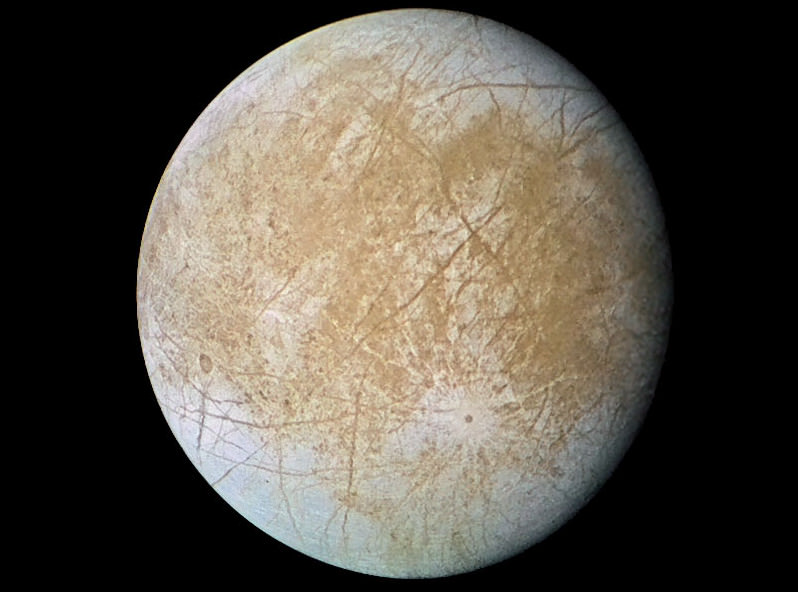
Image (Credit): The icy moon Europa. (NASA)

U.S. Poet Laureate Ada Limon was asked by NASA to write a poem for the upcoming Europa Clipper mission. Her new poem, “In Praise of Mystery: a Poem for Europa,” premiered late last week in Washington, DC.

Here is the poem from the Library of Congress (and you can also hear it in the poet’s voice):

Arching under the night sky inky
with black expansiveness, we point
to the planets we know, we

pin quick wishes on stars. From earth,
we read the sky as if it is an unerring book
of the universe, expert and evident.

Still, there are mysteries below our sky:
the whale song, the songbird singing
its call in the bough of a wind-shaken tree.

We are creatures of constant awe,
curious at beauty, at leaf and blossom,
at grief and pleasure, sun and shadow.

And it is not darkness that unites us,
not the cold distance of space, but
the offering of water, each drop of rain,

each rivulet, each pulse, each vein.
O second moon, we, too, are made
of water, of vast and beckoning seas.

We, too, are made of wonders, of great
and ordinary loves, of small invisible worlds,
of a need to call out through the dark.

Amazingly, this poem will be engraved on the exterior of the spacecraft.

NASA has done a great job stimulating scientists, but this is a great stimulus for budding poets as well.

A Day in Astronomy: The Founding of the European Space Agency

On this day in 1975, the European Space Agency (ESA) was founded after the combination of  the European Space Research Organisation (ESRO) and the European Launcher Development Organisation (ELDO). Ten countries were part of this new organization, which has since grown to 22 members (noted below). The Agency also has associate members and other cooperating partners.

You can find a list of the ESA’a past, present, and planned space missions here, which includes:

Note: According to the International Astronautical Federation, the ESA member include Austria, Belgium, the Czech Republic, Denmark, Estonia, Finland, France, Germany, Greece, Hungary, Ireland, Italy, Luxembourg, the Netherlands, Norway, Poland, Portugal, Romania, Spain, Sweden, Switzerland and the United Kingdom. Latvia, Lithuania and Slovenia are Associate Members. Canada takes part in certain programmes under a cooperation agreement. ESA has signed European Cooperating States Agreements with Bulgaria, Cyprus and Slovakia, and cooperation agreements with Croatia and Malta.

NASA TV: Stay Tuned In

If you cannot find anything worthwhile on regular television, don’t forget that NASA continues to broadcast key events on its own television station, including this week’s meeting on UFOs, now called “unidentified anomalous phenomena,” or UAPs.

Here is the latest schedule for NASA TV:

Tuesday, May 30
9 a.m. – Coverage of hatch closure for the Axiom Mission 2 crew aboard the International Space Station. Hatch closure scheduled for approx. 9:10 a.m. 
10:45 a.m. – Coverage of the the Axiom Mission 2 crew undocking from the International Space Station. Undocking scheduled for 11:05 a.m.
12:30 p.m. – ISS Expedition 69 in-flight educational event with the New Mexico Museum of Space History in Alamogordo, NM, and NASA flight engineers Frank Rubio and Steve Bowen
2 p.m. — Media teleconference on the science bound for the International Space Station aboard SpaceX’s 28th commercial resupply services mission

Wednesday, May 31
10:30 a.m. – Coverage of the public meeting of the independent study team on categorizing and evaluating data of unidentified anomalous phenomena (UAP)
3 p.m. – Unidentified anomalous phenomena (UAP) post-meeting media teleconference

Thursday, June 1
12 p.m. – News conference for upcoming spacewalks to install new International Space Station Roll-Out Solar Arrays (IROSAs)
7 p.m. — NASA and U.S. Poet Laureate Ada Limón unveil her poem for Europa

Saturn is Winning the Moon Contest

Image (Credit): Saturn’s Death Star-like moon Tethys. (NASA)

So Saturn now has 145 moons due to the discovery of 62 new moons, which is 50 more than the next closest competitor, Jupiter, with 95 moons. You can thank the University of British Columbia (UBC) for the new moon count.

The new discoveries come from a process used by UBC astronomers called ‘shift and stack’:

Shifting a set of sequential images at the rate that the moon is moving across the sky results in enhancement of the moon’s signal when all the data is combined, allowing moons that were too faint to be seen in individual images to become visible in the stacked image. The team used data taken using the Canada-France-Hawaii Telescope (CFHT) on top of Mauna Kea, Hawaii between 2019 and 2021. By shifting and stacking many sequential images taken during three hour spans, they were able to detect moons orbiting Saturn down to about 2.5 kilometres in diameter.

So, as you can read, some of these moons are pretty small. As of today, NASA was still showing 124 moons around Saturn, and another site, theplanets.org, is showing only 62 moons total around the planet. It appear the space agency and others will need to update their pages to show the new mini-moons.

For some reason I doubt the counting is over, just like identified dwarf planets, that seem to range from 5 to 19 at the moment, depending on the source.

The Juice Mission has Started

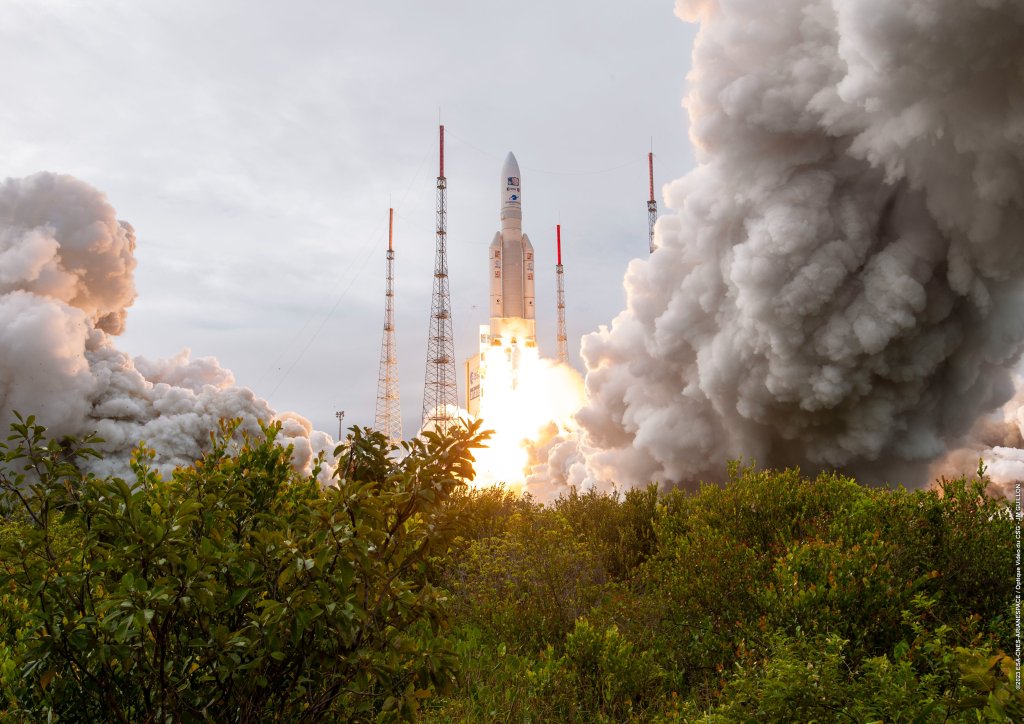
Image (Credit): The successful launch of the ESA’s Juice mission from Kourou, French Guiana on April 14, 2023. (ESA/M. Pédoussaut and ESA/CNES/Arianespace/Optique Vidéo du CSG/JM Guillon)

Earlier today, the European Space Agency’s (ESA) Jupiter Icy Moons Explorer (Juice)  mission successfully launched from French Guiana. It is the start of a long trip to the Jovian planet and its moons. The spacecraft will not reach Jupiter until July 2031. You can watch of video of the launch here. ESA has numerous other videos on the mission here.

ESA Director General Josef Aschbacher stated:

ESA, with its international partners, is on its way to Jupiter…Juice’s spectacular launch carries with it the vision and ambition of those who conceived the mission decades ago, the skill and passion of everyone who has built this incredible machine, the drive of our flight operations team, and the curiosity of the global science community. Together, we will keep pushing the boundaries of science and exploration in order to answer humankind’s biggest questions.

It is another great step forward in the exploration of our home solar system as we scan the skies for other more distant systems.

Image (Credit): Juice mission patch. (ESA)