Space Stories: JWST Confirms Earth-Size Exoplanet, Russia Sending Rescue Mission to ISS, and IO Erupts

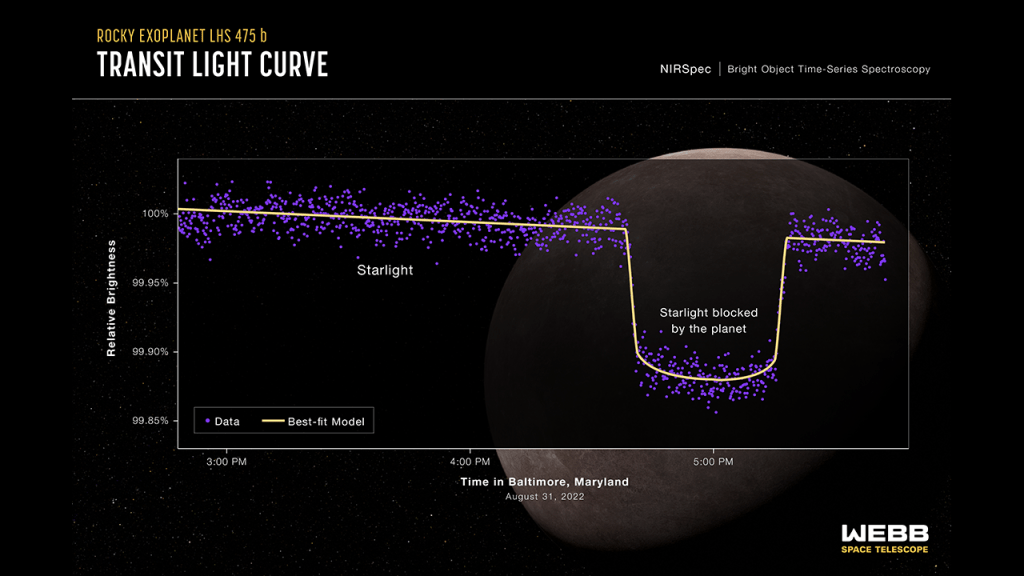
Image (Credit): James Webb Space Telescope (JWST) data associated with exoplanet LHS 475 b. (NASA, ESA, CSA, Leah Hustak (STScI))

Here are some recent stories of interest.

Webb Space Telescope: “NASA’s Webb Confirms Its First Exoplanet

Researchers confirmed an exoplanet, a planet that orbits another star, using NASA’s James Webb Space Telescope for the first time. Formally classified as LHS 475 b, the planet is almost exactly the same size as our own, clocking in at 99% of Earth’s diameter. The research team is led by Kevin Stevenson and Jacob Lustig-Yaeger, both of the Johns Hopkins University Applied Physics Laboratory in Laurel, Maryland.

ABC News: “Russia Will Launch New Capsule to Return Space Station Crew

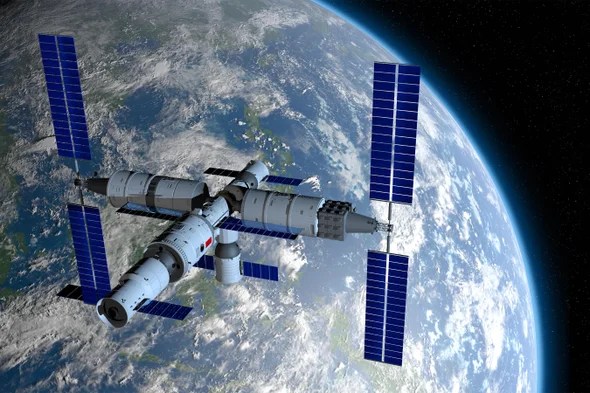
Russia will send up a new capsule next month to bring back three space station crew members whose original ride home was damaged, officials said Wednesday. The two Russians and one American will stay several extra months at the International Space Station as a result of the capsule switch, possibly pushing their mission to close to a year, NASA and Russian space officials told reporters.

MSN Science Alert: “Massive Volcanic Outburst Detected on Jupiter’s Hellish Moon Io

In the space around Jupiter, a torus of plasma created and fed by Io’s volcanic emissions grew significantly richer between July and September of last year and persisted until December, showing the moon underwent a spate of volcanic activity that released a huge amount of material. For something that’s just a little bit bigger than Earth’s Moon, Io is an absolute beast of volcanism. It’s bristling with volcanoes, with around 150 of the 400 known volcanoes erupting at any given time, creating vast lakes of molten lava.

Space Stories: Passing of Apollo Astronaut Walter Cunningham, Opal on Mars, and Juno Recovers

Image (Credit): Walter Cunningham adjusts his pressure suit before the Apollo 7 launch on October 11, 1968. (NASA)

Here are some recent stories of interest.

NASA: “Apollo Astronaut Walter Cunningham Dies at 90

Former astronaut Walter Cunningham, who flew into space on Apollo 7, the first flight with crew in NASA’s Apollo Program, died early Tuesday morning in Houston. He was 90 years old. “Walt Cunningham was a fighter pilot, physicist, and an entrepreneur – but, above all, he was an explorer. On Apollo 7, the first launch of a crewed Apollo mission, Walt and his crewmates made history, paving the way for the Artemis Generation we see today,” said NASA Administrator Bill Nelson. “NASA will always remember his contributions to our nation’s space program and sends our condolences to the Cunningham family.”

New Atlas: “Curiosity Finds Opal on Mars – a Possible Water Source for Astronauts

NASA’s Curiosity rover has discovered opal on Mars. The deposits may prove to be valuable to future Martian explorers not as jewelry but as a potential source of water. Opal is formed when water weathers silica-rich rocks, forming a solution that settles into cracks and crevices in the rock. Over time, this solution hardens into a solid lump that can be cloudy and dull or a dazzling display of color. Most supplies come from either Australia or Ethiopia, but now a new source has been discovered – Mars.

Space.com: “Juno Spacecraft Recovering its Memory After Mind-blowing Jupiter Flyby, NASA Says

NASA’s Juno probe is continuing to recover its memory at Jupiter after a data disruption interrupted communications between the spacecraft and its operators on Earth following a flyby of the giant planet in December. The Juno spacecraft’s latest flyby of Jupiter, its 47th close pass of the planet, was completed on Dec. 14. But as its operators at NASA’s Jet Propulsion Laboratory were receiving science data from the flyby they found they could no longer directly access the spacecraft’s memory. The team successfully rebooted Juno’s computer and on Dec. 17 they placed the spacecraft into “safe mode” with only essential systems operating as a precaution. 

Gift Ideas: Glowing Stars, Planets, and Moons

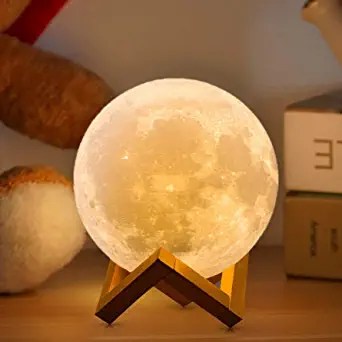
Image: Sample Moon lamp.

If you are looking for a fun gift that will encourage kids to learn more about the universe around them, then you cannot go wrong with a nightlight that illustrates the beauty of the nighttime objects above us. For instance, the Moon lamp shown above (there are many others like it on Amazon and elsewhere) allows an up-close view of this amazing orb. As with the Earth globes of old, seeing a world in three-dimensions and being able to touch it assists with understanding. Besides, in the case of the Moon, a youngster looking out the bedroom window will only see one side of the Moon, whereas the lamp provides the entire surface.

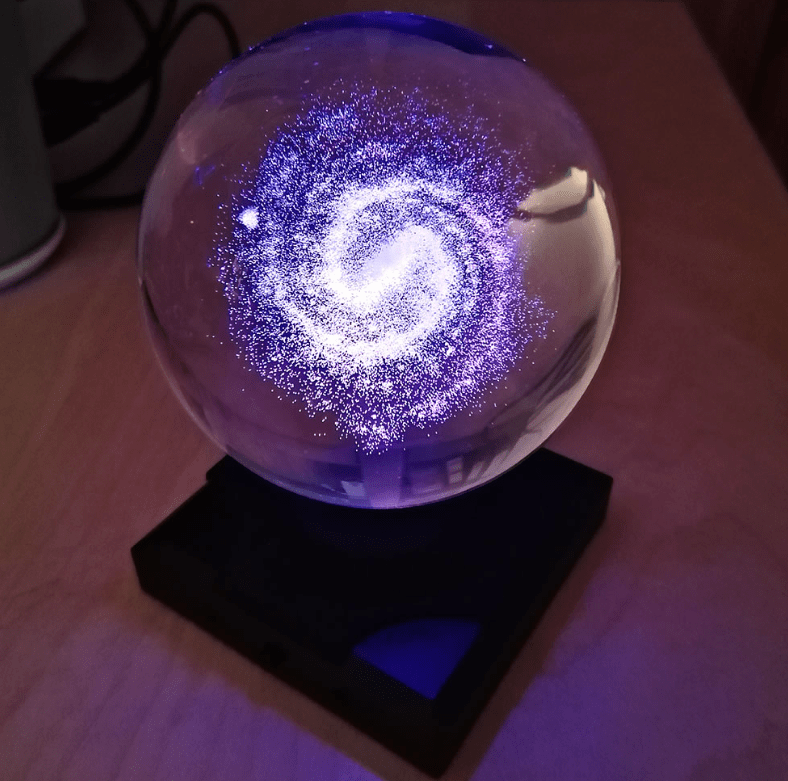
You can find similar lamps and nightlights showing Mars, Jupiter, and even the Milky Way (see below).

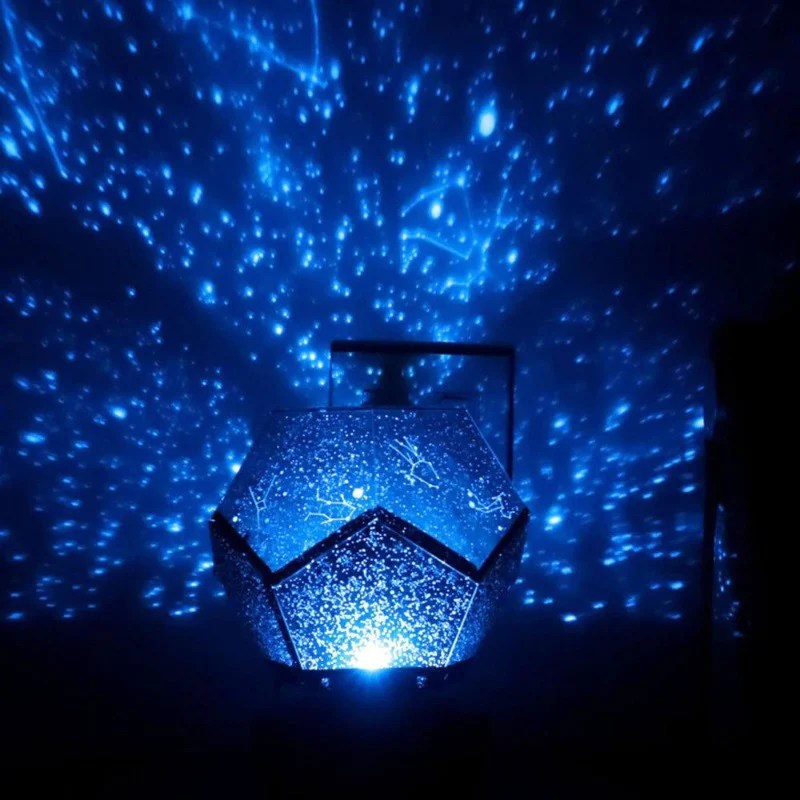
Or why not simply project the constellations onto the bedroom ceiling so kids can learn about the night sky even when it is cloudy outside? There is nothing like a personal planetarium.

Mind you, these gifts are not only for children, but it’s a good place to start. I may yet get one of those Moon lamps for my desk. Why should the kids have all the fun?

Image: Sample Milkyway lit orb.
Image: Sample constellation projector.

A Day in Astronomy: Visit to Asteroid Gaspra

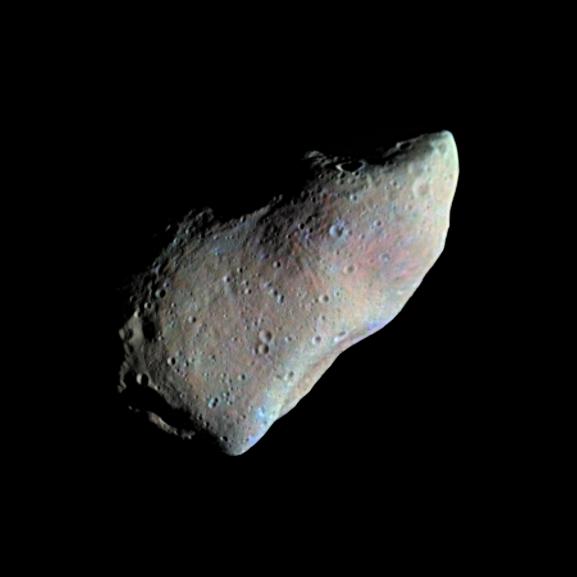
Image (Credit): Asteroid Gaspra in the asteroid belt, visited by the Galileo spacecraft on its way to Jupiter. (NASA/JPL/USGS)

On this day in 1991, NASA’s Galileo spacecraft flew by asteroid Gaspra, which is located in the asteroid belt between Mars and Jupiter. Galileo conducted a quick fly-by while flying towards Jupiter and its moons. The spacecraft also visited the asteroid Ida.

Asteroid Gasprawas first discovered back in 1916 by Russian astronomer G. N. Neujmin, who decided to name it after the Black Sea retreat of Gaspra, a Ukrainian spa town currently occupied by the Russians.

Here is some additional information from NASA about the asteroid, which has similar features to the asteroids now serving as moons to Mars (Phobos and Deimos):

A striking feature of Gaspra’s surface is the abundance of small craters. More than 600 craters, 100-500 meters (330-1650 feet) in diameter are visible here. The number of such small craters compared to larger ones is much greater for Gaspra than for previously studied bodies of comparable size such as the satellites of Mars. Gaspra’s very irregular shape suggests that the asteroid was derived from a larger body by nearly catastrophic collisions. Consistent with such a history is the prominence of groove-like linear features, believed to be related to fractures. These linear depressions, 100-300 meters wide and tens of meters deep, are in two crossing groups with slightly different morphology, one group wider and more pitted than the other. Grooves had previously been seen only on Mars’s moon Phobos, but were predicted for asteroids as well.

You car read more about the overall Galileo mission here.

Image (Credit): Artist’s rendering of the Galileo spacecraft arriving at Jupiter. (NASA)

The National Air and Space Museum is Open for Business

Image (Credit): The “Destination Moon” exibition at the refurbished National Air and Space Museum. (Smithsonian Museum)

If you have been awaiting the refurbishing of the Smithsonian’s National Air and Space Museum, then you will be happy to know that the museum reopened on October 14th. Only now you cannot simply stroll into the museum. Instead, you need to obtain a free timed-entry pass. Unfortunately, this seems to be the current system used by numerous museums to control traffic as well as capture all of your personal information so they can swamp you with junk mail and offers. Anyway…

Here are the a few of the new exhibits the museum is highlighting (go here for the full list):

  1. “Walking On Other Worlds”: Experience what it’s like in distant parts of our solar system in the “Walking on Other Worlds” interactive experience in the Kenneth C. Griffin Exploring the Planets Gallery. This immersive media exhibit presents visitors with a seven-minute “tour” of seven different worlds: Venus, Earth’s Moon, Mars, Jupiter, Saturn’s moon Titan, asteroid Ryugu, and comet 67P.
  2. Science Fiction Artifacts: New to display is a full-sized T-70 X-wing Starfighter “flown” by Poe Dameron (Oscar Isaac) in Star Wars: The Rise of Skywalker (2019). The screen-used vehicle is on long-term loan from Lucasfilm and is displayed hanging outside the planetarium. Star Trek is also represented in the new exhibitions. 
  3. ISS Cupola: In the One World Connected gallery, put yourself in the shoes of astronauts on the International Space Station (ISS) with the ISS Cupola interactive. Every 90 minutes, astronauts on board the ISS can see the Sun rise from the station’s Cupola, a European Space Agency-built observatory module. 

Given that NASA’s Artemis 1 mission is shooting for the Moon again, the timing is perfect. Of course, in December 2022 it will have been 50 years since the last human walk on the Moon’s surface, so we have a lot to celebrate as well as a lot of time to make up. Let’s hope a future update to the National Air and Space Museum includes models of spacecraft used to get humans to Mars.

And remember, you can also visit the Steven F. Udvar-Hazy Center outside the Washington Beltway that contains large planes, jets, and spacecraft that cannot fit in the DC museum, including the Space Shuttle Discovery. Last time I went there I could walk right in without using a timed-entry pass.

Image (Credit): Space Shuttle Discovery at the Steven F. Udvar-Hazy Center. (Smithsonian Museum)