Space Stories: Even More Space Tourists, Upcoming Asteroid Encounter, and Copernicus Had Help

Image (Credit): New Shepard’s NS-31 Mission crew. (Blue Origin)

Here are some recent stories of interest.

ABC News: Blue Origin Mission with All-female Crew, Including Katy Perry, Completes Space Trip

Blue Origin’s all-female crew, which included pop star Katy Perry, completed their trip into space Monday morning. The flight lasted around 11 minutes and traveled more than 60 miles above Earth, according to Blue Origin, passing the Kármán line, which at 62 miles above sea level is considered to be the boundary between Earth’s atmosphere and outer space. Along with Perry, the crew included Blue Origin owner Jeff Bezos’ journalist fiancée, Lauren Sanchez, who is also a helicopter pilot.

NASA: NASA’s Lucy Spacecraft Prepares Second Asteroid Encounter

NASA’s Lucy spacecraft is 6 days and less than 50 million miles (80 million km) away from its second close encounter with an asteroid; this time, the small main belt asteroid Donaldjohanson. This upcoming event represents a comprehensive “dress rehearsal” for Lucy’s main mission over the next decade: the exploration of multiple Trojan asteroids that share Jupiter’s orbit around the Sun.

University of Sharjah: Copernicus May Have Leaned on Ancient Muslim Astronomer in Developing his Cosmological System

New research has revealed that the cosmological model developed by Nicolaus Copernicus, the renowned European Renaissance polymath, bears striking resemblance to the one designed by an Arab Muslim astronomer nearly two centuries earlier. The research conducted at the University of Sharjah is a comparative and analytical study which examines in parallel the writings of Copernicus in correlation with the works of the 14th century Muslim astronomer Ibn al-Shatir.
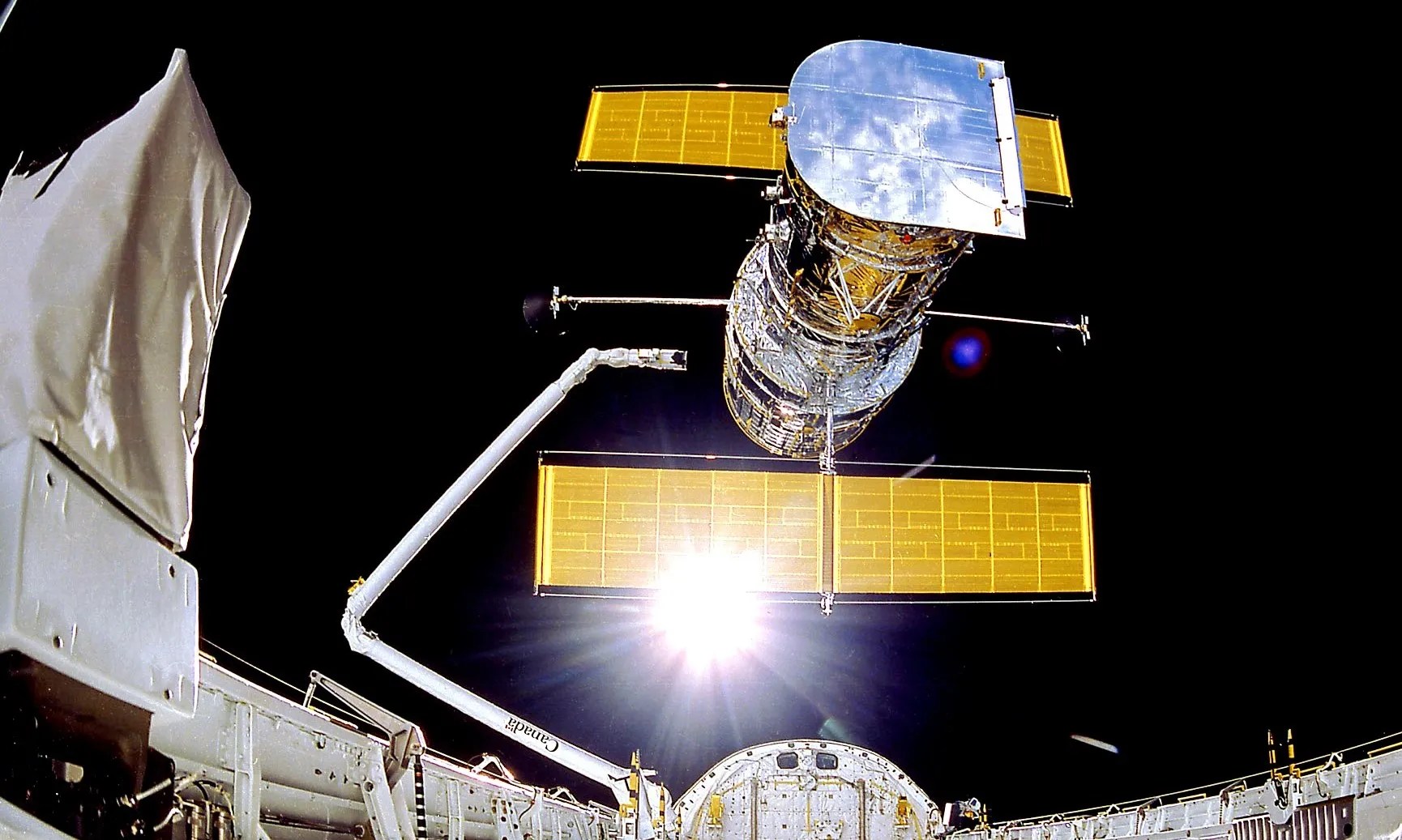
Space News: Extending Hubble’s Life, Another Step for the Habitable Worlds Observatory, and Asteroid Breakups

Image (Credit): The deployment of the Hubble Space Telescope on April 25, 1990 from the space shuttle Discovery. (NASA/Smithsonian Institution/Lockheed Corporation)

Here are some recent stories of interest.

NPR: Hubble will Change How it Points, But NASA Says ‘Great Science’ will Continue

The Hubble Space Telescope is suffering the kinds of aches and pains that can come with being old, and NASA officials say they’re shifting into a new way of pointing the telescope in order to work around a piece of hardware that’s become intolerably glitchy. Officials also announced that, for now, they’ve decided not to pursue a plan put forward by a wealthy private astronaut who wanted to go to Hubble in a SpaceX capsule, in a mission aimed at extending the telescope’s lifespan by boosting it up into a higher orbit and perhaps even adding new technology to enhance its operations.

NASA: NASA Awards Advance Technologies for Future Habitable Worlds Mission

NASA announced Friday it selected three industry proposals to help develop technologies for future large space telescopes and plan for the agency’s Habitable Worlds Observatory mission concept, which could be the first space telescope designed to search for life outside our solar system. The mission would directly image Earth-like planets around stars like our Sun and study their atmospheres for the chemical signatures of life, as well as enable other investigations about our solar system and universe. NASA is currently in the early planning stages for this mission concept, with community-wide working groups exploring its fundamental science goals and how best to pursue them. The agency is also in the process of establishing a Habitable Worlds Observatory Technology Maturation project office at NASA’s Goddard Space Flight Center in Greenbelt, Maryland.

Southwest Research Institute: Flyby of Asteroid Dinkinesh Reveals a Surprisingly Complex History

When NASA’s Lucy spacecraft flew past the tiny main belt asteroid Dinkinesh last November, the Southwest Research Institute-led mission discovered a trough and ridge structure on the main asteroid as well as the first-ever-encountered contact binary satellite. The flyby data of this half-mile-wide object revealed a dramatic history of sudden breakups and transformation. Scientists think a big chunk of Dinkinesh suddenly shifted, excavating the trough and flinging debris into its vicinity. Some materials fell back to the asteroid body, forming the ridge, while others coalesced to form a contact binary satellite known as Selam. The complex shapes show that Dinkinesh and Selam have significant internal strength and a complex, dynamic history.

Look What Lucy Found

Image (Credit): A view of the newly discovered second asteroid behind asteroid Dinkinesh. (NASA/Goddard/SwRI/Johns Hopkins APL/NOIRLab)

NASA’s Lucy spacecraft encountered a surprise last Wednesday as it approached the target asteroid Dinkinesh, located in the asteroid belt. Instead of finding a single asteroid, it found a binary pair. Early data indicated that asteroid Dinkinesh is about 0.5 miles wide and its orbiting partner is only 0.15 miles wide.

Lucy did not have time to stick around, but it captured enough images during its fly by to keep astronomers busy for some time. The spacecraft was flying about 10,000 mph as it passed the pair.

Lucy’s primary mission is the Trojan asteroids (that is, asteroids that share Jupiter’s orbit around the Sun). And why are they of interest? NASA mission page tells us:

Planet formation and evolution models suggest that the Trojan asteroids are likely to be remnants of the same primordial material that formed the outer planets (Jupiter, Saturn, Uranus, and Neptune), and thus serve as time capsules from the birth of our solar system over four billion years ago.

We may have many more surprises before Lucy finishes her 12-year mission.

Space Stories: Distant Spacecraft Updates, Lucy Gets Ready for a Flyby, and Lunar Near-Earth Asteroids

Image (Credit): Voyager II spacecraft instruments. (NASA)

Here are some recent stories of interest.

Space.com: “NASA’s interstellar Voyager Probes Get Software Updates Beamed from 12 Billion Miles Away

About 46 years after NASA’s Voyager 1 and Voyager 2 launched on an epic journey to explore space, the probes’ antique hardware continues to receive tweaks from afar. One update, a software fix, ought to tend to the corrupted data that Voyager 1 began transmitting last year, and another set aims to prevent gunk from building up in both spacecraft’s thrusters. Together, these updates intend to keep the spacecraft in contact with Earth for as long as possible.

NASA: “NASA’s Lucy Spacecraft Preparing for its First Asteroid Flyby

NASA’s Lucy spacecraft is preparing for its first close-up look at an asteroid. On Nov. 1, it will fly by asteroid Dinkinesh and test its instruments in preparation for visits in the next decade to multiple Trojan asteroids that circle the Sun in the same orbit as Jupiter. Dinkinesh, less than half a mile, or 1 kilometer, wide, circles the Sun in the main belt of asteroids located between the orbits of Mars and Jupiter. Lucy has been visually tracking Dinkinesh since Sept. 3; it will be the first of 10 asteroids Lucy will visit on its 12-year voyage. To observe so many, Lucy will not stop or orbit the asteroids, instead it will collect data as it speeds past them in what is called a “flyby.”

UC San Diego: “How Could a Piece of the Moon Become a Near-Earth Asteroid? Researchers Have an Answer

A team of astronomers has found a new clue that a recently discovered near-Earth asteroid, Kamooalewa, might be a chunk of the moon. They hypothesized that the asteroid was ejected from the lunar surface during a meteorite strike–and they found that a rare pathway could have allowed Kamooalewa to get into orbit around the sun while remaining close to the orbits of the Earth and the Moon. The research team details their findings in the Oct. 23 issue of the journal Nature Communications Earth & Environment. Kamo`oalewa has been the object of several astronomy studies in recent years. As a result, a Chinese mission launching in 2025 is set to land on the asteroid and return samples to Earth.

Space Stories: Europeans Not Joining Chinese Space Station, the Milky Way is Odd, and Lucy has a New Target

Image (Credit): A computer rendering of China’s new Tiangong space station in orbit. (Alejandro Miranda/Alamy Stock Photo)

Here are some recent stories of interest.

Royal Astronomical Society: “European Space Agency Says it has No Plans to Send Astronauts to China’s Tiangong Space Station

A top official with the European Space Agency said it had no plans to send European astronauts to the newly completed Chinese space station, making it clear for the first time that the agency is no longer committed to working with China in human space flight in the near future. “We are very busy supporting and ensuring our commitments and activities on the International Space Station,” ESA director general Josef Aschbacher told a press conference in Paris on Monday.

Royal Astronomical Society: “Milky Way Found to be More Unique than Previously Thought

Is the Milky Way special, or, at least, is it in a special place in the Universe? An international team of astronomers has found that the answer to that question is yes, in a way not previously appreciated. A new study shows that the Milky Way is too big for its “cosmological wall”, something yet to be seen in other galaxies. The new research is published in Monthly Notices of the Royal Astronomical Society.

Southwest Research Institute: “SwRI-Led Lucy Team Announces New Asteroid Target

NASA’s Lucy spacecraft will add another asteroid encounter to its 4-billion-mile journey. On Nov. 1, 2023, the Southwest Research Institute-led Lucy mission will get a close-up view of a small main belt asteroid to conduct an engineering test of the spacecraft’s innovative asteroid-tracking navigation system. The Lucy mission was already on course to break records by its planned visit of nine asteroids during its 12-year mission to tour the Jupiter Trojan asteroids, which orbit the Sun at the same distance as Jupiter. Originally, Lucy was not expected to get a close-up view of any asteroids until 2025, when it will fly by the main belt asteroid (52246) Donaldjohanson. However, the SwRI-led Lucy team identified a small, as-yet unnamed asteroid in the inner main belt as a potential new and useful target for the Lucy spacecraft.