Boeing Layoffs are Bad News for NASA’s Artemis Program

Image (Credit): Boeing’s Space Launch System. (NASA)

As if things could not get worse over at NASA, it now has to contend with Boeing’s financial problems. Boeing is considering laying off about 400 employees working on the Space Launch System (SLS), or about one third of the employees working on the system. The SLS is the backbone of the Artemis program returning the U.S. to the Moon and eventually Mars.

This follows problems last year with Boeing’s Starliner mission to the International Space Station. The two astronauts on the first manned Starliner mission are still on the station due to safety concerns about their return to Earth on the same spacecraft that brought them to the station.

None of this portends well for Boeing, NASA, or the space industry in general. This may simply throw more work towards SpaceX, making NASA more reliant on a company whose head seems more interesting in tearing down the U.S. government than focusing on the U.S. space mission. Besides, after the loss of the latest Starship, SpaceX is not in any position to replace what would be lost with the SLS. The end of the SLS may simply mean the end of any chance for the U.S. to beat China to the Moon.

This may serve the interests of Elon Musk, who always preferred going Mars, but given the lack of preparation for such a mission beyond a rocket (including lessons learned from the Artemis program), it seems even the Mars mission may be drifting into the sunset.

We need a strong NASA and clear mission priorities that are achievable in the short term. With a billionaire tourist taking over as NASA’s new leader, we need to be very careful NASA does not simply become another Dancing with the Stars for C-list celebrity wannabes.
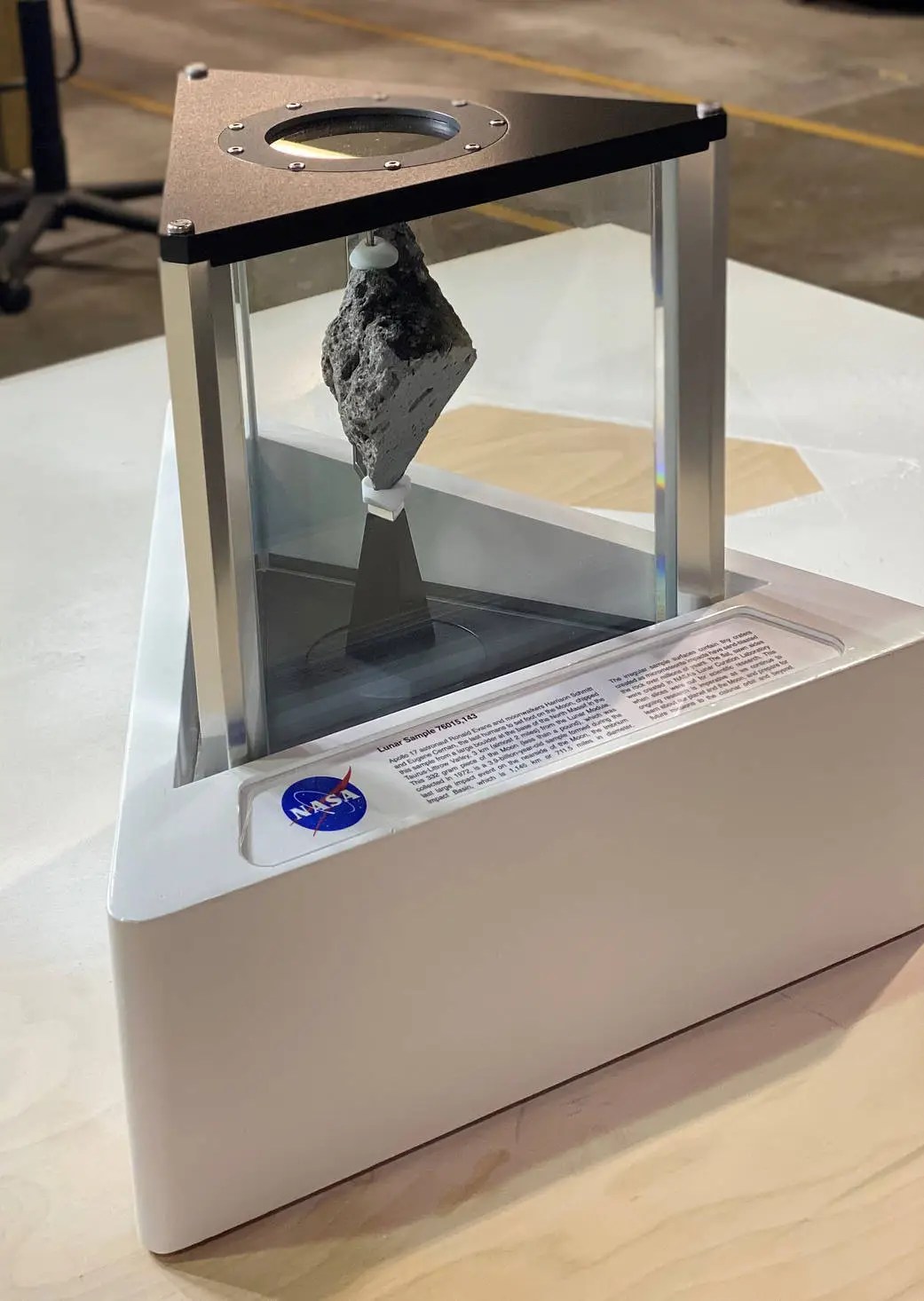
Moon Rock Moves from White House

Image (Credit): Moon rock loaned to the White House by NASA. (NASA)

As the new administration decorates the White House’s Oval Office, it was determined that a lunar rock no longer needs to be present. The rock from the last Apollo mission, labeled “Lunar Sample 76015,143.” was provided to the Biden administration back in 2021 to remind him of U.S. efforts to return to the Moon.

The inscription on the Moon rock reads:

Apollo 17 astronaut Ronald Evans and moonwalkers Harrison Schmitt and Eugene Cernan, the last humans to set foot on the Moon, chipped this sample from a large boulder at the base of the North Massif in the Taurus-Littrow Valley, 3 km (almost 2 miles) from the Lunar Module. This 332 gram piece of the Moon (less than a pound), which was collected in 1972, is a 3.9-billion-year-old sample formed during the last large impact event on the nearside of the Moon, the Imbrium Impact Basin, which is 1,145 km or 711.5 miles in diameter.

The irregular sample surfaces contain tiny craters created as micrometeorite impacts have sand-blasted the rock over millions of years. The flat, sawn sides were created in NASA’s Lunar Curation Laboratory when slices were cut for scientific research. This ongoing research is imperative as we continue to learn about our planet and the Moon, and prepare for future missions to the cislunar orbit and beyond.

So does this mean the Moon is out, or did it not match the new drapes? Or is President Trump hoping to add his own Moon rock to his office after a successful Artemis mission?

It is not clear where the Moon stands in the current priorities of this White House given its ongoing efforts to push NASA employees into retirement or resignation, end scientific meetings, and eliminate all efforts at diversity at the agency.

Maybe Mars is the new target, but even that seems further off as Elon Musk burrows into government programs he know nothing about while the latest Starship disintegrated over the Caribbean.

Space missions take focus, which seems to be elsewhere at the moment.

Maybe the rock should stay in the Oval Office for the time being to remind the current administration what our country can do when it has a president with a vision that brings everyone together to accomplish an amazing task.

Space Stories: Farewell to Bill Nelson, an Unpredictable Universe, and Ponds and Lakes on Mars

Image (Credit): Bill Nelson appearing before the Senate Committee on Commerce, Science, and Transportation on April 21, 2021 as the nominee to be the 14th administrator of NASA. (NASA/Bill Ingalls)

Here are some recent stories of interest.

WESH.comNASA Administrator Bill Nelson Writes Letter to Next Leader, Reflects on Legacy and Future of Space Exploration

In a heartfelt letter addressed to the 15th Administrator of NASA, Bill Nelson expressed his admiration for the agency’s workforce and the immense honor of leading the organization dedicated to space exploration. Nelson, who has a rich history with NASA, having flown on the Space Shuttle Columbia and served as a U.S. Senator from Florida, emphasized the exceptional nature of the NASA team. He noted that the agency embodies a “can-do spirit” that exemplifies American ingenuity and leadership in space.

Duke UniversityDan Scolnic Shows that the Universe Is Still Full of Surprises

The Universe really seems to be expanding fast. Too fast, even. A new measurement confirms what previous — and highly debated — results had shown: The Universe is expanding faster than predicted by theoretical models, and faster than can be explained by our current understanding of physics. This discrepancy between model and data became known as the Hubble tension. Now, results published in the Astrophysical Journal Letters provide even stronger support to the faster rate of expansion. “The tension now turns into a crisis,” said Dan Scolnic, who led the research team.

CaltechSignatures of Ice-Free Ancient Ponds and Lakes Found on Mars

Researchers have discovered two sets of ancient wave ripples on Mars, signatures of long-dried bodies of water preserved in the rock record. Wave ripples are small undulations in the sandy shores of lakebeds, created as wind-driven water laps back and forth. The two sets of ripples indicate the former presence of shallow water that was open to the Martian air, not covered by ice as some climate models would require.

Space Quote: Next Step Mars?

Credit: NASA

“We will pursue our manifest destiny into the stars, launching American astronauts to plant the Stars and Stripes on the planet Mars.”

-Inaugural statement by President Trump on January 20, 2024. He may want to check with NASA on the Artemis program given that the planned trip to the Moon has already cost taxpayers billions of dollars. He might also want to read a recent Politico story that discusses congressional preference for a Moon first program. The story quotes Texas Republican Brian Babin, who stated, “To bypass the moon would be a mistake.” It might also look bad to give the Moon to the Chinese long before we figure out a way to safely get to Mars. For all of Musk’s talk on this matter, the loss of a Starship rocket last week was not encouraging. We are having trouble enough getting ready to return to the Moon.

Space Stories: Aliens Using Black Holes, Fire Approaches JPL, and New Approaches for the Mars Sample

Credit: Image by Gerd Altmann from Pixabay

Here are some recent stories of interest.

Universe TodayScientists Propose New Method to Detect Alien Civilizations via Black Holes

A new paper looks at another way we might be able to detect advanced civilizations, and at its center is the need for energy. The more advanced a civilization becomes, the greater their need for energy and one of the most efficient ways, according to current theories, is to harness the energy from an actively feeding black hole. The paper suggests a civilization feeding matter into a black hole could harvest energy from it; more excitingly perhaps, the process could be detectable within 17,000 light years.

LA TimesFirefighters Battle to Protect NASA’s Jet Propulsion Laboratory, Mt. Wilson

Officials said they are making progress in protecting two key institutions from the Eaton fire. Don Fregulia, an operations section chief for the California Department of Forestry and Fire Protection, which has joined in the Eaton fire response, said that efforts to protect Mt. Wilson had proved successful and he expected that to remain the case. “We’re actively engaged there, and so far, no loss to any values at risk at Mt. Wilson,” Fregulia said. “We’re feeling good about what we have to do up there tonight to keep that site secure.” He said the fire had also spread close to NASA’s Jet Propulsion Laboratory, but he said that’s a priority and crews were “making good progress there as well.”

NASANASA to Explore Two Landing Options for Returning Samples from Mars

To maximize chances of successfully bringing the first Martian rock and sediment samples to Earth for the benefit of humanity, NASA announced Tuesday a new approach to its Mars Sample Return Program. The agency will simultaneously pursue two landing architectures, or strategic plans, during formulation, encouraging competition and innovation, as well as cost and schedule savings. NASA plans to later select a single path forward for the program, which aims to better understand the mysteries of the universe, and to help determine whether the Red Planet ever hosted life. NASA is expected to confirm the program – and its design – in the second half of 2026.