Podcast: Neil deGrasse Tyson in the Hot Seat

Last week’s Real Time with Bill Maher included an interview with astrophysicist Neil deGrasse Tyson, which did not go very well given the line of questioning. Mr. Maher was trying to entrap Dr. Tyson into some anti-woke politics, but he did not play along.

With all the topics Dr. Tyson could address on the show, it was a waste of time for viewers to witness this ambush. Mr. Maher continues to forget that he is a comedian and his guests come onto the show to have some fun. You can listen to the mess here.

Fortunately, the Overtime show after the main show, which focuses on questions from the audience, finally addressed some space-related questions, including one about Mr. Musk’s plans to go to Mars. Dr. Tyson said the costs, risks, and return on investment do not currently justify such a mission. However, he pointed out that once it becomes a space race with China then it may be something worth pursuing.

It was an interesting answer, and yet it seemed to ignore that we already have decided as a nation to go to Mars under the Artemis program even with the cost, risks, and lack of return on investment. It has a different time-table than Mr. Musk’s vision, but it is a plan that seems to be in place at the moment.

Maybe Dr. Tyson believes that too will be a space race similar to what it going on now with China regarding a Moon landing. It seems more likely than not at the moment.

Anyway, ignore the main show and tap into the Overtime show for some fun space-related discussions.
Martian Space Stories: Ocean Shoreline Located, Rings Turned to Moons, and Ancient Liquid Water

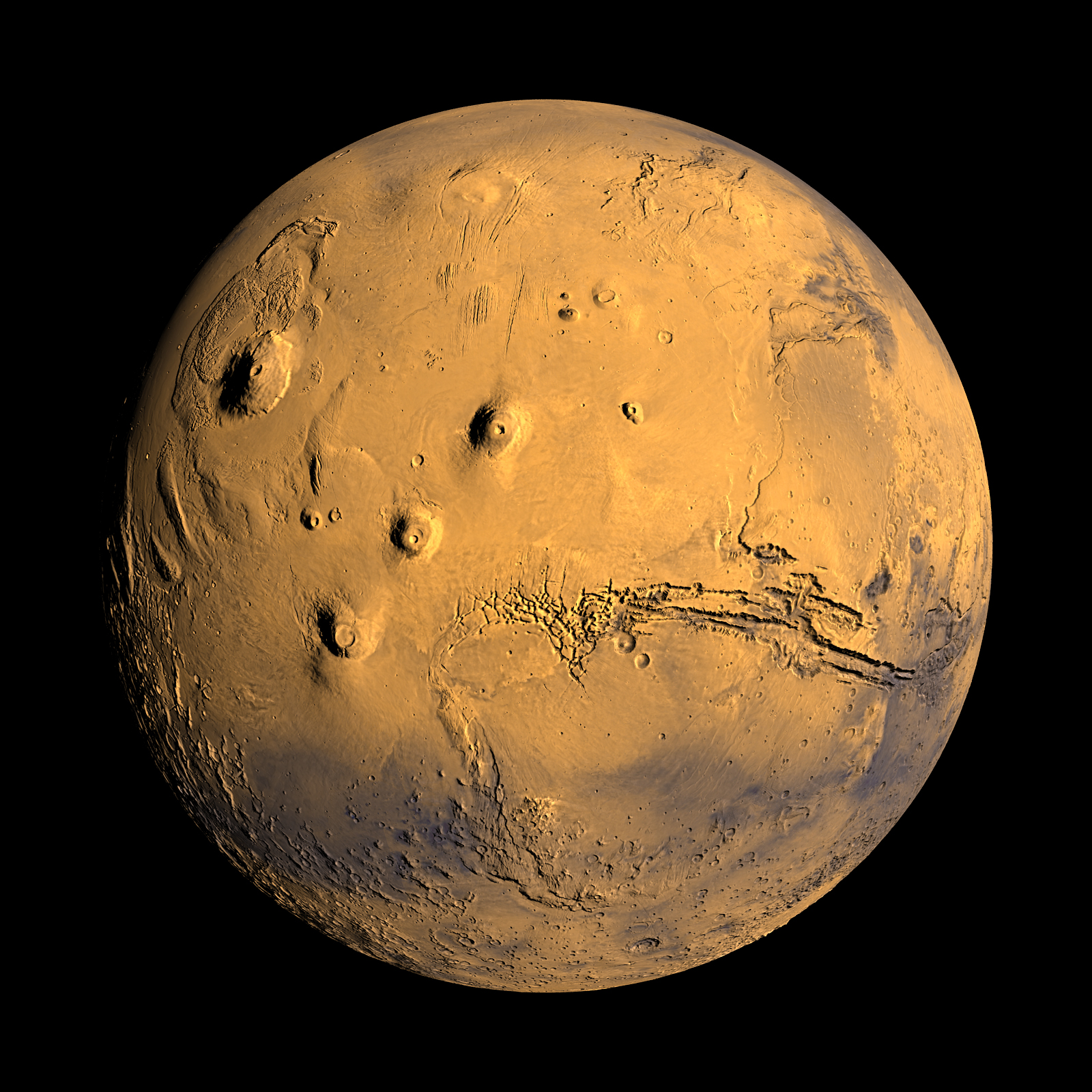
Image (Credit): The Red Planet. (NASA/JPL)

Here are some recent stories on Mars.

Earth.comChina’s Mars Zhurong Rover Finds an Ocean Shoreline on the Red Planet

The Chinese Mars rover Zhurong is adding an exciting twist to the story and history of water on Mars. After landing in southern Utopia Planitia on Mars in May 2021, the now-defunct Zhurong rover went to work exploring the Martian surface, and its latest findings might just change the way we think about the Red Planet. Bo Wu and a team of researchers from Hong Kong Polytechnic University believe they’ve found compelling evidence of an ocean shoreline for a massive body of water that once covered Mars’ northern lowlands.

New York TimesAn Asteroid’s Destruction May Have Given Mars Rings, Then Moons

Something’s not quite right about the moons of Mars. They are too small — Phobos is 17 miles across, and Deimos is a mere nine miles in length. And they aren’t round, but lumpy, misshaped objects. Frankly, they don’t resemble moons at all…A study published Wednesday in the journal Icarus makes a case that the moons did indeed start out in asteroid form. But it’s not the genesis everyone was expecting. Using supercomputer-powered simulations, scientists describe a situation in which a large-enough asteroid was captured by Mars long ago and torn to shreds by the planet’s gravity, briefly forming a debris cloud — and possibly a ring system — around Mars that ultimately clumped together to form two moons.

Astrobiology NewsMeteorite Contains Evidence Of Liquid Water On Mars 742 Million Years Ago

An asteroid struck Mars 11 million years ago and sent pieces of the red planet hurtling through space. One of these chunks of Mars eventually crashed into the Earth somewhere near Purdue and is one of the few meteorites that can be traced directly to Mars. This meteorite was rediscovered in a drawer at Purdue University in 1931 and therefore named the Lafayette Meteorite. During early investigations of the Lafayette Meteorite, scientists discovered that it had interacted with liquid water while on Mars. Scientists have long wondered when that interaction with liquid water took place. An international collaboration of scientists including two from Purdue University’s College of Science have recently determined the age of the minerals in the Lafayette Meteorite that formed when there was liquid water. The team has published its findings in Geochemical Perspective Letters.

Space Quote: Mars is Humanity’s Dream and Destiny

Credit: NASA/JPL-Caltech

“The age-old dream of endowing human minds and hands access to the cosmos does not belong to Donald Trump, nor should it be considered the exclusive possession of any particular political party. It belongs to humanity. It is essential that we make that clear, because the fortunes of political war are always changing. Should the Mars project come to be regarded as the mere hobby horse of a controversial politician, business leader, or partisan faction, it would surely face cancellation the next time the winds of power shift. We cannot let that happen. Precisely because we are not followers of Mr. Trump, we need to step up and help explain why all Americans, regardless of party, should support this initiative.”

Statement by Mars Society President Dr. Robert Zubrin regarding the election of Donald Trump.

Artemis and More Under a New Administration

Credit: The Planetary Society.

Will NASA be pulled in a new direction under a Trump administration? The Planetary Society does not think so, as noted in a recent article, “Space in the 2024 Elections: A Space Advocate’s Guide to the U.S. Presidential Election.

The graphic above highlights the party platforms on space, showing a lot of similarity between the two parties. If you also consider the fact that the Artemis program was started under the first Trump Administration, as well as the close association between Trump and Elon Musk (at the moment), then one sees an even stronger indication that the Moon and Mars will remain a large part of the new administration’s focus.

The article notes:

For former President Trump, maintaining U.S. preeminence is a major component of his campaign rhetoric. To that end, a second Trump Administration would likely view space as a key arena for competition with China, and would therefore prioritize initiatives aimed at maintaining American dominance in the space domain. This could include bolstering programs that accelerate the development of commercial space capabilities, like Artemis and the Commercial Lunar Payload Services program. Mars Sample Return is an example of a program that offers an opportunity to leverage the burgeoning commercial space industry to accomplish something that no other nation has: returning scientifically significant samples from another planet.

All of this should offer some protection for NASA in a new administration that is already talking about downsizing government and eliminating at least one department. Besides, I doubt a cost-cutting panel headed by Mr. Musk will cut off the hand that feeds him. NASA has been good to SpaceX, and that is likely to continue.

We will see many more papers and opinion pieces on potential changes in the days and weeks to come.

Weekend Reading: The Health Hazards of Space Travel: Novel Insights from Quantum Biology

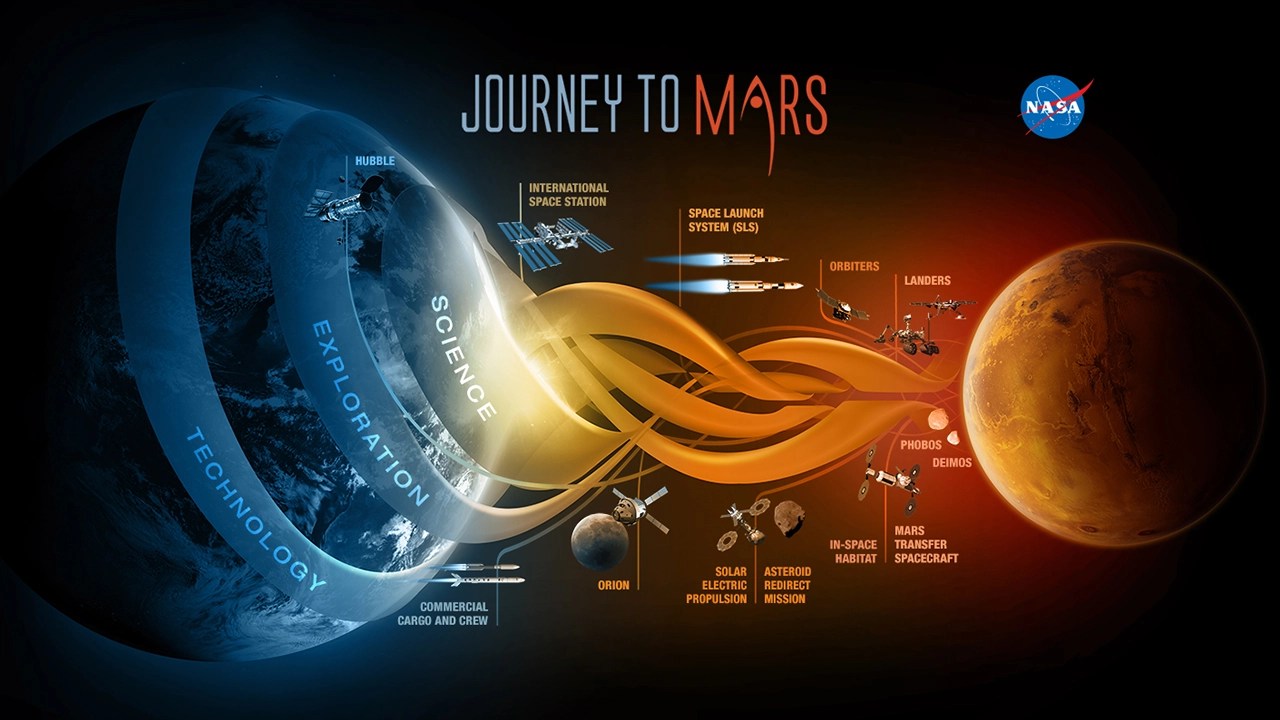
Image (Credit): A graphic from 2014 showing NASA’s approach to a human presence on Mars. This has been superseded by the Artemis program, but many elements remain the same. (NASA)

Yesterday’s post highlighted the dangers involved in low-Earth orbit travel, while another earlier posting mentioned a book by Kelly and Zach Weinersmith who wrote “A City on Mars: Can We Settle Space, Should We Settle Space, and Have We Really Thought This Through?

Well, the evidence continues to build on the difficulty of space travel and the need for greater study. This time its a report from The Guy Foundation in England, established by Geoffrey and Kate Guy to “facilitate exploration into quantum effects in biology and the role it could play in advancing medicine.” The 94-page report is titled The Health Hazards of Space Travel: Novel Insights from Quantum Biology.

You can read it this weekend at your leisure, but the bottom line is stated succinctly in the executive summary, further summarized here:

  • ...space travel seems likely to induce accelerated ageing in astronauts…associated with the disruption of cellular bioenergetics which could have other, perhaps more worrying health consequences.
  • …complex long-lived organisms, such as humans, will not be able to adapt to the unnatural environment of space, while shorter-lived, rapidly evolving ones, such as bacteria will.
  • At this stage, the following factors seem particularly significant…
    • zero gravity…;
    • {i}ncreased radiation…;
    • [t]he lack of a magnetic field…; and
    • [a] lack of near-infrared radiation.
  • Further experiments are urgently needed to improve our understanding of the underlying causes of space-induced ill health, and potential approaches to mitigate it.

The bottom line is that if we want to spread more than bacteria throughout the solar system and beyond, we need to get to work on these issues.

I am hoping Mr. Musk and friends are reading this before jumping off a cliff (or Earth in this case) with Mars-bound Starships. In fact, it may encourage Mr. Musk to use some of his funds to study these issues rather than play games with politics here are Earth. The $47 billion spent on Twitter would have gone a long way to help Mr. Musk achieve his dream of a Mars-based society, if that really is his dream.