27th Annual International Mars Society Convention

You still have time to sign up for the Mars Society’s 27th Annual International Mars Society Convention, happening from August 8-11 in Seattle, WA.

Some of the guests include:

  • Tiffany M. Morgan, Deputy Director of the Mars Exploration Program in NASA’s Science Directorate, who will give an address about “Exploring Mars Together, DRAFT Plan for a Sustainable Future for Science at Mars.”
  • Howard Hu, the Orion Program Director at NASA, who will give an address about “NASA’s Artemis plans for returning to the Moon and beyond,”
  • Brig. General (Ret.) Dr. S. Pete Worden, Chairman of the Breakthrough Prize Foundation, who will give an address about “Life in the Universe and Private Sector Space Science Initiatives.”
  • Dr. Alan Stern, a renowned planetary scientist and commercial astronaut, who will give an address about “The Other Red Planet” focusing on Pluto.

These are just a few of the names and presenters this year. You can also watch the presentations from prior conventions if you want to see what you missed.

Space Quote: Second Thoughts About a Journey to Mars

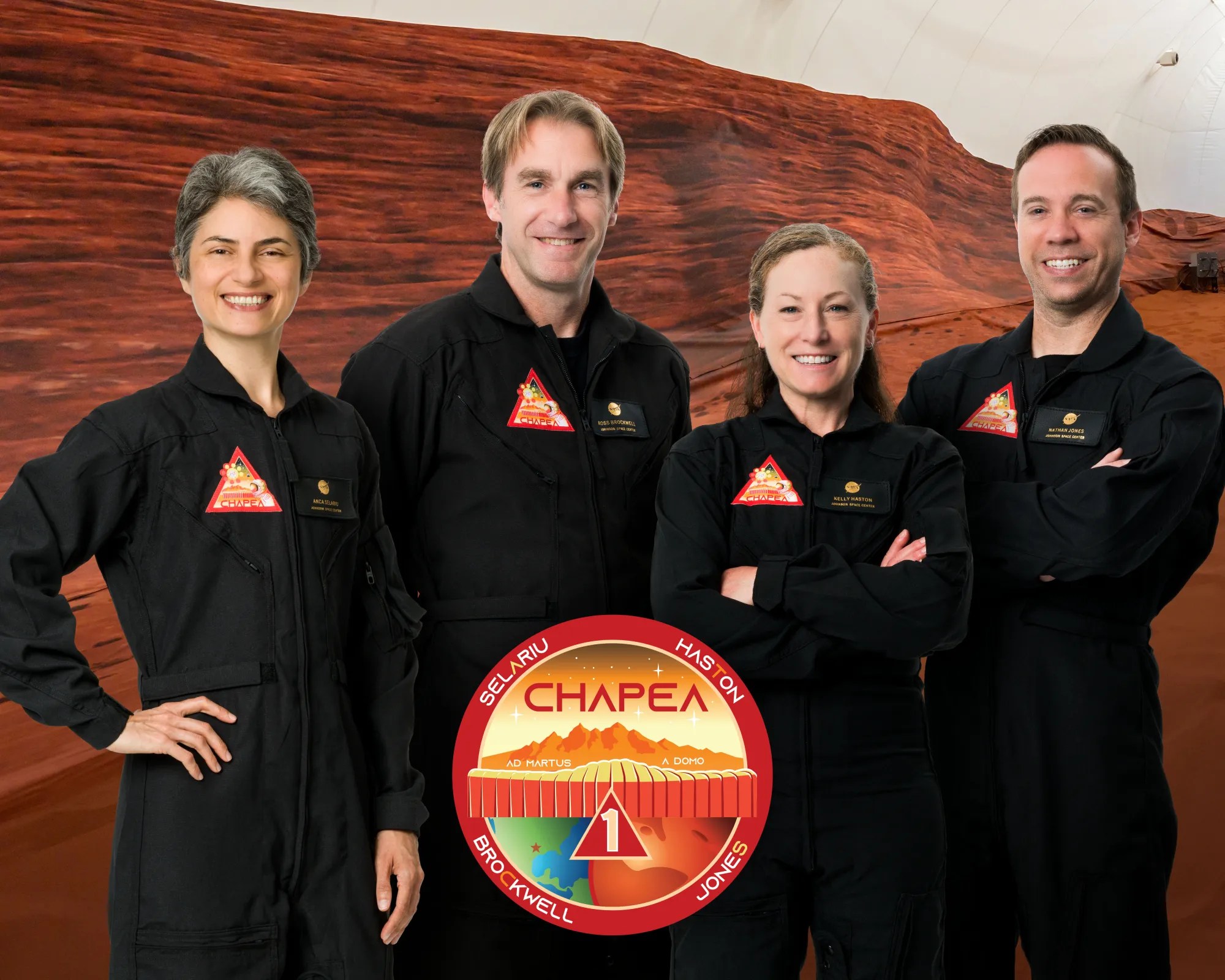
Image (Credit): Official mission 1 CHAPEA crew portrait (from left to right: Anca Selariu, Ross Brockwell, Kelly Haston, Nathan Jones). (NASA)

“”It would still cause me a great deal of thought, but I think my answer now is it would be very difficult to leave my partner, to leave my people, for that amount of time, because it would be far more than a year…That commitment, it’s going to be a tremendous effort when people go, and I really applaud whoever gets to do that. But I’m not sure it’ll be me.”

Statement by Kelly Haston, a Canadian research scientist, after spending 378 days as part of NASA’s yearlong Mars simulation project. She was part of a team of four individuals who lived together during this period at the Johnson Space Center in Houston in what is called the Crew Health and Performance Exploration Analog (CHAPEA) project. The next simulation mission is planned for next year.

Space Stories: Fewer Eyes on Asteroids, Volunteer Martians Released, and Russians Plans for a New Space Station

Image (Credit): NEOWISE space telescope. (NASA)

Here are some recent stories of interest.

Flying Magazine: NASA’s Asteroid, Comet Hunting Telescope Set to Retire at End of Month

A NASA space telescope designed to “hunt” asteroids and comets that could pose a threat to life on Earth and orbiting spacecraft will soon burn up in orbit. In late 2024 or early 2025, the agency’s Near-Earth Object (NEO) Wide-field Infrared Survey Explorer—or NEOWISE—is expected to come home in pieces following the conclusion of its second mission later this month…However, NASA has a replacement lined up: the Near Earth Object Surveyor (NEO Surveyor), set for a 2027 launch. The infrared space telescope is the first to be designed specifically for hunting large numbers of NEOs in and around Earth orbit. It has a baseline development cost of $1.2 billion to which NASA committed in 2022.

NPR: Volunteers Who Lived in a NASA-created Mars Replica for Over a Year Have Emerged

Four volunteers who spent more than a year living in a 1,700-square-foot space created by NASA to simulate the environment on Mars have emerged. The members of the Crew Health and Performance Exploration Analog mission — or CHAPEA — walked through the door of their habitat at NASA’s Johnson Space Center in Houston on Saturday to a round of applause…Haston and the other three crew members — Anca Selariu, Ross Brockwell and Nathan Jones — entered the 3D-printed Mars replica on June 25, 2023, as part of a NASA experiment to observe how humans would fare living on the Red Planet.

Reuters: Russia Plans to Create Core of New Space Station by 2030

Russia is aiming to create the four-module core of its planned new orbital space station by 2030, its Roscosmos space agency said on Tuesday. The head of Roscosmos, Yuri Borisov, signed off on the timetable with the directors of 19 enterprises involved in creating the new station. The agency confirmed plans to launch an initial scientific and energy module in 2027. It said three more modules would be added by 2030 and a further two between 2031 and 2033.

Study Findings: Which Caves on Mars are Safe to Live In?

Image (Credit): A region in Chryse Planitia where Tiu, Ares, and Kasei Valles end, which is pockmarked by impact craters large and small. (HiRISE/The University of Arizona)

Here are some highlights from the paper presented at the 55th Lunar and Planetary Science Conference:

For reliable protection against cosmic radiation, living and working spaces for colonists are best built below the surface. These colonies also need to be provided with energy. And solar panels are not the best option because the solar radiation flux is much lower on Mars and the panels will be constantly dusted with dust due to frequent dust storms. A nuclear reactor may be the best option.

Humans also need constant access to water resources. From the point of view of the reliability of the future housing, a lava tube with strong walls best meets these requirements. It is a hollow formation in the crust, formed as a result of the release of volcanic lava. And based on the need to provide settlements with water, a more suitable case should be considered underground caves in glacial cracks with a gentle horizontal entrance. After all, there are already significant deposits of water ice under the surface. But the walls of such settlements will be less strong, and they will require more careful preparatory work.

Publication: 55th Lunar and Planetary Science Conference, held 11-15 March, 2024 at The Woodlands, Texas/Virtual. LPI Contribution No. 3040, id.1028

Contact Info: A. P. Vidmachenko, National University of Life and Environmental Sciences of Ukraine, Str. Heroyiv Oborony, 12, Kyiv, 03041, Ukraine, avidmachenko@gmail.com.

Link to paper: https://www.hou.usra.edu/meetings/lpsc2024/pdf/1028.pdf

Study-related stories:

Space Stories: Moss for Mars, Martian Space Rocks, and a Red Planet Practice Habitat

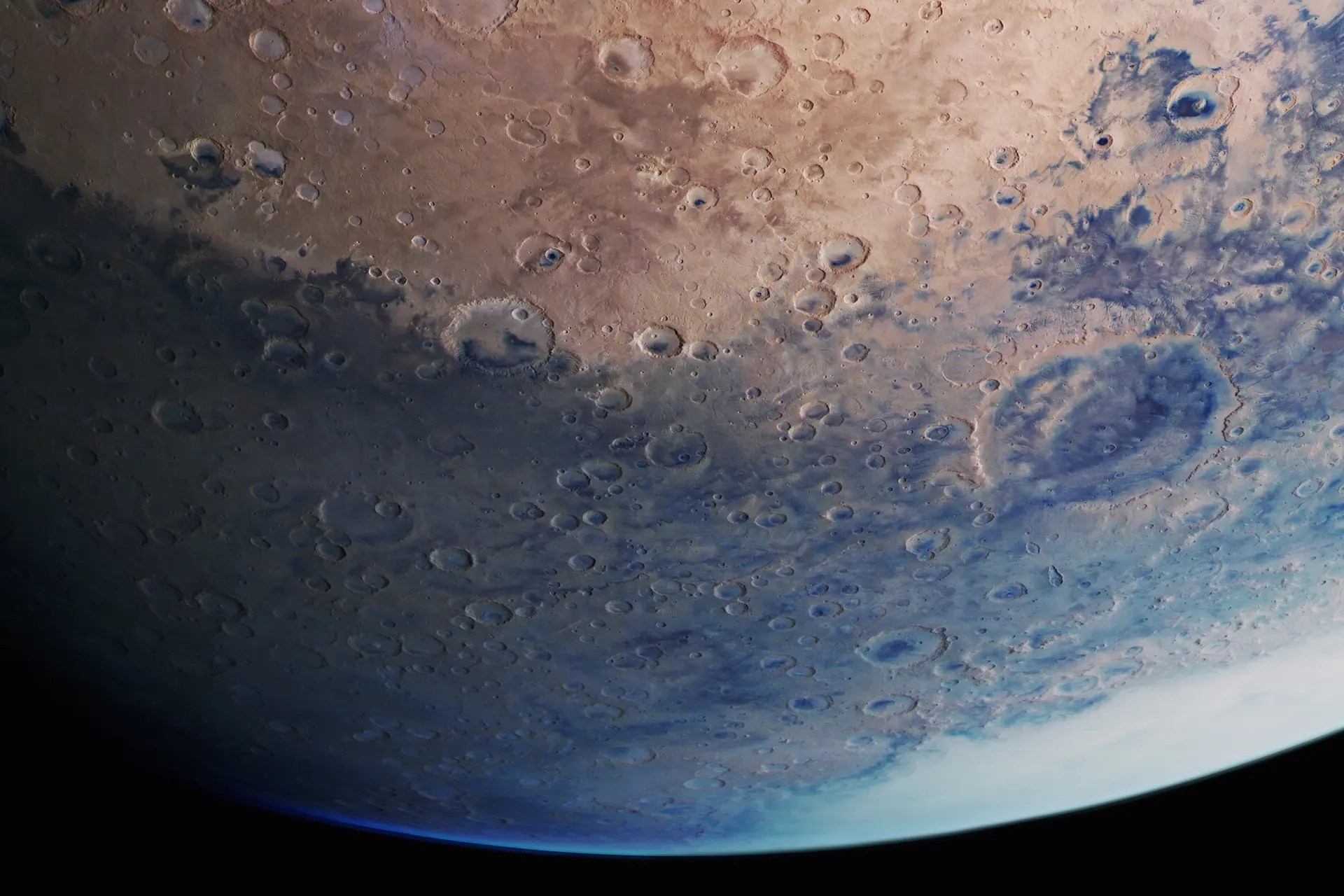
Image (Credit): A detailed view of the Martian surface. (ESA/DLR/FU Berlin)

Here are some recent Mars-related stories of interest.

The Guardian: Scientists Find Desert Moss ‘That Can Survive on Mars’”

While Matt Damon relied on potatoes cultivated in crew biowaste to survive in the hit film The Martian, researchers say it is a humble desert moss that might prove pivotal to establishing life on Mars. Scientists in China say they have found Syntrichia caninervis – a moss found in regions including Antarctica and the Mojave desert – is able to withstand Mars-like conditions, including drought, high levels of radiation and extreme cold.

CNN: Mars Gets Hit by Hundreds of Basketball-size Space Rocks Every Year

Hundreds of basketball-size space rocks slam into Mars each year, leaving behind impact craters and causing rumblings across the red planet, according to new research. Mission planners could use the revelations, recorded in data collected by a now-retired NASA mission, as they determine where to land future robotic missions as well as astronaut crews on the red planet. NASA’s InSight mission ended when the stationary lander lost a battle to an accumulation of Martian dust on its solar panels in December 2022, but the wealth of data the spacecraft collected is still fueling new research.

UPI: Crew Inside NASA’s Mars Habitat Simulator to Exit After More Than a Year

The first volunteer crew, to live for more than a year inside NASA’s Mars habitat at the Johnson Space Center in Houston, will exit the simulated Red Planet ground mission on Saturday…The crew entered CHAPEA on June 25, 2023, and enacted Mars mission operations, including virtual reality “Mars-walks” while growing and harvesting vegetables to supplement their shelf food. They also spent their time maintaining equipment while being tested with stressors, including isolation and communication delays with Earth.