Image (Credit): Artist’s rendering of a Martian habitat as envisioned by the Colorado School of Mines and ICON as part of NASA’s 3D Printed Habitat Challenge. (Logan Architecture)
Just a heads up. Tune into CBS’s 60 Minutes next Sunday to learn more about NASA’s efforts to design what may be future habitats on Mars. It involves 3D-printing technologies, which have also been discussed as a means of building a lunar base. In fact, NASA has issued contracts for such construction on the Moon.
Here is a clip discussing this upcoming segment. It is part of a 90-minute episode of 60 Minutes. I am not sure if we should expect a name change for the series.
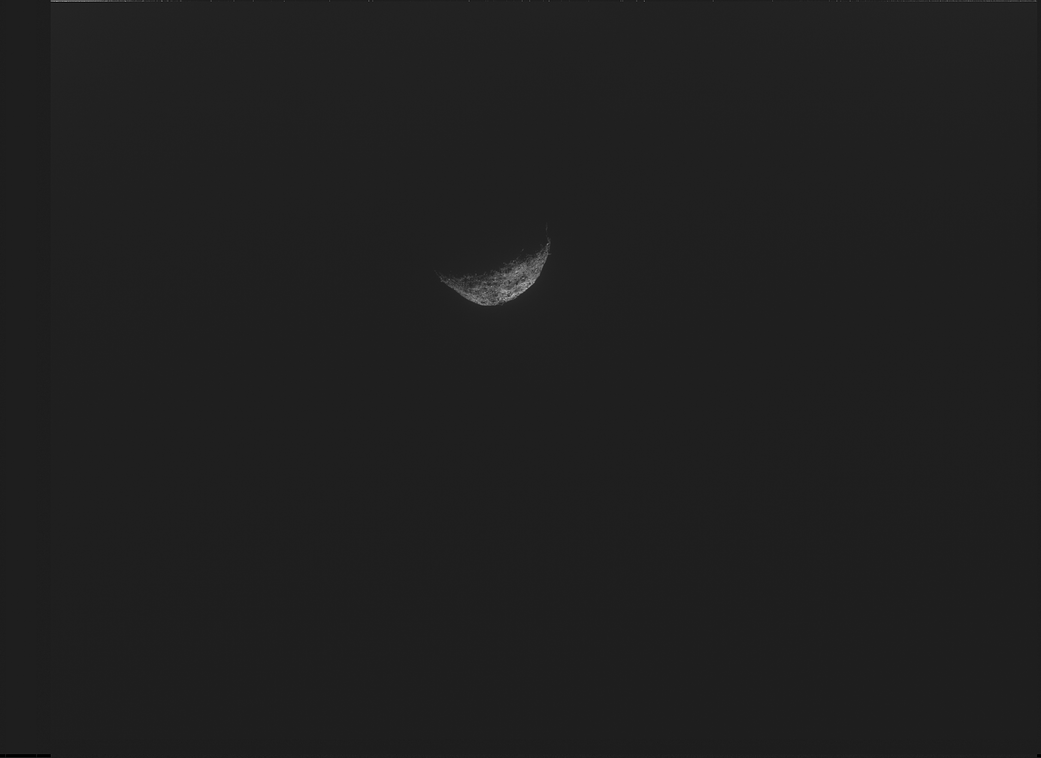
Image (Credit): Asteroid Bennu as seen by the OSIRIS-REx as it begins its return to Earth back in May 2021. (NASA/Goddard/University of Arizona; Writer Daniel Stolte, University of Arizona)
This weekend will should see the safe landing of a asteroid sample from far away. On Sunday, NASA’s Origins, Spectral Interpretation, Resource Identification, Security, Regolith Explorer (OSIRIS-REx) spacecraft will return to Earth with sample material from asteroid Bennu, which it encountered two years ago.
Launched on Sept. 8, 2016, the spacecraft spent about two years getting to Bennu and then more than two years studying the asteroid and collecting a 250-gram sample that should be in the hands of NASA scientists shortly. The graphic below shows the return path of the sample as it heads for the Utah desert. You can also watch this NASA video for more information on the overall mission and keep abreast of mission highlights via this mission blog. NASA also has a recent podcast discussing the spacecraft’s adventures and trip back to Earth.
And what about OSIRIS-REx after it makes this deposit? It will become OSIRIS-APEX (APEX for “Apophis Explorer”) and go back into the inner solar system before encountering asteroid Apophis in 2029.
We talk about rocket reuse, but this is a terrific example of spacecraft reuse.
The timing could not be better as NASA awaits 2024 budget decisions from Congress and further discussions about another sample return, this one from Mars.
A team recently calculated that most of the Moon’s permanently shadowed regions (PSRs) are at most around 3.4 billion years old and can contain relatively young deposits of water ice. Water resources are considered key for sustainable exploration of the Moon and beyond, but these findings suggest that current estimates for cold-trapped ices are too high.
NASA’s Parker Solar Probe was built to withstand the ravages of the environment near our sun—and with good reason. The car-size spacecraft has now flown through a giant solar outburst of charged particles called a coronal mass ejection (CME). If that CME had it hit Earth instead, it may have caused vast, continent-wide blackouts, scientists say. Some of those searing particles whipped through space at about three million miles per hour.
NASA’s Perseverance rover has done the unthinkable. Or, at least, a small device on the rover has. According to a tweet and article shared by NASA’s Perseverance team on Twitter, a device known only as MOXIE has proven that we can generate oxygen on Mars using the planet’s CO2-concentrated atmosphere. This tech is a huge boon, and the success of this story could help pave the way for future oxygen generation on the Red Planet, something that would make long-term exploration of the planet far more feasible.
Image (Credit): Artist’s rendering of the SLS. (NASA)
The Government Accountability Office (GAO) recently completed a review of NASA’s Space Launch System (SLS), which is the cornerstone of the Artemis program. GAO assessed the extent to which (1) NASA has established plans to measure the SLS program costs post-Artemis I, and (2) the program has made progress with its plans to reduce projected SLS costs.
So what is the bottom line? This quote is most concerning: “Senior NASA officials told GAO that at current cost levels, the SLS program is unaffordable.”
The SLS is the vehicle that is supposed to demonstrate our ability to return to the Moon as well as our readiness for a Mars mission. But all of this is contingent on continued funding from Congress, and the congressional auditors have raised a red flag.
I expect you could find similar audit issues with the earlier Apollo missions as well as other space missions, yet NASA does not need to give Congress a reason to put money elsewhere. Let’s hope NASA’s leaders take the audit seriously and show some progress to keep all of the parties happy and the funding alive.
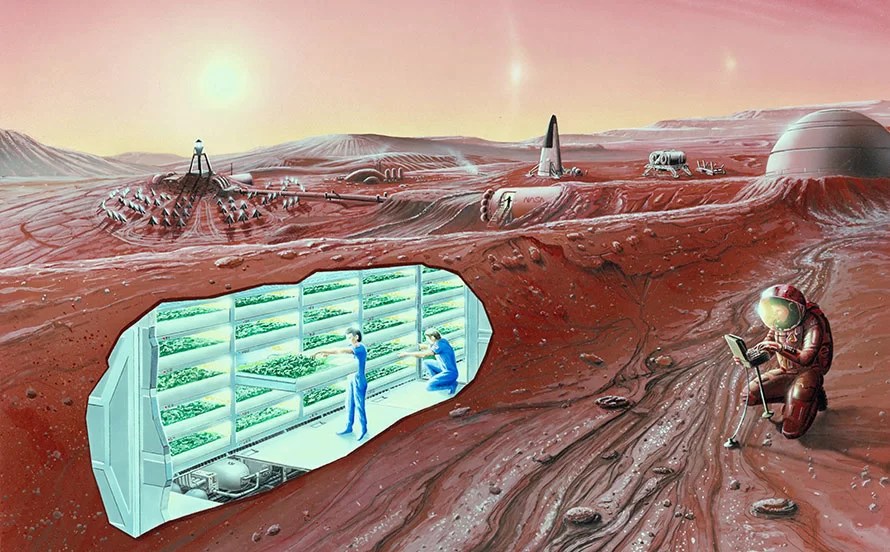
Image (Credit): An imagined Martian settlement. (NASA)
Astronomy magazine has a good article titled “Predictions for the Next 50 Years of Astronomy.” Five astronomers provide their ideas about what we might experience in the field of astronomy in the 2070s.
For instance, S. Alan Stern, a planetary scientist and member of the U.S. National Science Board, had this prediction:
By the ’70s, I expect we’ll have human exploration taking place on multiple worlds in the solar system, with Antarctic-like, semipermanent bases scattered around the globes of at least Luna and Mars. I also expect we may by then have much larger and more powerful launch vehicles, even fusion-based or high-power electric propulsion, making trip times an order of magnitude shorter than today. Just think: Mars in a few weeks, Pluto and the Kuiper Belt in a year!
I just want to see the Moon landing get underway before any predictions about the Kuiper Belt, but it is all exciting and in many ways unknowable given what has happened in the last 50 years. For instance, how many people 50 years ago believed that we would have a catalog of thousands of exoplanets, many similar to Earth?
Of course, predictions are tough. Here is what some scientists were saying in the 1970s about the fate of our little planet, as reported by the American Enterprise Institute:
{Paul] Ehrlich sketched out his most alarmist scenario for the 1970 Earth Day issue of The Progressive, assuring readers that between 1980 and 1989, some 4 billion people, including 65 million Americans, would perish in the “Great Die-Off.”
Harrison Brown, a scientist at the National Academy of Sciences, published a chart in Scientific American that looked at metal reserves and estimated the humanity would totally run out of copper shortly after 2000. Lead, zinc, tin, gold, and silver would be gone before 1990.
We have our issues today, but I am very happy that these earlier scientists did not have the gift of prophesy.




 Our Awesome Universe