Study Findings: Drift of Earth’s Pole Confirms Groundwater Depletion as a Significant Contributor to Global Sea Level Rise 1993–2010

Credit: Reto Stöckli, Nazmi El Saleous, and Marit Jentoft-Nilsen, NASA GSFC

Geophysical Research Letters (plain language) abstract:

Melting of polar ice sheets and mountain glaciers has been understood as a main cause of sea level rise associated with contemporary climate warming. It has been proposed that an important anthropogenic contribution is sea level rise due to groundwater depletion resulting from irrigation. A climate model estimate for the period 1993–2010 gives total groundwater depletion of 2,150 GTon, equivalent to global sea level rise of 6.24 mm. However, direct observational evidence supporting this estimate has been lacking. In this study, we show that the model estimate of water redistribution from aquifers to the oceans would result in a drift of Earth’s rotational pole, about 78.48 cm toward 64.16°E. In combination with other well-understood sources of water redistribution, such as melting of polar ice sheets and mountain glaciers, good agreement with PM observations serves as an independent confirmation of the groundwater depletion model estimate.

Citation: Ki-Weon Seo, Dongryeol Ryu, Jooyoung Eom, Taewhan Jeon, Jae-Seung Kim, Kookhyoun Youm, Jianli Chen, Clark R. Wilson. Drift of Earth’s Pole Confirms Groundwater Depletion as a Significant Contributor to Global Sea Level Rise 1993–2010. Geophysical Research Letters  (2023).
https://doi.org/10.1126/science.abo6192

Study-related stories:

Note: We have been unintentionally terra-forming the Earth while looking at Mars and elsewhere to find candidates for intentional terra-forming. I believe we are learning that it is much easier to break a working system than create a new system from scratch.

$10 Billion for Some Martian Rocks?

Image (Credit): Hole left by the Perserverance rover as it collected its 14th sample of Martian rock. (NASA)

A recent ARS Technica article, “NASA’s Mars Sample Return Has a New Price Tag—and it’s Colossal,” discusses the potential plans to retrieve rocks from the Martian surface at a total cost of $10 billion. This has the potential to crowd out other important NASA projects and may need to be reconsidered at a time of budget constraints.

NASA has been seeking innovative solutions from the private sector to lower the retrieval costs, but the mission may be on hold for some time. Getting rocks from the Moon and even an asteroid seems easy by comparison.

Maybe NASA needs to seen another private sector solution – a study of Martian rocks on the surface of Mars. It may be easier to land a laboratory and conduct long-term experiments in situ rather than attempting a journey back to Earth. It is something to consider for now and may give us quicker access to the rocks.

Of course, we can always wait until Elon Musk lands on the Red Planet and retrieves them.

Podcast: Should We Be Talking to the Stars (or Exoplanets, to be More Precise)?

I recommend you tune into another episode from The Planetary Society’s podcast Planetary Radio. In the episode, Space Policy Edition: The Policy Implications of Active SETI, we hear a discussion about the advantages and disadvantages of an active SETI program, and whether we can even cease outreach to the neighboring systems given what has already been transmitted and the nature of our world today.

The guest on the episode is Jacob Haqq Misra, Senior Research Investigator at the Blue Marble Space Institute of Science. He is the author of a new book, Sovereign Mars: Transforming Our Values Through Space Settlement, though his main points related to our SETI program.

For instance, whether or not people support an active or passive SETI program often depends on whether we believe in benevolent or destructive aliens. Of course, the matter is unknowable until it happens, yet fraught with fears based on what we know about ourselves and our own exploration.

The discussion also discussed the presentation of SETI in films, such as Contact, as well as the definition of intelligence itself, be it whales (remember Star Trek IV: The Voyage Home?) or even ChatGPT. And we are already past the point of turning off our “active outreach” given that interested aliens are probably looking for both bio-signatures and techno-signatures, which we are creating without any thought. Astronomers are currently searching for such signatures among the exoplanets, so it would make sense the same type of search is being focused on our solar system.

Plenty of food for thought. Enjoy the show.

Credit: University Press of Kansas

Space Stories: James Webb’s Partner, the Big Bang Black Holes, and Green Energy on the Red Planet

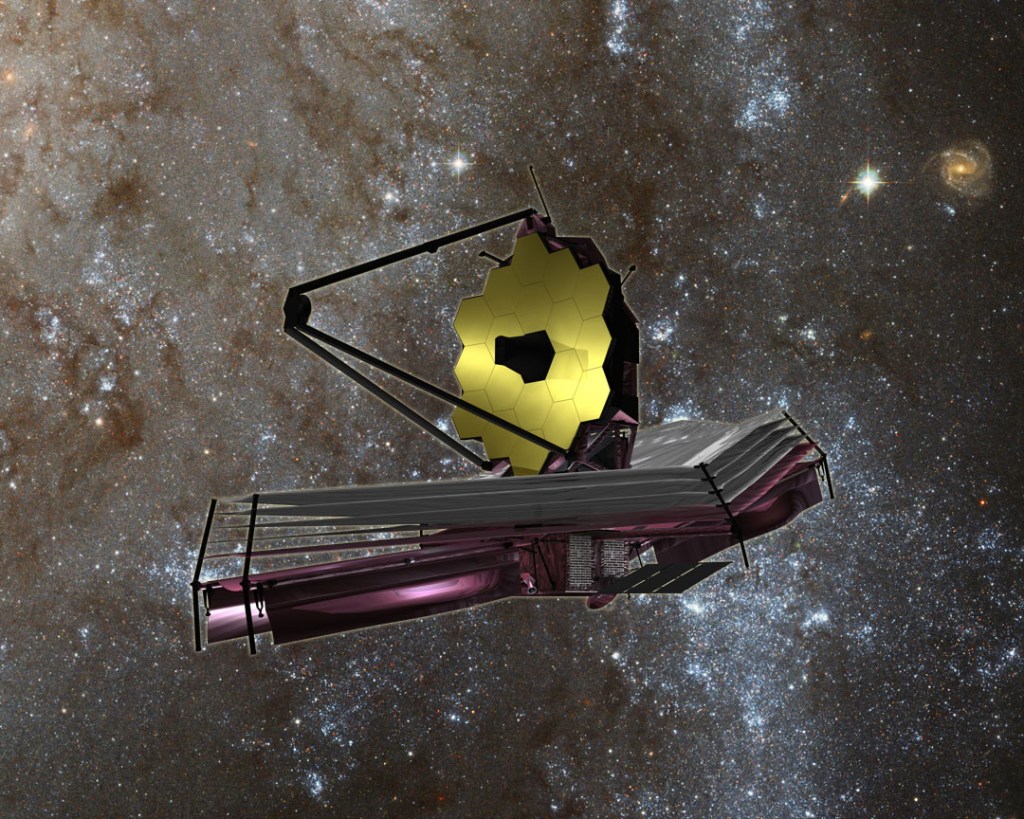
Image (Credit): James Webb Space Telescope. (NASA)

Here are some recent stories of interest.

Futurism: “NASA Sending Adorable Little Buddy to Hang Out Next to the James Webb

The space agency recently selected a toaster-sized cubesat that will become the much bigger telescope’s tiny, adorable “sidekick,” according to a statement. NASA chose the $8.5 million space mission, called the “Monitoring Activity from Nearby sTars with uv Imaging and Spectroscopy” (MANTIS), which will be designed and built by researchers at the University of Colorado Boulder. The diminutive but mighty spacecraft, scheduled to launch sometime in 2026, will make observations of the night sky in the full range of ultraviolet light, including extreme UV (EUV) light, a more energetic form.

Universe Today: “Why Didn’t the Big Bang Collapse in a Giant Black Hole?

Despite the enormous densities, the early universe didn’t collapse into a black hole because, simply put, there was nothing to collapse into…Even though the early universe was incredibly dense, it was also incredibly uniform. The average density throughout the universe was the same from place to place. There weren’t enough differences to trigger the formation of black holes.

University of Warwick: “Using Photosynthesis for Martian Occupation—While Making Space Travel More Sustainable

In a study published in Nature Communications, scientists assess a new technique which could convert renewable, green energy from outside the Earth’s atmosphere. They are taking advantage of photosynthesis—the chemical process plants undergo every day to create energy—to help the space industry become more sustainable. The research led by the University of Warwick evaluates the use of a special device known as semiconductor to absorb sunlight on moon and Mars. It is hoped that the devices could promote Martian life support systems.

Pic of the Week: The Ongoing Perseverance Rover Mission

Image (Credit): NASA’s Perseverance Mars rover captured this mosaic of a hill nicknamed “Pinestand.”
(NASA/JPL-Caltech/ASU/MSSS)

This week’s image comes from NASA’s Mars rover Perseverance as it explores the to Jezero Crater. The photo was posted last month. It has been a little while since we directly our attention at the Red Planet.

The image shows what may be the result of a fast-moving river some time in the past. In the NASA write-up accompanying the photo above, we read:

“Pinestand” is an isolated hill bearing sedimentary layers that curve skyward, some as high as 66 feet (20 meters). Scientists think these tall layers may also have been formed by a powerful river, although they’re exploring other explanations, as well.

“These layers are anomalously tall for rivers on Earth,” [postdoctoral researcher at NASA’s Jet Propulsion Laboratory in Southern California Libby] Ives said. “But at the same time, the most common way to create these kinds of landforms would be a river.”