ChatGPT and Elon Musk

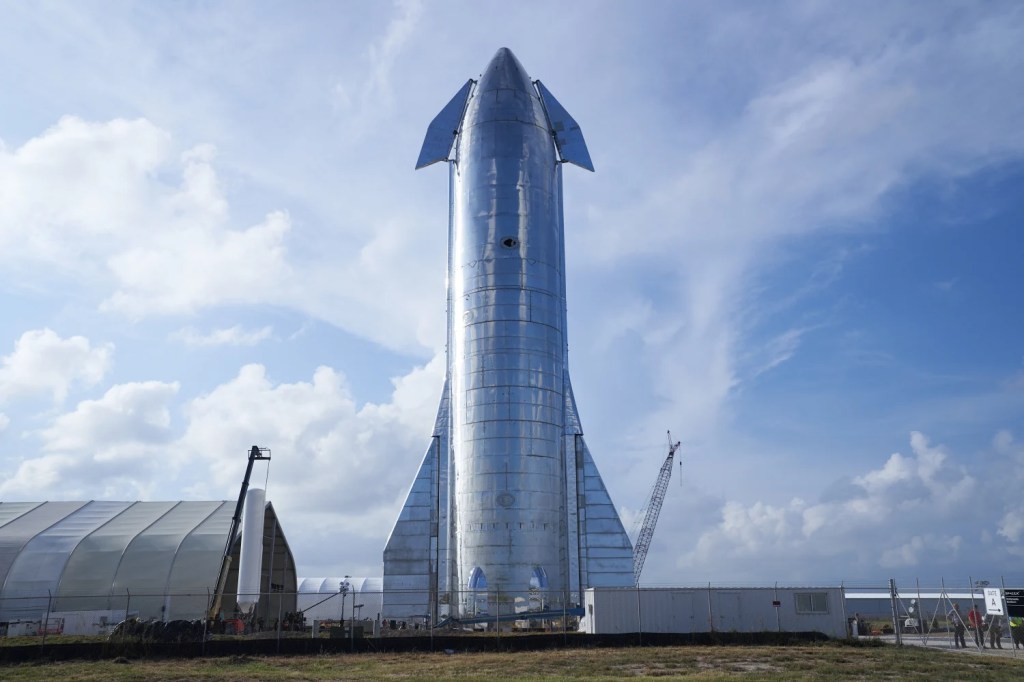
Image (Credit): SpaceX’s Starship rocket to be used for travel to Mars. (SpaceX)

You have probably heard of the new artificial intelligence program ChatGPT, which can compose stories and articles. So what happens when you ask it to do a simple task? I asked the program to compose a poem to cover the following scenario:

Elon Musk has become frustrated with Twitter, so he takes a rocket to Mars to live there forever. 

Here is what I received from ChatGSP:

Elon Musk, oh how he tried

To make Twitter work for him,

But in the end, he sighed

Fed up with all the noise

The constant need for attention

He made a bold decision

He’d leave this world behind

And start anew on Mars

Where he could truly shine

With his rocket at the ready

He blasted off to the stars

Leaving Earth and its troubles steady

On the Red Planet he would live

Where he could truly be himself

And all his dreams he could fulfill

No more anger, no more frustration

Just peace and solitude at last

On Mars, he found his new destination.

Not a bad start. Maybe ChatGPS needs to get in touch with the SpaceX engineers working at Twitter to determine whether this adventure can be arranged.

Extra: Here is another poem ChatGTP put together on a 2025 moon landing. It was not perfect. For example, I don’t think we will need to worry about “lunar mud.”

In 2025 we took a trip to the moon
To see what secrets it held in its dune
We strapped on our suits and climbed in our ship
And blasted off into the endless abyss

The stars shone bright as we soared through the sky
And the moon grew larger as we drew nigh
We landed on the surface with a thud
And took our first steps on the lunar mud

We explored the craters and the rocky terrain
And marveled at the view of Earth again
We planted a flag and collected some rocks
And gazed at the stars from a lunar box

We took lots of pictures and had lots of fun
But soon it was time to return to Earth, our home
We climbed back in our ship and took off with a roar
Leaving the moon to shine bright once more

But the memories of our trip will never fade
And the experience will forever be engraved
In our hearts and minds as a wondrous feat
A trip to the moon, a dream complete.
Space Stories: Eruptions on Mars, World’s Largest Radio-Astronomy Observatory, and Saudi Space Hotels

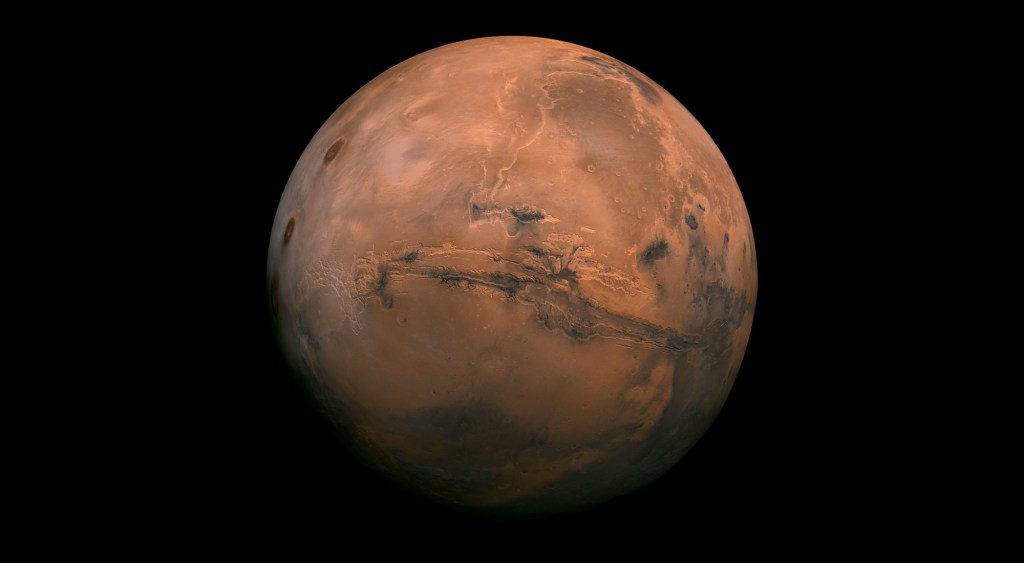
Image (Credit): Image of the planet Mars. (NASA)

Here are some recent stories of interest.

University of Arizona: “Giant Mantle Plume Reveals Mars is More Active Than Previously Thought

In a study published in Nature Astronomy, scientists from the University of Arizona challenge current views of Martian geodynamic evolution with a report on the discovery of an active mantle plume pushing the surface upward and causing earthquakes and volcanic eruptions. The finding suggests that the planet’s deceptively quiet surface may hide a more tumultuous interior than previously thought…Mantle plumes are large blobs of warm and buoyant rock that rise from deep inside a planet and push through its intermediate layer – the mantle – to reach the base of its crust, causing earthquakes, faulting and volcanic eruptions. The island chain of Hawaii, for example, formed as the Pacific plate slowly drifted over a mantle plume.

Nature.com: “‘Great Scientific Step Forward’: Construction of World’s Largest Radio Observatory is Finally Under Way

After 30 years of planning and negotiations, construction begins this week on the Square Kilometre Array (SKA), the world’s largest radio-astronomy observatory. The giant instrument — to be built across sprawling sites in Australia and Africa — will collect the radio signals emitted by celestial objects and will hopefully shed light on some of the most enigmatic problems in astronomy, such as the nature of dark matter and how galaxies form.

UAE in Space: “Saudi Arabia in Talks over Plans for Next-Generation Space Stations

Saudi Arabia is in talks with other nations over plans for the next generation of space stations, which could one day serve as floating hotels among the stars. Mohammed bin Saud Al Tamimi, governor of the Communications, Space and Technology Commission, said he sees space commodities as a “huge opportunity”. He was speaking remotely on the first day of the Abu Dhabi Space Debate, a major conference that addressed the new geopolitics of space and emerging trends. Mr Al Tamimi said that the Kingdom would be announcing its national space strategy early next year.

Gift Ideas: Glowing Stars, Planets, and Moons

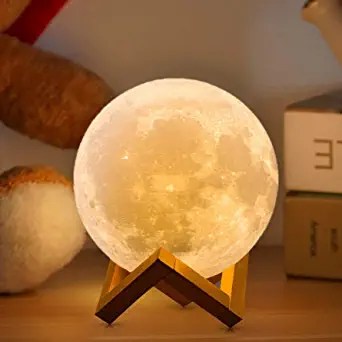
Image: Sample Moon lamp.

If you are looking for a fun gift that will encourage kids to learn more about the universe around them, then you cannot go wrong with a nightlight that illustrates the beauty of the nighttime objects above us. For instance, the Moon lamp shown above (there are many others like it on Amazon and elsewhere) allows an up-close view of this amazing orb. As with the Earth globes of old, seeing a world in three-dimensions and being able to touch it assists with understanding. Besides, in the case of the Moon, a youngster looking out the bedroom window will only see one side of the Moon, whereas the lamp provides the entire surface.

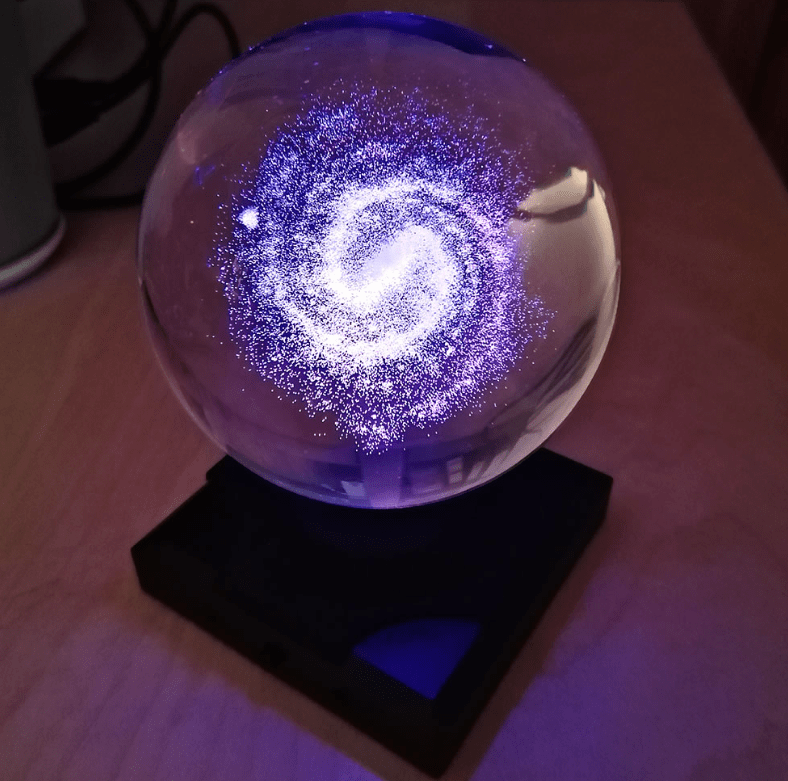
You can find similar lamps and nightlights showing Mars, Jupiter, and even the Milky Way (see below).

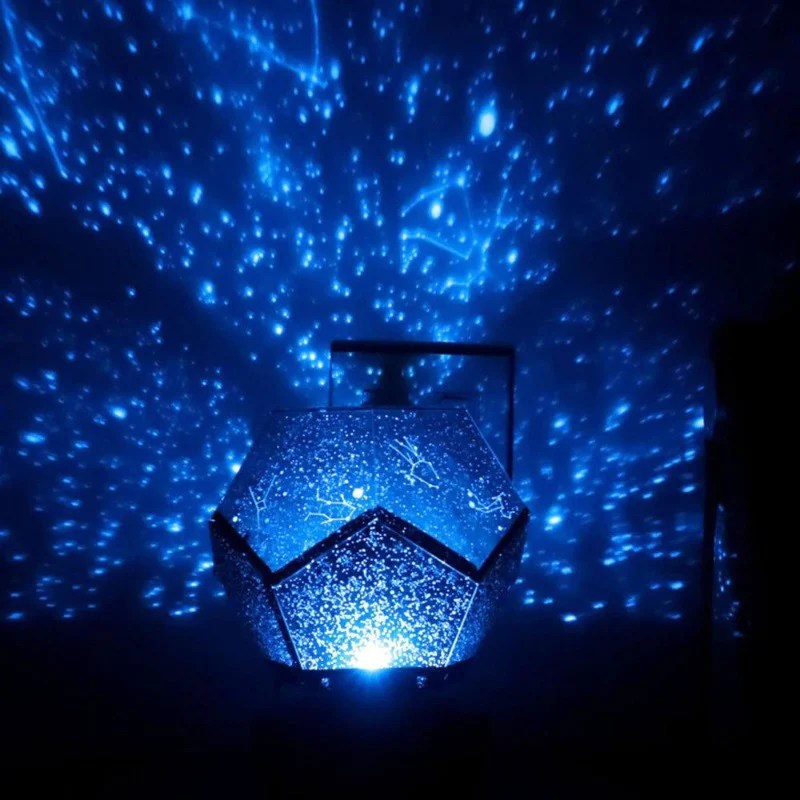
Or why not simply project the constellations onto the bedroom ceiling so kids can learn about the night sky even when it is cloudy outside? There is nothing like a personal planetarium.

Mind you, these gifts are not only for children, but it’s a good place to start. I may yet get one of those Moon lamps for my desk. Why should the kids have all the fun?

Image: Sample Milkyway lit orb.
Image: Sample constellation projector.

Space Stories: Early Galaxies, Early Life on Mars, and Gold-Rich Stars

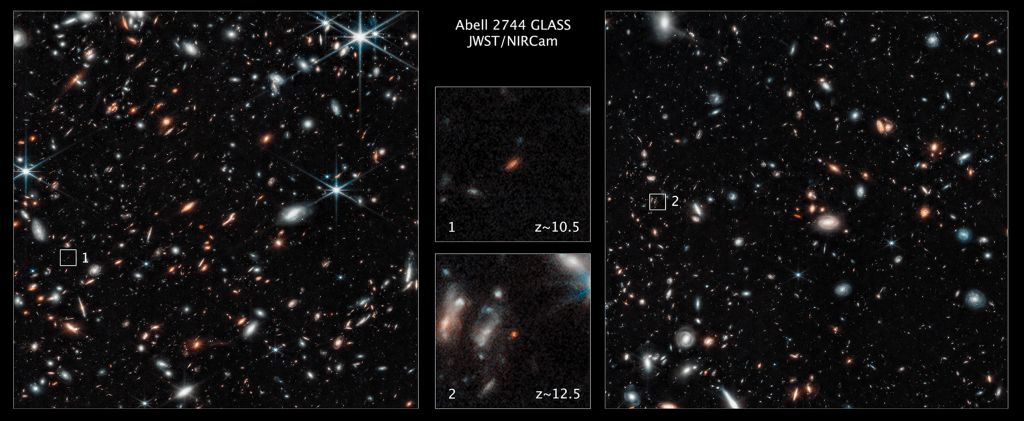
Image (Credit): Two of the farthest galaxies seen to date are captured in these Webb Space Telescope pictures of the outer regions of the giant galaxy cluster Abell 2744. The galaxies are not inside the cluster, but many billions of light-years farther behind it. The galaxy labeled (1) existed only 450 million years after the big bang. The galaxy labeled (2) existed 350 million years after the big bang. Both are seen really close in time to the big bang which occurred 13.8 billion years ago. These galaxies are tiny compared to our Milky Way, being just a few percent of its size, even the unexpectedly elongated galaxy labeled (1). (NASA, ESA, CSA, Tommaso Treu (UCLA), Zolt G. Levay (STScI))

Here are some recent stories of interest.

NASA: “NASA’s Webb Draws Back Curtain on Universe’s Early Galaxies

With just four days of analysis, researchers found two exceptionally bright galaxies in the GLASS-JWST images. These galaxies existed approximately 450 and 350 million years after the big bang (with a redshift of approximately 10.5 and 12.5, respectively), though future spectroscopic measurements with Webb will help confirm…“These observations just make your head explode. This is a whole new chapter in astronomy. It’s like an archaeological dig, and suddenly you find a lost city or something you didn’t know about. It’s just staggering,” added Paola Santini, fourth author of the Castellano et al. GLASS-JWST paper.

University of Copenhagen: “The First Life in Our Solar System May Have Been on Mars

When Mars was a young planet, it was bombarded by ice asteroids delivering water and organic molecules necessary for life to emerge. According to the professor behind a new study, this means that the first life in our solar system may have been on Mars.

National Astronomical Observatory of Japan: “Gold-rich Stars Came from Ancient Galaxies

Recently, hundreds of gold-rich stars have been detected by state-of-the-art telescopes worldwide. New simulations of galaxy formation, with the highest resolution in both time and mass, show that these gold-rich stars formed in progenitor galaxies, small galaxies which merged to create the Milky Way…According to the research, most gold-rich stars formed over 10 billion years ago in small, building-block galaxies―known as progenitor galaxies. Some but not all progenitor galaxies experience a neutron star merger, where large amounts of heavy r-process elements are produced and released, enriching that particular small galaxy. The predicted abundance of gold-enriched stars in the final Milky-Way-sized galaxy matches what is actually observed.

Space Stories: Challenger Debris Located, Chinese Mars Engine, and Risky Trip to the Space Station

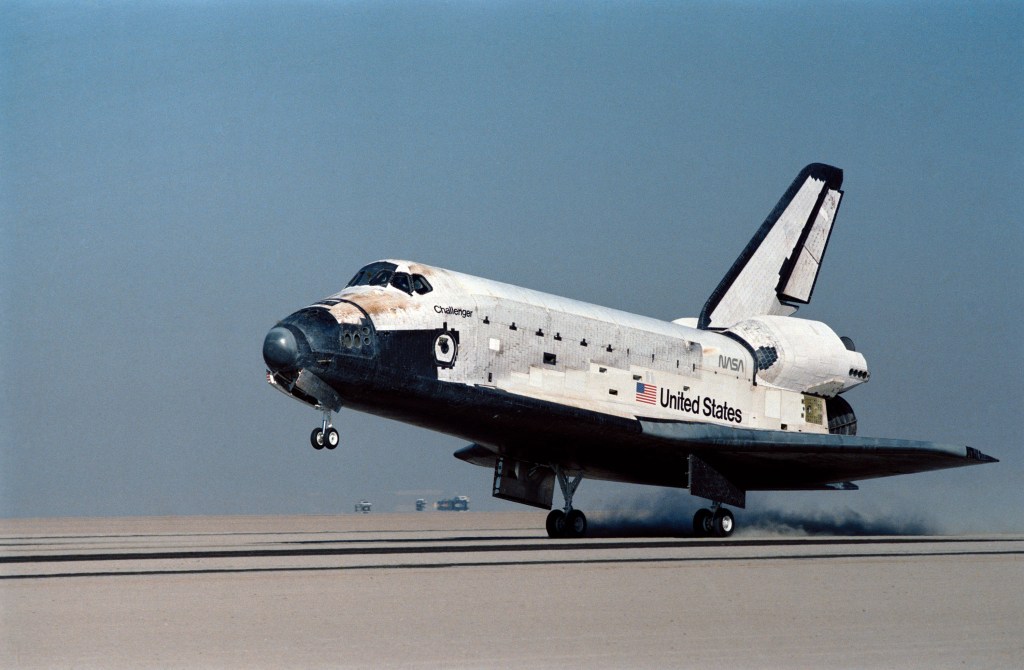
Image (Credit): Space shuttle Challenger landing at Edwards Air Force Base in California on Nov. 6, 1985. (NASA)

Here are some recent stories of interest.

NASA: “NASA Views Images, Confirms Discovery of Shuttle Challenger Artifact

NASA leaders recently viewed footage of an underwater dive off the East coast of Florida, and they confirm it depicts an artifact from the space shuttle Challenger. The artifact was discovered by a TV documentary crew seeking the wreckage of a World War II-era aircraft. Divers noticed a large humanmade object covered partially by sand on the seafloor. The proximity to the Florida Space Coast, along with the item’s modern construction and presence of 8-inch square tiles, led the documentary team to contact NASA.

Space.com:China Just Test-fired the Engine for its Huge New Moon and Mars Rocket

China has completed a first hot fire test of a fully-assembled powerful new engine that could power new launch vehicles and boost the country’s space capabilities. The full system test of the 500-ton-thrust, dual nozzle kerosene-liquid oxygen staged combustion cycle engine took place on Nov. 5, marking a milestone for the rocket engine. 

Phys.org:Cargo Ship Reaches Space Station Despite Jammed Solar Panel

A Northrop Grumman capsule delivered several tons of supplies to the International Space Station on Wednesday despite a jammed solar panel. The shipment arrived two days after launching from Virginia. Only one of the cargo ship’s two round solar panels opened following liftoff. Flight controllers tried in vain to open the stuck panel, but managed to draw enough power for the flight with just one.