Image (Credit): NASA’s Perseverance Rover on Mars. (NASA)
Now that we have learned a little more about China’s Martian rover, maybe we should check on NASA’s Perseverance Rover. According to a recent press release from NASA, earlier this month Perseverance started its three-mile trip to the river delta on the rim of Jezero Crater after already exploring the Martian surface for about 13 months. This delta may contain evidence of ancient microbial life. As with the Chinese rover mission, the collected samples will be returned to Earth via a later mission.
The Perseverance arrived on the Martian surface February 18, 2021. The mission has already shown success with the Ingenuity Helicopter, while the rover is showing greater abilities to self-navigate. All of this is proving to be promising for future robotic exploration of the planet.
You can get facts about the Perseverance mission here and ongoing updates here.
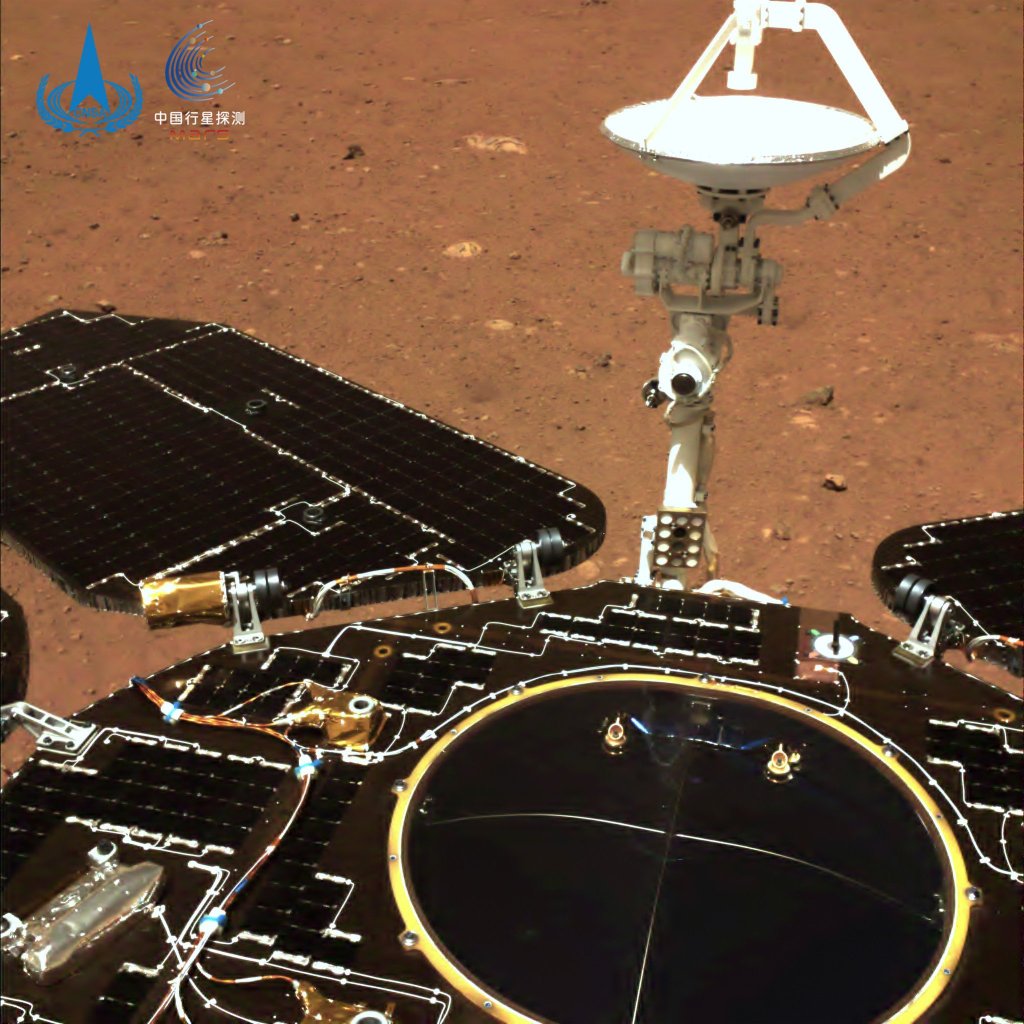
Image (Credit): Two images from China’s Martian Rover Zhurong. (CNCA)
The China National Space Administration (CNSA) Watcher site posted the above before and after selfies taken by the Zhurong Mars Rover. The top shot was taken on May 19, 2021 and the bottom shot on January 22, 2022. You can see the dust that has accumulated in less than a year on the rover’s panels. The site notes that the rover has the ability to vibrate and loosen the accumulated dust.
China launched Tianwen-1, which carried the rover, on July 23, 2020. It went into orbit around Mars in February 2021, with the Zhurong Rover landing on the Martian surface on May 14, 2021. China sent the rover to the Red Planet to find evidence of water. If all goes well, China hopes to bring a Martian samples back to Earth in a subsequent mission. The Planetary Society has some helpful information here on the Chinese mission.
Image (Credit): China’s Mars Rover Zhurong next to its landing platform on the surface of the red planet. (CNSA)
Image (Credit): Upcoming HBO movie Moonshot. (HBO)
On March 31st you can can watch another space-related movie, though this one has a misleading name. Called Moonshot, the setting is actually a space colony on Mars. You can watch a trailer of the HBO Max movie here.
While its just a platform for a young adult romantic comedy, it will be fun to see how the film portrays life on the Red Planet. Given that it includes a stowaway on the trip to Mars, you have to wonder what kind of space program these people are running when every pound of extra weight is critical.
Of course, Netflix already did the Mars mission stowaway story in last year’s film Stowaway.
So don’t think too hard. Just enjoy the spacecraft and scenery.
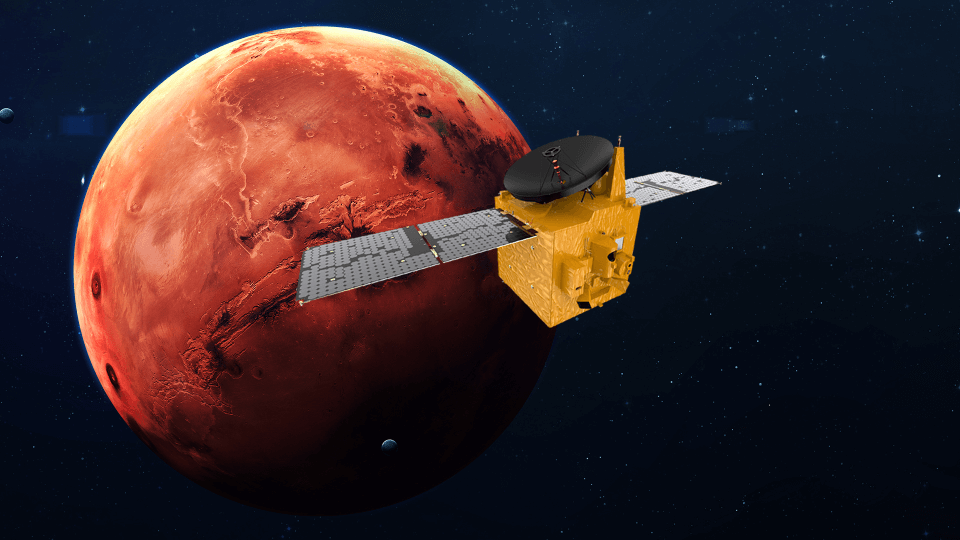
Image (Credit): Artist’s image of UAE’s Hope probe orbiting Mars. (UAE Space Agency)
You may want to visit Time magazine and view the article “The Woman Who Took the UAE to Mars.” It summarizes Sarah Al Amiri’s efforts related to the United Arab Emirates’ mission to Mars as well as her plans for the country’s space agency, which she now heads as Chairwoman.
Prior to becoming Chairwoman, Ms. Amiri was deputy project manager of a mission to map the Martian atmosphere. Her team, which was 80 percent female, developed the Hope probe to accomplish this goal. The probe was launched aboard a Japanese rocket in July 2020 and now orbits Mars. The data obtained from this mission is being shared openly to assist others studying the Martian atmosphere.
Another mission mentioned in the Time article by Chairwoman Amiri is a tour of seven asteroids as well as a flyby of Venus. A UAE space page defines the mission in this way:
The spacecraft will undertake a 3.6 billion-kilometre, five-year journey, which will see it perform gravity assist manoeuvres by orbiting first Venus, then Earth in order to build the velocity required in order to reach the main asteroid belt, located beyond Mars…The mission will study seven main belt asteroids…The mission will make its first close planetary approach orbiting Venus in mid-2028, followed by a close orbit of Earth in mid-2029. It will make its first fly-by of a main asteroid belt object in 2030, going on to observe a total of seven main belt asteroids before its final landing on an asteroid 560 million kilometres from Earth in 2033. This will make the Emirates the fourth nation to land a spacecraft on an asteroid.
What was not mentioned in the story but is available via another UAE government page is plans for several other space endeavors, including:
Sending a rover to the Moon in 2024. The rover’s name is Rashid, named in honor of the late Sheikh Rashid bin Saeed Al Maktoum, former Ruler of Dubai.
Establishing a settlement on Mars by 2117, and building a Mars Science City within the UAE to make this Martian mission possible.
Yesterday, the European Space Agency (ESA) announced that another space program has been impacted by the Russia’s invasion of Ukraine:
Regarding the ExoMars programme continuation, the sanctions and the wider context make a launch in 2022 very unlikely. ESA’s Director General will analyse all the options and prepare a formal decision on the way forward by ESA Member States.
The ESA website on the Exomars program notes that it is a two part mission searching for life on Mars: the Trace Gas Orbiter launched in 2016 and the Exomars rover and surface platform planned for launch in 2022. NASA also contributed to this latest mission:
NASA’s participation in the 2022 ExoMars Rover mission includes providing critical elements to the premier astrobiology instrument on the rover, the Mars Organic Molecule Analyzer (MOMA). By studying organic molecules, the chemical building blocks of life, MOMA is designed to help answer questions about whether life ever existed on Mars, along with its potential origin, evolution and distribution on the Red Planet.
The list of impacted space missions will only grow.






 Our Awesome Universe