Should We Return to Uranus?

Source/Credit: A NASA composite image of Uranus taken from Voyager 2 and the Hubble Space Telescope.

In an earlier posting, I highlighted some scientific papers calling for a return to Neptune rather than Uranus, in part because of Neptune’s moon Triton. But what is the argument for a mission to Uranus? Below I highlight one of the papers submitted to the Planetary Science and Astrobiology Decadal Survey 2023-2032 arguing the merits of a NASA mission to Uranus.

The paper, “The Science Case for Spacecraft Exploration of the Uranian Satellites,” states:

The large moons of Uranus are possible ocean worlds that exhibit a variety of surface features, hinting at endogenic geologic activity in the recent past. These moons are rich in water ice, as well as carbon-bearing and likely nitrogen-bearing constituents, which represent some of the key components for life as we know it. However, our understanding of Uranus and its moons is severely limited by the absence of data collected by an orbiting spacecraft…

An orbiter would vastly improve our understanding of these possible ocean worlds and allow us to assess the nature of water and organics in the Uranian system, thereby improving our knowledge of these moons’ astrobiological potential. A Flagship mission to Uranus can be carried out with existing chemical propulsion technology by making use of a Jupiter gravity assist in the 2030 – 2034 timeframe, leading to a flight time of only ~11 years, arriving in the early to mid 2040’s (outlined in the Ice Giants Pre-Decadal Survey Mission Study Report: https://www.lpi.usra.edu/icegiants/mission_study/Full-Report.pdf).

The five large moons discussed in the paper are Miranda, Ariel, Umbriel, Titania, and Oberon. Titania and Oberon where the first to be discovered back in 1787, followed by the later discoveries of Ariel, Umbriel, and Miranda (in that order). Unlike the moons of other planets, the moons of Uranus are named after magical spirits in English literature.

All of these ocean worlds have gained greater interest as we learn about the dynamics of life on of our own planet. As noted in an article in the MIT Technology Review:

It was once thought the solar system was probably a barren wasteland apart from Earth. Rocky neighbors were too dry and cold like Mars, or too hot and hellish like Venus. The other planets were gas giants, and life on those worlds or their satellite moons was basically inconceivable. Earth seemed to be a miracle of a miracle.

But life isn’t that simple. We now know that life on Earth is able to thrive in even the harshest, most brutal environments, in super cold and super dry conditions, depths of unimaginable pressures, and without the need to use sunlight as a source of energy. At the same time, our cursory understanding of these obscure worlds has expanded tremendously. 

We have plenty of worlds to explore in our own solar system as other scientists continue their search for exoplanets and exomoons. The only question now is which local worlds will we visit in our next round of space missions.

Is the U.S. Falling Behind in the Space Race?

Source/Credit: Yutu 2 rover on the dark side of the moon from the China National Space Administration.

As much as we talk about cooperation in space, it is always nice to be the first nation to pass a milestone, be it the first man on the Moon or the first probe of Pluto. The U.S. has plenty of great stories about space travel, as do the Russians, and now the Chinese are creating their own stories. For instance, China’s Yutu 2 rover was the first rover to explore the dark side of the Moon.

Now Politico magazine is worried about China taking the lead in some areas, as well as militarizing space. A recent article, “‘We’re falling behind’: 2022 seen as a pivotal lap in the space race with China,” discussed the race for the moon as well as delays in the U.S. spacecraft to get us there:

A linchpin of the NASA moon effort is the Space Launch System, the Boeing-built mega-rocket that has been beset by years of delay and cost overruns that is finally set to make its maiden test flight in 2022.

The U.S., Russia, and China all have designs on the moon:

The U.S. moon program has been enlisting international partners in the form of the Artemis Accords, which now includes more than a dozen countries. But Russia and China, which are pursuing a lunar research station, are also seeking partners.

We already know that the U.S. hopes to have astronauts on the Moon in 2024, so what are the Russian and Chinese schedules for their projects? It appears the two nations are working on a joint lunar research base scheduled for the 2030s. However, not everyone is convinced this will happen. A Foreign Policy article, “A Chinese-Russian Moon Base? Not So Fast,”voiced skepticism that the two nations can generate sufficient funding, technological know-how, and political unity to pull off such a mission, citing earlier joint attempts, including a Martian mission:

In 2007, China and Russia signed an agreement for “joint Chinese-Russian exploration of Mars,” culminating in a 2011 launch of a Mars orbiter and landing craft. However, the Russian rocket malfunctioned, causing Russian and Chinese spacecraft to come crashing back down to Earth, an embarrassing conclusion to both countries’ first attempt to reach the red planet.

The two nations seems to be even more unified against the U.S. since this Foreign Policy article was published, so anything is possible. However, the U.S. did pretty well in the 1960s and 1970s after initially trailing the Russians, so my money is still on the U.S. in this latest race.

Where Should NASA Travel To In The Years to Come?

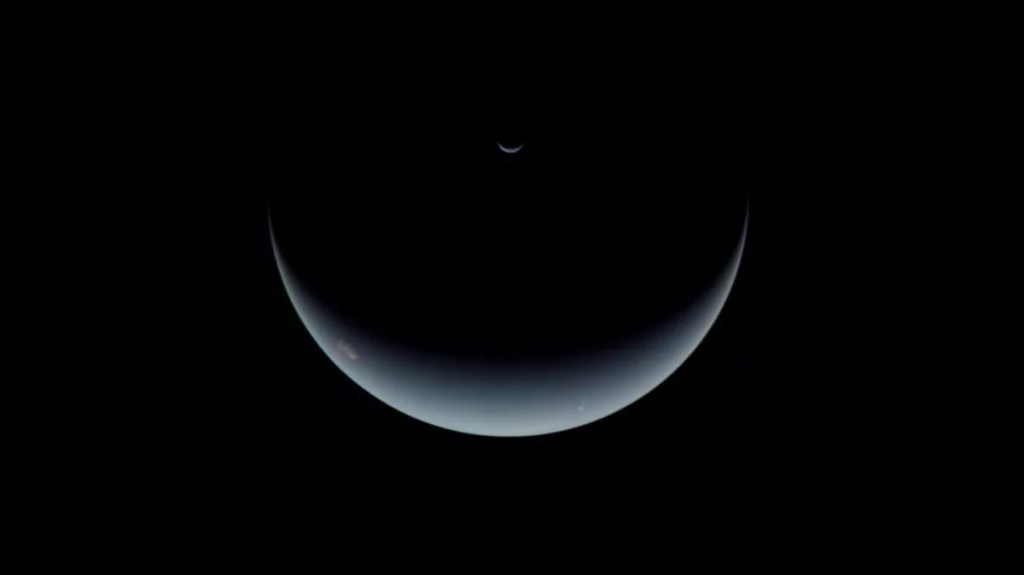
Source/Credit: Voyager 2 image of Neptune and Triton from NASA/JPL-Caltech/Björn Jónsson.

In a recent posting, the non-profit Planetary Society is recommending NASA consider a return to Neptune and its moon Triton, noting that such a mission was part of the plan in the last Decadal Survey in 2010 along with trips to Mars and Europa (both of which are underway). NASA was aiming for Uranus or Neptune, but the Planetary Society stated a preference for Neptune.

The last and only visit to Neptune back in 1989 with NASA’s Voyager 2 spacecraft providing our first close view of the planet. The Voyager 2 mission also led to the discovery of six new moons as well as four rings around the planet. Moreover, the mission detected what may be underground oceans on the moon Triton.

The Planetary Society believes Triton, most likely a captured object from the Kuiper Belt, should be the deciding factor for visiting Neptune rather than Uranus. A 2019 paper, “The NASA Roadmap to Ocean Worlds,” highlights the value of visiting Triton to learn more about its potential oceans:

Triton is deemed the highest priority target to address as part of an Ocean Worlds Program. This priority is given based on the extraordinary hints of activity shown by the Voyager spacecraft (e.g., plume activity; smooth, walled plains units; the cantaloupe terrain suggestive of convection)…and the potential for ocean-driven activity given by Cassini results at Enceladus. Although the source of energy for Triton’s activity remains unclear, all active bodies in the Solar System are driven by endogenic heat sources, and Triton’s activity coupled with the young surface age makes investigation of an endogenic source important. Further, many Triton mission architectures would simultaneously address Ice Giant goals on which high priority was placed in the Visions and Voyages Decadal Survey. Finally, as Triton likely represents a captured Kuiper Belt object (KBO), some types of comparative planetology with KBOs could also be addressed in a Triton mission. Before the next Decadal Survey, a mission study should be performed that would address Triton as a potential ocean world; such a study could be part of a larger Neptune orbiter mission. The Decadal Survey should place high priority on Triton as a target in the Ocean Worlds Program.

The next Decadal Survey is being prepared now and among the papers submitted for consideration is this one highlighted by the Planetary Society – “Neptune and Triton: A Flagship for Everyone.” This paper states that a large strategic mission, called a “Flagship Mission,” to Neptune and Triton would have may benefits:

A Flagship Mission to Neptune and Triton would provide many firsts, an orbiter and atmospheric probe would not only be feasible on a Flagship budget, but achievable given the current state of the technology required by such a venture. This bold mission of exploration would be the first to orbit an ice giant to study the planet, its rings, small satellites, space environment, and the planetsized moon, Triton, itself a captured dwarf planet from the Kuiper Belt and a geophysically reactivated twin of Pluto. Broadly, the mission would address the following questions: How do the interiors and atmospheres of ice giant (exo)planets form and evolve? What causes Neptune’s strange magnetic field, and how do its magnetosphere and aurora work? What are the origins of and connections between Neptune’s rings, arcs, and small moons? Is Triton an ocean world? What causes its plumes? What is the nature of its atmosphere? and how can Triton’s geophysics and composition expand our knowledge of dwarf planets like Pluto?

It sounds like a strong argument to me. I imagine the other 500 or so papers submitted as part of the upcoming Decadal Survey have some other great scientific missions in mind as well. I look forward to seeing the final recommendations to NASA.

Sidebar: The Artemis Mission

Source/Credit: Orion spacecraft from NASA.

With all the previous posts about NASA’s Artemis mission, I should have outlined the three stages ahead as we return to the Moon:

Artemis I: This stage involves an uncrewed flight test around the Moon. The new Space Launch System carrying the empty Orion spacecraft will launch from NASA’s Kennedy Space Center in Florida. The mission will last from four to six weeks. The European Space Agency has supplied a key piece for this mission – a service module, which will supply the spacecraft’s main propulsion system and power (and also house air and water for astronauts on future missions).

Artemis II: This next stage will confirm all of the Orion spacecraft’s systems operate as designed with crew aboard in the actual environment of deep space as the spacecraft circles the Moon. The mission is expected to last just over 10 days

Artemis III: This third and final stage will land a crew on the surface of the Moon. NASA has awarded Human Landing System contracts to Blue Origin, Dynetics, and SpaceX. This final stage will be followed by annual crewed missions to the Moon.

The ultimate goal of Artemis is to establish a presence on the Moon as well as build an orbiting Gateway that can serve as a multi-purpose outpost providing essential support for long-term human return to the lunar surface. The Gateway will also serve as a staging points for deep space exploration, such as travel to Mars.

This is a broad and hopeful mission. The only thing that seems a bit odd is the website mission statement for Artemis:

With Artemis missions, NASA will land the first woman and first person of color on the Moon, using innovative technologies to explore more of the lunar surface than ever before. We will collaborate with commercial and international partners and establish the first long-term presence on the Moon. Then, we will use what we learn on and around the Moon to take the next giant leap: sending the first astronauts to Mars.

I think the first focus of this multi-billion dollar lunar mission should be space exploration, which should also include a diverse crew. Maybe it is better to stick to the more universal statement in the earlier Artemis Plan:

Under the Artemis program, humanity will explore regions of the Moon never visited before, uniting people around the unknown, the never seen, and the once impossible. We will return to the Moon robotically beginning next year, send astronauts to the surface within four years, and build a longterm presence on the Moon by the end of the decade…we will use the Moon as the stepping stone for our next greatest leap—human exploration of Mars.

You say potato and I say spuds.

Source/Credit: Artemis I mission map from NASA.

Note: NASA’s Artemis page was somewhat out of date when I posted this summary. For instance, in April 2021, SpaceX was chosen to provide the lunar lander.

Update: On March 31st, NASA announced it was looking for “…other U.S. companies to provide new lander development and demonstration missions from lunar orbit to the surface of the Moon.”

Private Space Missions: Is Venus Next?

Source/Credit: Venus from Mattias Malmer/NASA/JPL..

NBC news reports that a privately-funding space probe could visit Venus as early as next year as phase one of a three-part mission. The goal of the Venus Life Finder Mission, involving MIT alumni and Rocket Lab, is to search for signs of life or microbial-type life. This effort is another encouraging sign of increased interest in scientific missions throughout the solar system.

An earlier press release on the Venus Life Finder site stated:

The Venus Life Finder Missions are a series of focused astrobiology mission concepts to search for habitability, signs of life, and life itself in the Venus atmosphere. While people have speculated on life in the Venus clouds for decades, we are now able to act with cost-effective and highly-focused missions. A major motivation are unexplained atmospheric chemical anomalies, including the “mysterious UV-absorber”, tens of ppm O2,  SO2 and H2O vertical abundance profiles, the possible presence of PH3 and NH3, and the unknown composition of Mode 3 cloud particles. These anomalies, which have lingered for decades, might be tied to habitability and life’s activities or be indicative of unknown chemistry itself worth exploring.  Our proposed series of VLF missions aim to study Venus’ cloud particles and to continue where the pioneering in situ probe missions from nearly four decades ago left off. The world is poised on the brink of a revolution in space science. Our goal is not to supplant any other efforts but to take advantage of an opportunity for high-risk, high-reward science, which stands to possibly answer one of the greatest scientific mysteries of all, and in the process pioneer a new model of private/public partnership in space exploration.

It has been more than a decade since a government has sent a mission to Venus. The last US mission to Venus was the Magellan launched in May 1989, which started to orbit Venus in 1990 and continued to do so for four years. The European Space Agency sent the Venus Express to the planet in November 2005, while Japan sent the Akatsuki in May 2010.

Interest continues among government parties. For example, just last year NASA announced two new missions to Venus:

DAVINCI+ (Deep Atmosphere Venus Investigation of Noble gases, Chemistry, and Imaging) to measure the composition of Venus’ atmosphere to understand how it formed and evolved, as well as determine whether the planet ever had an ocean. The mission consists of a descent sphere that will plunge through the planet’s thick atmosphere, making precise measurements of noble gases and other elements to understand why Venus’ atmosphere is a runaway hothouse compared the Earth’s. It will also will return the first high resolution pictures of the unique geological features on Venus known as “tesserae,” which may be comparable to Earth’s continents, suggesting that Venus has plate tectonics.

VERITAS (Venus Emissivity, Radio Science, InSAR, Topography, and Spectroscopy) to map Venus’ surface to determine the planet’s geologic history and understand why it developed so differently than Earth. In addition, it will map infrared emissions from Venus’ surface to map its rock type, which is largely unknown, and determine whether active volcanoes are releasing water vapor into the atmosphere. 

Source: Venuscloudlife.com.