China’s Space Program: The Next Five Years

Source: China National Space Administration.

On January 28th, China the released its five-year plan for its space program. Titled China’s Space Program: A 2021 Perspective, the paper addresses both accomplishments to date as well as how the China National Space Administration (CNSA) and China Manned Space (CMS) Program will build upon those accomplishments. China has plenty to be proud of, including multiple lunar missions with a sample successfully returned to Earth, a Mars mission with a rover, and efforts to finalize the nation’s first space station. The paper states, “From 2016 to December 2021, 207 launch missions were completed, including 183 by the Long March carrier rocket series.”

In terms of space exploration, in addition to sending more missions to the Moon, the paper states China plans to:

· Launch asteroid probes to sample near-earth asteroids and probe main-belt comets;

· Complete key technological research on Mars sampling and return, exploration of the Jupiter system, and so forth; [and]

· Study plans for boundary exploration of the solar system.

The paper also addresses planned progress in some of the other areas already discussed on this site, including limiting the amount of debris in space and monitoring what is already up there. For instance, China plans to work on “space debris cleaning,” improve its “space debris monitoring system,” and “actively participate in formulating international rules regarding outer space.” Such actions should benefit all spacefaring nations.

Check out the paper for more on China’s plans for the future.

Source: Chang’e-5 after returning to Earth with lunar samples. Image from the BBC.

Recommended Reading: Kim Stanley Robinson in The New Yorker

Source: Amazon.com.

The January 31st edition of The New Yorker has an article written by Joshua Rothman where he interviews Kim Stanley Robinson they hike through the Sierra mountains. The article,”Best-Case Scenario,” covers a lot of ground and has its ups and downs (sorry, I could not help myself). The Sierras offer a nice setting for experiencing the beauty of this strange planet while also scaring the reader about what may be lost as the hikers deal with the smoke of distant forest fires.

The two most prominent books discussed in the article are Mr. Stanley’s recent The Ministry for the Future and his 2015 novel Aurora, allowing the reader to appreciate both the uniqueness of this world as well as attempts by his characters to reach more distant worlds. I enjoyed reading both Aurora and Mr. Stanley’s Mars trilogy, but I should probably spend some time reading his works focusing on planet Earth. Mr. Stanley has made it clear that we need to preserve the one place in the universe that we know can host us. As he stated in BoingBoing back in 2015, “…there is no Planet B. Earth is our only home.”

With regard to expanding into our galaxy, in the same article he stated:

I’m not saying we shouldn’t go into space; we should. We should send people to the moon, and Mars, and the asteroids, and every place we can in the solar system, putting up stations and swapping humans in and out of them. This is not only a beautiful thing to do, but useful in helping us to design a long-term relationship with Earth itself. Space science is an Earth science. The solar system is our neighborhood. But the stars are too far away.

Mr. Stanley has spoken far and wide for some time about his novels, his views on space travel, and his concerns regarding our future. For more on all of this, you can try his Facebook page or this unofficial site. And you may want to check out some other articles in The New Yorker as well, such as this May 2021 piece, “Is Mars Ours?

Should We Name the Moon’s New Crater After Mr. Musk?

Source: SpaceX Rocket from NASA.

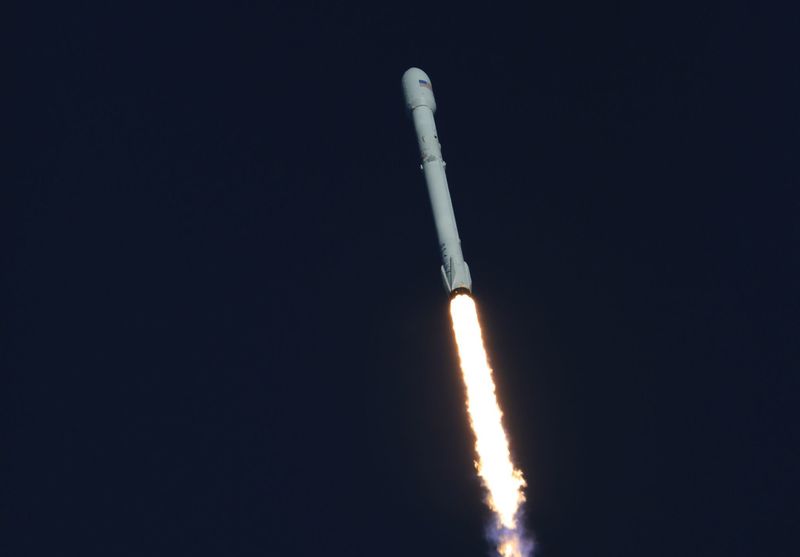
In the early days of March, a SpaceX rocket booster is expected to crash into the surface of the Moon just north of its equator. Part of a rocket launched in 2015, the booster has been floating around ever since.

In general, the Moon has not been used for trash storage beyond the lunar missions. Moreover, SpaceX likes to be known for landing its boosters back on Earth rather than sending them off into the wild blue (or black) yonder.

This could be an opportunity for SpaceX to claim it has created one of the first unintentional man-made craters on the Moon. The small crater could be known as the Musk Mini-Basin.

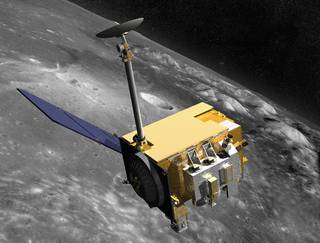
Luckily, Mr. Musk’s Tesla Roadster, launched in 2018, made it past the Moon with little incident (and then overshot Mars). We did not need an Elon Musk Parking Lot on the moon, yet the little red car would have been quite a sight for NASA’s Lunar Reconnaissance Orbiter (LRO).  

Source: LRO from NASA.

Extra: Visit this Sky & Telescope story for LRO images of the six Apollo landing sites on the Moon.

Update: Recent news indicates that the object about to hit the Moon is not a SpaceX rocket booster but rather a Chinese rocket part from the Long March 3C that launched the Chang’e 5-T1 lunar mission. I guess we will need to rethink the naming of that new crater.

NASA’s Travel Agency

Source: NASA’s Jet Propulsion Laboratory.

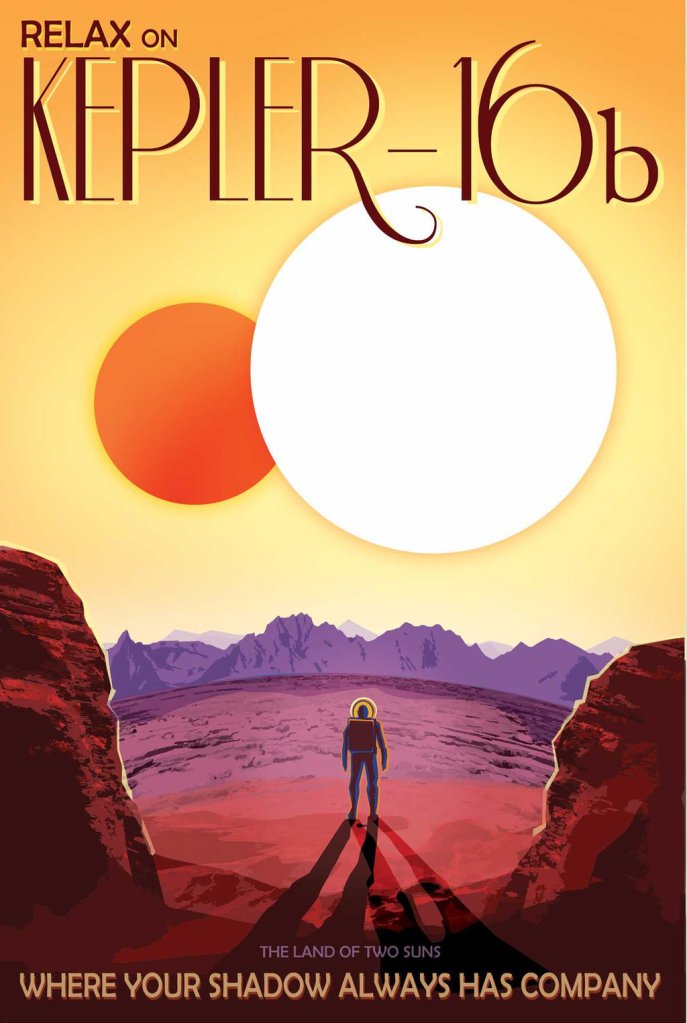
If you are getting tired of staying home these days, NASA has some fun destinations in mind for you. Late last year, NASA’s Jet Propulsion Laboratory (JPL) put together “Visions of the Future” to show you where the space agency hopes to go someday. You may not want to pack just yet, but whether it is this solar system or some other solar system, NASA wants to help.

The poster above for Kepler-16b comes with this enticing description:

Like Luke Skywalker’s planet “Tatooine” in Star Wars, Kepler-16b orbits a pair of stars. Depicted here as a terrestrial planet, Kepler-16b might also be a gas giant like Saturn. Prospects for life on this unusual world aren’t good, as it has a temperature similar to that of dry ice. But the discovery indicates that the movie’s iconic double-sunset is anything but science fiction.

You might also enjoy this NASA video showing some space activities in these prime locations.

I dropped in a few more posters below, but be sure to check out all of them. A big thanks also to the folks at JPL for these fun images. The 14 posters were created by nine artists, designers, and illustrators.

Of course, these free photos are already being sold on Etsy.com and elsewhere as posters and t-shirts.

Source: NASA’s Jet Propulsion Laboratory.

Whatever Happened to Mars-One?

Source: Artist’s impression of a Mars One community on Mars from MIT

I remember the image above from Mars One and thinking that maybe the private sector could find an innovative way to beat governments to Mars. I also remember the profiles of individuals volunteering for a one-way trip to Mars to be part of the proposed Martian colony. So much for that idea. Mars One ran out of money and appears to be little more than a website at this point, where you can read the following:

In 2016 Mars One ran out of funds and was unable to continue the selection program and the technical studies. In the years after that, several attempts were made to raise additional funds, but they were unsuccessful. Despite that, Mars One has had an impact on Mars exploration by promoting the idea of permanent settlement. We, Mars One’s co-founders, are still convinced that the first crews that go to Mars should (or will have to) go there to stay. 

So Mars One still believes a one-way trip is the best approach. If so, it appears Mars One did not have the secret for a very long existence on Mars. An MIT study discussing the venture said the new martians would have survived a short time before expiring as they attempted to grow their food:

As the air inside the habitat continued to leak, the total atmospheric pressure would drop, creating an oppressive environment that would suffocate the first settler within an estimated 68 days.

I am not sure how that would have helped the drive to Mars if the first spot we established was a graveyard.

So give Mars Once credit for keeping the dream alive, and even being optimistic about the technology someday appearing to make it possible, though not in time for its scheduled mission. Fortunately, it went out of business before derailing our hopes for a successful manned mission to Mars.

Source: Mars One.