A 4-billion-year-old meteorite from Mars did not show any signs of life, according to The Guardian newspaper. That said, the 4-pound rock found in Antarctica in 1984 that presumably broke off of Mars’ surface billions of years ago does have compounds that could lead to life.
More samples should be on their way if NASA’s Perseverance Rover mission on Mars can assist with the return of Martian samples back here to Earth for additional study. So there is still hope that we will find more interesting results down the road.
Extra: The origin (now debunked) story on this rock from a NASA research team of scientists at the Johnson Space Center, Houston, TX, and at Stanford University, Palo Alto, CA, was titled “Meteorite Yields Evidence of Primitive Life on Early Mars.”
This week Amazon Prime released the final episode of the The Expanse, a brilliant space drama that has been running for six seasons, first on Syfy and later on Amazon Prime. Based on a series of books written by James S. A. Corey (a two-person team), it tells the story of a settled solar system where the old problems dividing all of us are simply moved onto a larger playing field. Mars and Earth are jockeying for power while the miners in the asteroid belt creating the necessary resources feel forgotten and abused. War ensues as does new discoveries (and related weapons), which simply get folded into the ongoing battles. And the playing field widens again as a portal, called the Ring, gives the warring factions access to more star systems and planets.
The television series is a wonder to watch, with excellent acting, fantastic story-lines, and the creative use of venues in our solar system, from Ceres in the asteroid belt to the various moons of Jupiter, Saturn, and Uranus. It is also a very dark show as it illustrates an ugly side to our expansion into new worlds – ruthless ambition, terrorism, revolution, and civil war.
I have not seen anything like it since the remake of Battlestar Galactica, and I would put it on the same level (with some better special effects given the time that has passed). But the most important part is the characters, and you will find a team in the center of this series that you would follow anywhere.
If you are new to the series, you are in for a lot of fun. If you are finishing the series like me and you have only experienced the television show, I think the next step is to dig into the books to live in this world a little longer.
This week’s photo is from the Planetary Society’s Year in Pictures collection. The photo shows NASA’s latest Mars rover, Perseverance, as well as the helicopter Ingenuity in the background (hard to see at first). A better image of the helicopter is provided below. The rover landed on Mars in February 2021 at the Jezero Crater and has been conducting science ever since that time. NASA plans to send some of the Perseverance’s soil samples back to Earth for more study. You can learn more about this Mars mission here.
If you are looking for a new podcast, or just want to listen to an interesting conversation, I recommend BBC’s recent Inside Science episode about human travel to the Moon and Mars. Titled “A New Space Age?,” the December 30, 2021 episode discusses NASA’s Artemis lunar program, the timetable for travel to Mars, and whether or not we even need to send humans into space.
Dr. Kevin Fong leads a panel of experts to discuss these topics:
— Dr. Mike Barratt, a senior NASA astronaut and medical doctor based at the Johnson Space Center;
— Dr. Anita Sengupta, Research Associate Professor in Engineering at the University of Southern California; and
— Oliver Morton, Briefings editor at the Economist and author of several books on the Moon and Mars.
If you enjoy the conversation, you may want to look around a few of the other episodes as well, such as the December 16, 2021 episode on the James Webb Space Telescope.
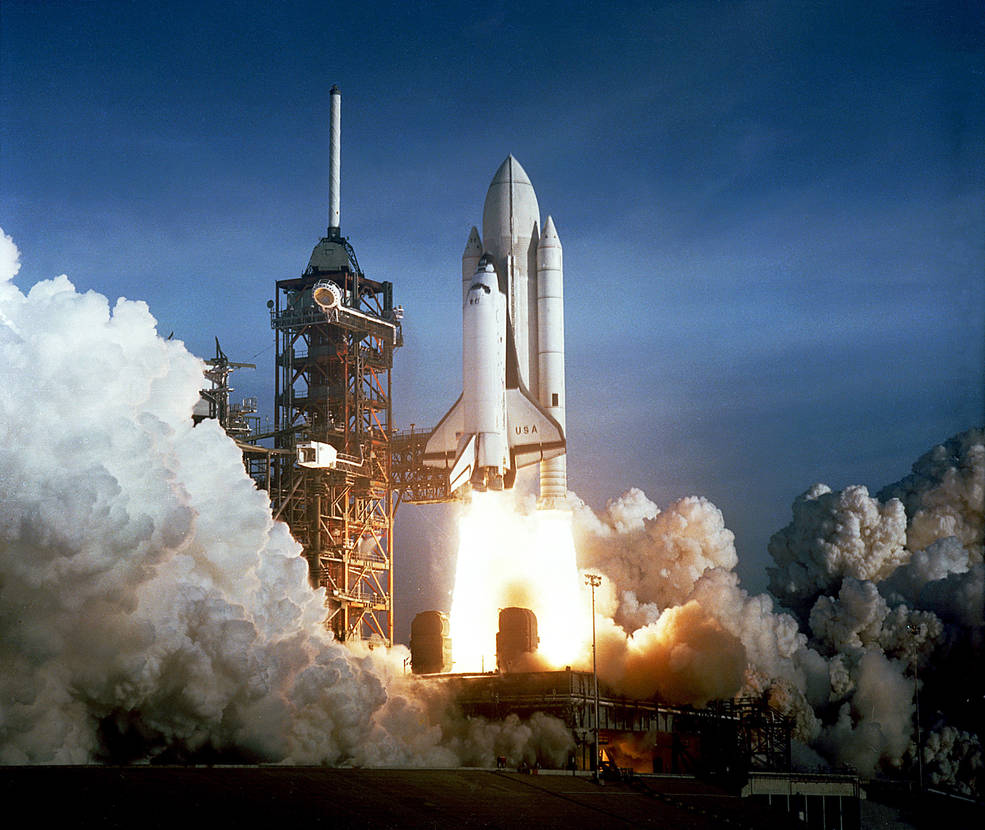
Source: NASA imagine showing Space shuttle Columbia lifting off from Launch Pad 39A on April 12, 1981, to begin STS-1.
Earlier his week NASA highlighted the 50 year anniversary of President Nixon’s decision to initiate a space shuttle program to follow the success of the Apollo Moon missions. The story states:
In January 1972, he directed NASA to develop and build a reusable space transportation system, commonly known as the space shuttle. The reusability of the shuttle’s components was expected to provide regular access to space to many customers, while at the same time reducing costs.
The space shuttle was proposed by the National Aeronautics and Space Council, which also proposed a trip to Mars. The Council’s report states:
As a focus for the development of new capability, we recommend the United States accept the long-range option or goal of manned planetary exploration with a manned Mars mission before the end of this century as the first target.
While the space shuttle was eventually operational by 1981, we still await a clear timeline for a trip to Mars. NASA said it will start with a trip back to the Moon first. Let’s hope we do not need to wait another 50 years before a manned trip to Mars.


 Our Awesome Universe