With all of the current chaos related to NASA funding, one might think America has moved away from its previous support for space missions. However, a poll reported last month by CBS News tells a different story.
As shown in the image above, 67 percent of Americans polled by CBS News and YouGov are in favor or NASA returning astronauts to the Moon, and 65 percent feel the same way about a trip to Mars.
This is encouraging yet may not be enough to save NASA as it faces severe budget cuts and the loss of thousands of employees.
Some might say that the cuts are unrelated to the Moon and Mars missions, which are still being funded by the White House. However, that does not matter. NASA is losing expertise in all areas while its employees feel harassed and unappreciated. It is hard to build a successful space program on top of this disarray.
If so many Americans believe we should be back on the Moon and travel to Mars, how will they feel should China beat us to one or both? How will the current White House be viewed?
Maybe that is what should keep the White House and others proposing these drastic cuts up at night.
Image (Credit): International partners empowering NASA’s mission on Mars. (US Embassy & Consulates in Italy)
While spreading out the manned missions to the International Space Station (ISS) among various private sector partners sounded like a great idea, it has proven less than perfect. First we had to worry about the emotional stability of SpaceX’s CEO, and now we need to worry about the financial viability of Boeing, the only other company on a path to bring astronauts to the ISS.
…faced challenges including labor actions, production delays, quality control problems, and financial losses on government contracts. Given Boeing’s importance to the defense industrial base, Congress may assess whether or not these developments have implications for U.S. national security…Some analysts have speculated that Boeing could declare bankruptcy or seek to sell elements of its space or defense business.
One of the author’s suggestions is for the US government to expand its contracting efforts with “trusted international companies.” While the article is focused on the defense realm, it sounds like a good idea for the space realm as well.
The major US space goals already include our trusted international partners, such as the ISS, Artemis and Mars programs, so none of this much of a stretch. Maybe it just needs to be more of the focus as the current US firms show their vulnerabilities when poorly managed. I would add to this list the need to offer greater support to other, newer US-based space companies to further diversity the workload.
This may not be a time to call for greater international coordination led by NASA when the agency is also showing its vulnerabilities when poorly managed, yet we need to plan for future days when the craziness dies down. In the meantime, as Europe prepares for NASA cuts to joint programs, we have a lot of convincing to do if we want a deeper international space industry.
A new administrator for NASA may help, as well as a Congress that does its job and protects the future of our space programs.
I don’t care if you call it “Make the Moon the Goal Again.” Just get started.
Last Thursday, former NASA astronaut Jim Lovell passed away at the age of 97. Mr. Lovell was one of the first astronauts to orbit the Moon in Apollo 8, and he also commanded the Apollo 13 mission around the Moon under great stress after the onboard explosion of an oxygen canister. While the crew was unable to complete its mission by landing on the Moon, he was able to safely bring his crew back to Earth.
In commenting on the Apollo 13 mission, Mr. Lovell later said ““It was plagued by bad omens and bad luck from the very beginning.” Even so, he was part of a long tradition of trial and error as the U.S. stretched itself and eventually ferried men and supplies to the lunar surface. The deaths of three astronauts in the Apollo 1 capsule had shown the world that a mission to the Moon was a dangerous gamble.
Mr. Lovell took his chances and we are all the better for it. He also stated:
There are people who make things happen, there are people who watch things happen, and there are people who wonder what happened. To be successful, you need to be a person who makes things happen.
He made things happen.
You can read more on Mr. Lovell’s life and career at these sites:
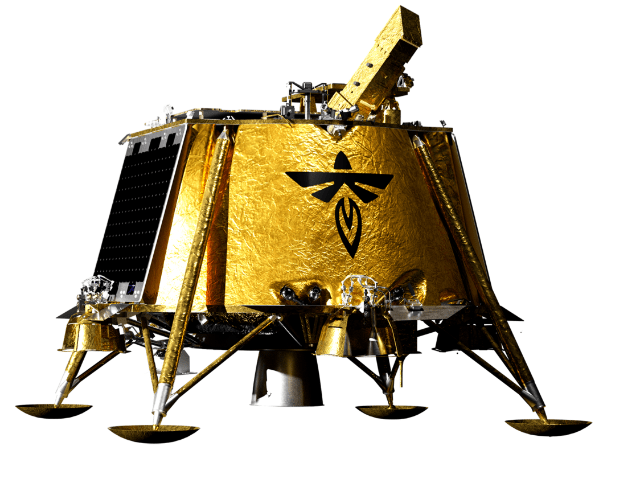
Image (Credit): The Blue Ghost lunar lander. (Firefly Aerospace)
Firefly Aerospace, the Texas-based company that successfully put a lander on the Moon earlier this year, is now having success with the stock market as well. It’s initial public offering (IPO) earlier this week led to a valuation of about $6 billion for the company. The sale provided Firefly with about $868 million in new funds to supports its ongoing efforts.
Firefly Aerospace has seen contracts roll in after its recent lunar success. For example, just last month NASA awarded the company a $177 million Commercial Lunar Payload Services contract. The contract calls for Firefly to deliver NASA-sponsored payloads to the lunar South Pole in 2029.
After the award last month, CEO Jason Kim stated:
Firefly is honored to support another NASA CLPS task order as a proven, reliable partner for robotic missions to the Moon…Following our first Blue Ghost mission that made history just a few months ago, this bold Firefly team proved we have the right mix of grit, innovation, and dedication to not only stick the landing, but also complete all scientific objectives for our payload partners. We’ve set the bar high, and we aim to continue setting new records in our missions to come with our active production line of Blue Ghost landers.
This is good news for other companies striving for a piece of the space industry. Now we just need to ensure NASA remains a reliable partner for Firefly Aerospace and others who have proven they can get the job done.
The Trump administration has asked NASA employees to draw up plans to end at least two major satellite missions, according to current and former NASA staffers. If the plans are carried out, one of the missions would be permanently terminated, because the satellite would burn up in the atmosphere. The data the two missions collect is widely used, including by scientists, oil and gas companies and farmers who need detailed information about carbon dioxide and crop health. They are the only two federal satellite missions that were designed and built specifically to monitor planet-warming greenhouse gases.
Acting NASA Administrator Sean Duffy has directed the agency to fast-track plans to put a nuclear reactor on the moon. Expediting work to place a reactor on the lunar surface to help power moon exploration efforts would keep the United States ahead of China and Russia, both of which have “announced on at least three occasions” a joint effort to develop such a project by the mid-2030s, according to a directive dated July 31 and obtained by CNN.
NASA’s Lunar Trailblazer ended its mission to the Moon on July 31. Despite extensive efforts, mission operators were unable to establish two-way communications after losing contact with the spacecraft the day following its Feb. 26 launch. The mission aimed to produce high-resolution maps of water on the Moon’s surface and determine what form the water is in, how much is there, and how it changes over time. The maps would have supported future robotic and human exploration of the Moon as well as commercial interests while also contributing to the understanding of water cycles on airless bodies throughout the solar system.




 Our Awesome Universe