Moon Rock Moves from White House

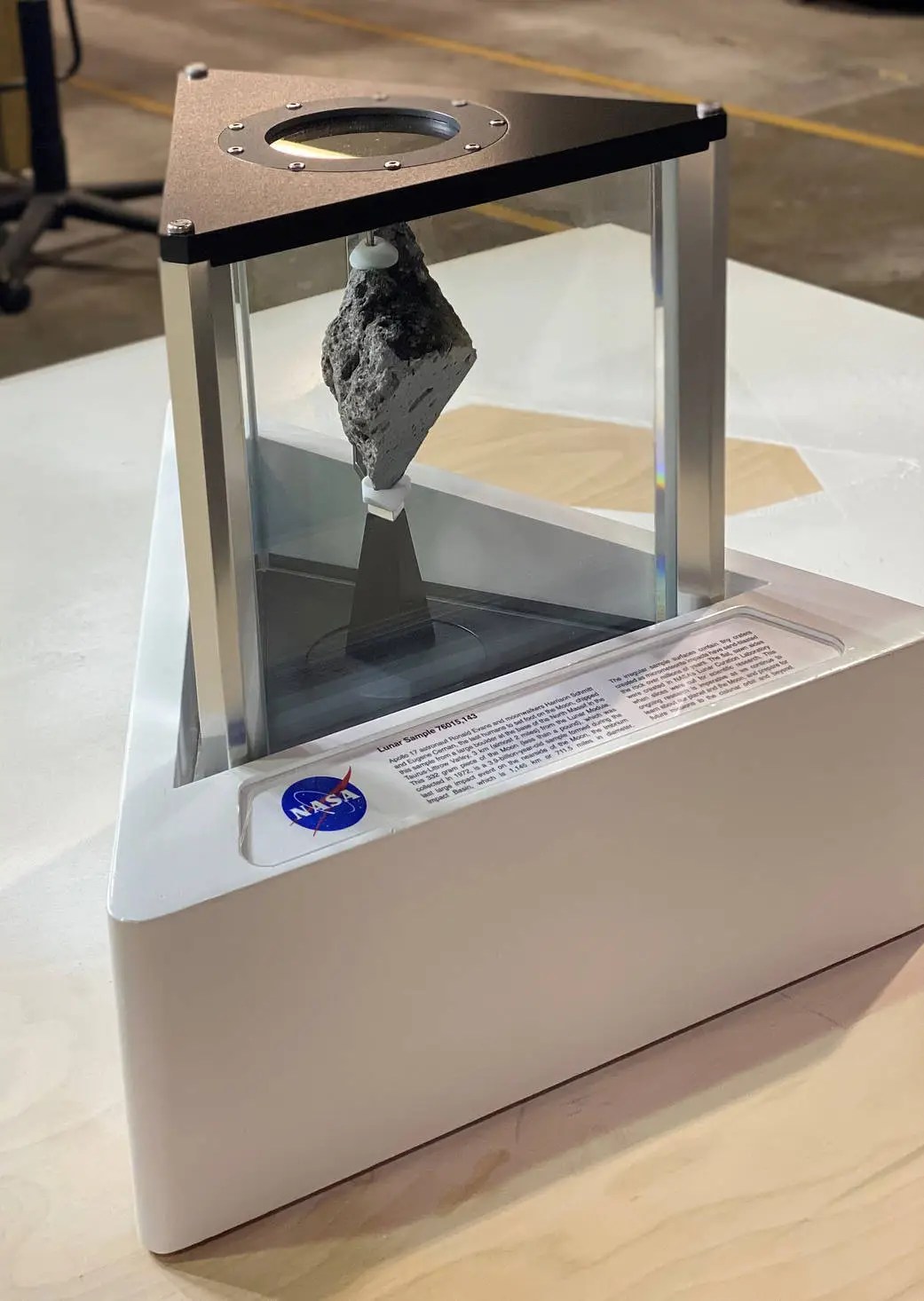
Image (Credit): Moon rock loaned to the White House by NASA. (NASA)

As the new administration decorates the White House’s Oval Office, it was determined that a lunar rock no longer needs to be present. The rock from the last Apollo mission, labeled “Lunar Sample 76015,143.” was provided to the Biden administration back in 2021 to remind him of U.S. efforts to return to the Moon.

The inscription on the Moon rock reads:

Apollo 17 astronaut Ronald Evans and moonwalkers Harrison Schmitt and Eugene Cernan, the last humans to set foot on the Moon, chipped this sample from a large boulder at the base of the North Massif in the Taurus-Littrow Valley, 3 km (almost 2 miles) from the Lunar Module. This 332 gram piece of the Moon (less than a pound), which was collected in 1972, is a 3.9-billion-year-old sample formed during the last large impact event on the nearside of the Moon, the Imbrium Impact Basin, which is 1,145 km or 711.5 miles in diameter.

The irregular sample surfaces contain tiny craters created as micrometeorite impacts have sand-blasted the rock over millions of years. The flat, sawn sides were created in NASA’s Lunar Curation Laboratory when slices were cut for scientific research. This ongoing research is imperative as we continue to learn about our planet and the Moon, and prepare for future missions to the cislunar orbit and beyond.

So does this mean the Moon is out, or did it not match the new drapes? Or is President Trump hoping to add his own Moon rock to his office after a successful Artemis mission?

It is not clear where the Moon stands in the current priorities of this White House given its ongoing efforts to push NASA employees into retirement or resignation, end scientific meetings, and eliminate all efforts at diversity at the agency.

Maybe Mars is the new target, but even that seems further off as Elon Musk burrows into government programs he know nothing about while the latest Starship disintegrated over the Caribbean.

Space missions take focus, which seems to be elsewhere at the moment.

Maybe the rock should stay in the Oval Office for the time being to remind the current administration what our country can do when it has a president with a vision that brings everyone together to accomplish an amazing task.


Space Stories: NASA Kills Student Program, NASA Science Groups Stalled, and Moon Mission Untouched So Far

Credit: Image by Maicon Fonseca Zanco from Pixabay

Here are some recent stories of interest related to changes at NASA.

Science: DEI Order Grounds NASA Program to Link Undergraduates with Mission Scientists

At NASA, officials are moving quickly to comply with President Donald Trump’s executive order directing agencies to cease funding for diversity, equity, and inclusion (DEI) programs. NASA has already informed researchers supported by one high-profile program for undergraduate students that several of the agency’s spacecraft contractors will no longer take part in the program, following the agency’s guidance. And NASA has warned the researchers that it is likely to kill grants that have already been awarded.

Space News: NASA Pauses Work of Science Groups, Citing Trump Executive Orders

NASA has directed a set of science committees to pause their work, citing recent Trump administration executive orders, a move that canceled one meeting and put planning for others on hold. NASA Headquarters sent memos Jan. 31 to the leaders of several committees, known as “analysis groups” or “assessment groups,” that provide input to the agency’s astrophysics and planetary science divisions. The memo said NASA needed to determine if the groups’ activities complied with new executive orders.

Orlando Sentinel: Despite DEI Demise, NASA Still Touts Goal to Land 1st Woman, 1st Person of Color on Moon

NASA continues to highlight goals of landing the first woman and first person of color on the lunar surface even amid the agency’s recent shutdown of diversity, equity and inclusion programs — also known as DEI — under executive orders from President Trump. “With NASA’s Artemis campaign, we are exploring the moon for scientific discovery, technology advancement, and to learn how to live and work on another world as we prepare for human missions to Mars,” reads the Artemis mission statement on NASA’s website. “We will collaborate with commercial and international partners and establish the first long-term presence on the moon. NASA will land the first woman, first person of color, and first international partner astronaut on the moon using innovative technologies to explore more of the lunar surface than ever before.” The announcement NASA would send the first woman to the moon came under Trump’s first presidency.

NASA Gets to Work Under the New Administration by Shutting Down DEI

Almost the first words the NASA employees heard from their acting administrator was the end of the diversity, equity, and inclusion (DEI) efforts within the agency.

In an email earlier today, Acting NASA Administrator Janet Petro stated, in part:

Notice the use of “Radical” in the executive order and the Office of Personnel Management email address including “truth,” favorite words of the incoming administration. Are we using federal dollars for this latest “witch hunt” (to use more of the favorite words)? None of this will help to calm the fears of hard-working NASA employees trying to focus on space missions rather than the political silliness in Washington, DC.

It does make you wonder what is coming down the road. For example, the Artemis mission on NASA’s website is pretty clear in terms of what it hopes to accomplish:

Will the goal of landing the first woman, person of color, and international partner be seen as encouraging too much diversity? The Artemis II crew, shown below, already meets the mission profile, but maybe that will change with the Artemis III crew that lands on the Moon. At this point, it would not be too surprising ito find the Artemis III crew consists of four white billionaires using a rover as a golf cart to hit balls across the lunar surface.

We’ll see what happens, as they say.

Image (Credit): NASA’s Artemis II mission crew (left to right): NASA astronauts Christina Hammock Koch, Reid Wiseman (seated), Victor Glover, and Canadian Space Agency astronaut Jeremy Hansen. (NASA)

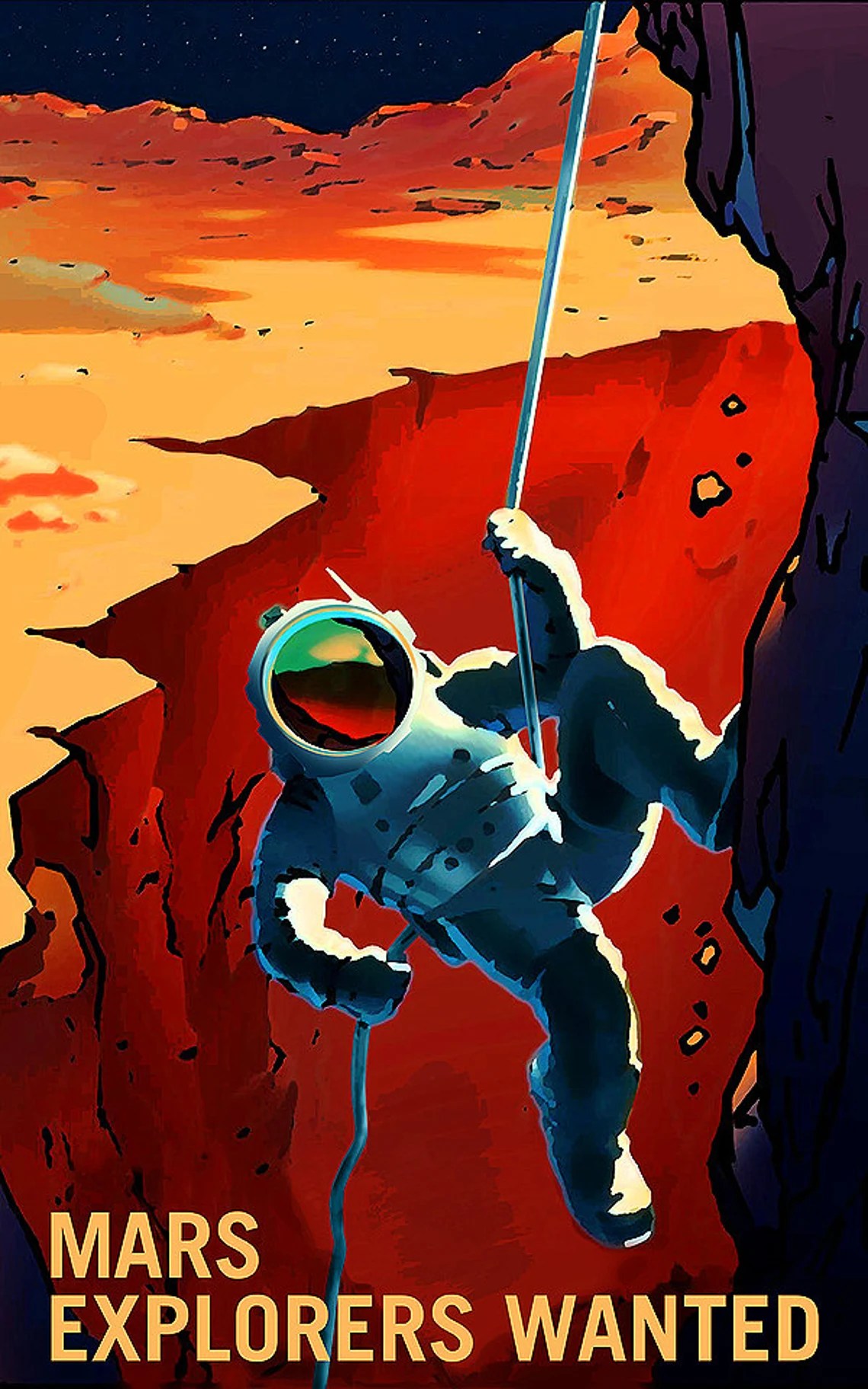
Space Quote: Next Step Mars?

Credit: NASA

“We will pursue our manifest destiny into the stars, launching American astronauts to plant the Stars and Stripes on the planet Mars.”

-Inaugural statement by President Trump on January 20, 2024. He may want to check with NASA on the Artemis program given that the planned trip to the Moon has already cost taxpayers billions of dollars. He might also want to read a recent Politico story that discusses congressional preference for a Moon first program. The story quotes Texas Republican Brian Babin, who stated, “To bypass the moon would be a mistake.” It might also look bad to give the Moon to the Chinese long before we figure out a way to safely get to Mars. For all of Musk’s talk on this matter, the loss of a Starship rocket last week was not encouraging. We are having trouble enough getting ready to return to the Moon.

A Day in Astronomy: Birth of Edgar Allan Poe

Image (Credit): Illustration for Edgar Allan Poe’s “The Unparalleled Adventure of One Hans Pfaall” in Jules Verne’s “Edgar Poe et Ses Oeuvres.” (Musée des Familles magazine from Pari in 1864, courtesy of the Bibliothèque Nationale de France)

On this day in 1809, Edgar Poe was born in Boston, MA. “Allan” was added later as his middle name after he lost both parents and was taken in by the Allan family. He would only live for 40 years, but in that short time he created a wealth of stories that are still fresh in the minds of all of us, be it The Raven or The Fall of the House of Usher.

While many may think only of Gothic fiction when hearing the name Edgar Allan Poe, you should add astronomy to that list given Mr. Poe 1835 short story titled The Unparalleled Adventure of One Hans Pfaall. In this tale, his main character spends 19 days traveling to the Moon in a balloon and sends back a letter detailing his exploits.

This simple story may have inspired the Great Moon Hoax in 1935 about a massive telescope sighting strange beasts on the lunar surface, including zebras and unicorns. More importantly, it may have inspired Jules Verne to write From the Earth to the Moon, which was published in 1865.

The short story itself is somewhat dry and filled with calculations, as is the case with From the Earth to the Moon. As far as Mr. Pfaall’s findings once arriving on the Moon, you will learn little about the lunar inhabitants he discovered nor the Moon itself (you can read the entire story here).

This is just an example of how he defines the Moon’s inhabitants:

I had barely time to observe that the whole country, as far as the eye could reach, was thickly interspersed with diminutive habitations, ere I tumbled headlong into the very heart of a fantastical-looking city, and into the middle of a vast crowd of ugly little people, who none of them uttered a single syllable, or gave themselves the least trouble to render me assistance, but stood, like a parcel of idiots, grinning in a ludicrous manner, and eyeing me and my balloon askant, with their arms set a-kimbo.

While it’s not The Martian Chronicles, it still represents Poe’s curiosity about lunar travel distilled into a single tale. It also became the starting point for all of the fantastic science fiction that followed to this day.