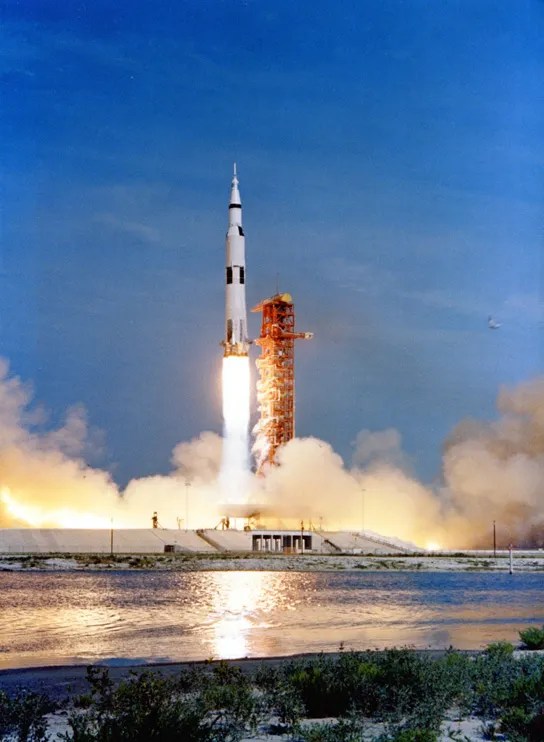
Image (Credit): The launch of the Apollo 11 space vehicle from the launch pad on July 16, 1969. (NASA/ Kipp Teague)
On this day in 1969, NASA launched the Saturn V rocket that carried astronauts Armstrong, Edwin “Buzz” Aldrin, and Michael Collins on the first manned lunar landing. The 363-feet tall Saturn V rocket was launched from Pad A, Launch Complex 39, Kennedy Space Center, at 9:32 a.m. EDT.
While this was the most significant use of the Saturn V at that point in time, it was the backbone of the Apollo program. The first crewed Saturn V to launch was Apollo 8, which orbited the Moon without landing.
You can listen in on the control room chatter surrounding the launch at this NASA launch history site.
NASA has a number of events planned for this month to celebrate the 55th anniversary of the Moon landing. You can read about the planned activities at this NASA anniversary site.
This weekend you can see a space-related movie, but it is light fare that probably should have been released on Apple TV+.
Fly Me to the Moon is a romantic comedy centered on an Apollo 11 Moon mission starring Scarlett Johansson and Channing Tatum. All you need to know is shown in this trailer.
Dramatizing the Apollo 11 mission is fine, but the part of the story about trying to fake the Moon landing does not seem necessary, particularly nowadays when conspiracy kooks are around every corner.
The movie Capricorn One about a fake landing on Mars had a time and a place in a troubled America, but the use of a fake landing here is just a cheap stunt adding little value to the film.
Luckily, real life drama can be so much better than Hollywood drama. I think I will skip this movie and watch Apollo 13again.
If you are interested in the future of humanity on Mars, you may want to tune into Red Planet Radio from The Mars Society. A recent podcast, as well as an upcoming podcast, highlight some things to consider before you pack your bags.
Back on June 15, in the podcast titled “Dr. Antonio Paris, Astrophysicist, Author “Mars: Your Personal 3-D Journey!,” we heard from Dr. Antonio Paris, who is the Chief Scientist at the Center for Planetary Science as well as an Assistant Professor of Astronomy and Astrophysics at St. Petersburg College, Florida. In this podcast, Dr. Paris discussed the difficulties of traveling in space as well as the types of structures one might need to build to live safely on Mars. He also discussed his recent book, Mar: Your Personal 3D Journey to the Red Planet.
Tomorrow (July 2) another podcast episode will include a three-person NASA panel discussing topics such as general Mars exploration, strategies for sample returns from the Red Planet, and the architecture supporting Moon to Mars missions.
The three panelists are:
Nujoud Merancy: Deputy Associate Administrator, Strategy and Architecture Office, in the Exploration Systems Development Mission Directorate for NASA Headquarters.
Eric Ianson: Deputy Director, Planetary Science Division, and Director, Mars Exploration Program and Radioisotope Power Systems Program at NASA Headquarters.
Dr. Lindsay Hays: Program Scientist in the Planetary Science Division at NASA Headquarters and Deputy Program Scientist for the Mars Sample Return Mission.
I enjoyed the first episode and look forward to tomorrow’s discussion.
And don’t forget that from August 8-11 The Mars Society will hold its 27th Annual International Mars Society Convention at the University of Washington in Seattle, Washington. You can see videos from prior conventions here.
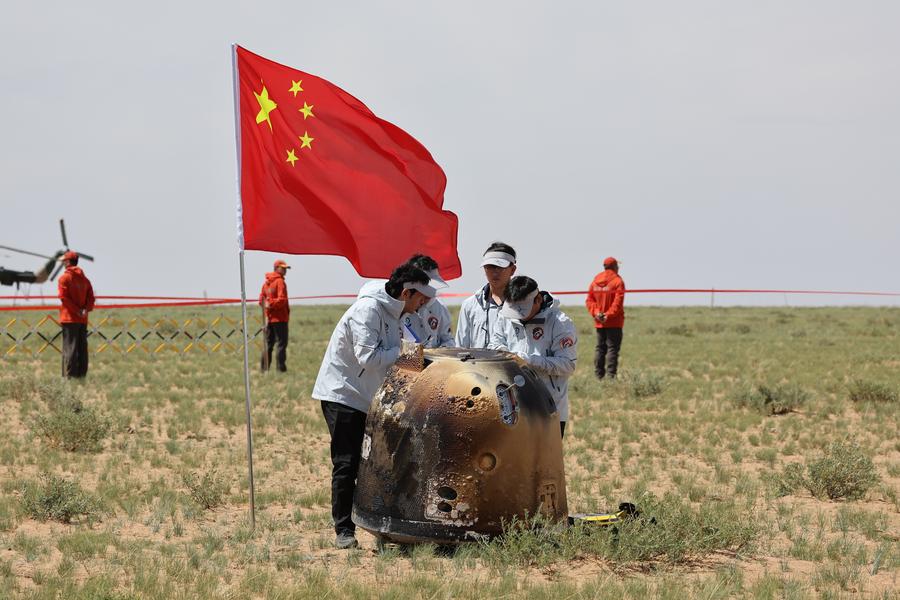
Image (Credit): The capsule retrieval site in north China’s Inner Mongolia Autonomous Region. (Xinhua/Jin Liwang)
It was a good day for China as it became the first nation to successfully retrieve a lunar sample from the far side of the Moon. The Chang’e-6 return capsule safely landed in China earlier today following the mission’s start back on May 3. The sample itself departed the Moon’s surface on June 4.
Wang Qiong, deputy chief designer of the Chang’e-6 mission, stated:
A portion of the samples will be stored permanently, while another portion will be stored at a different location as backup in case of disasters. Then we will prepare the remaining portion, and distribute them to scientists in China and foreign countries in accordance with the lunar sample management regulations.
Congratulations to the Chinese people. Hopefully, the entire scientific community can benefit from what the lunar sample tells us.
NASA and SpaceX are planning for the possibility of modifying the Artemis III mission. Instead of landing on the Moon, a crew would launch in the Orion spacecraft and rendezvous with Starship in low-Earth orbit. This would essentially be a repeat of the Apollo 9 mission, buying down risk and providing a meaningful stepping stone between Artemis missions. Officially, NASA maintains that the agency will fly a crewed lunar landing, the Artemis III mission, in September 2026. But almost no one in the space community regards that launch date as more than aspirational. Some of my best sources have put the most likely range of dates for such a mission from 2028 to 2032. A modified Artemis III mission, in low-Earth orbit, would therefore bridge a gap between Artemis II and an eventual landing.
The satellite galaxy Crater II (or Crater 2) of the Milky Way is located approximately 380,000 light-years away from Earth in the constellation of Crater. This galaxy is extremely cold and exceptionally diffuse, and has low surface brightness. According to new research, Crater II exists thanks to a self-interacting dark matter.
Using NASA’s Chandra X-ray Observatory and ESA’s (European Space Agency’s) XMM-Newton, astronomers are exploring whether nearby stars could host habitable exoplanets, based on whether they emit radiation that could destroy potential conditions for life as we know it. This type of research will help guide observations with the next generation of telescopes aiming to make the first images of planets like Earth. A team of researchers examined stars that are close enough to Earth that future telescopes could take images of planets in their so-called habitable zones, defined as orbits where the planets could have liquid water on their surfaces. Any images of planets will be single points of light and will not directly show surface features like clouds, continents, and oceans. However, their spectra — the amount of light at different wavelengths — will reveal information about the planet’s surface composition and atmosphere.




 Our Awesome Universe