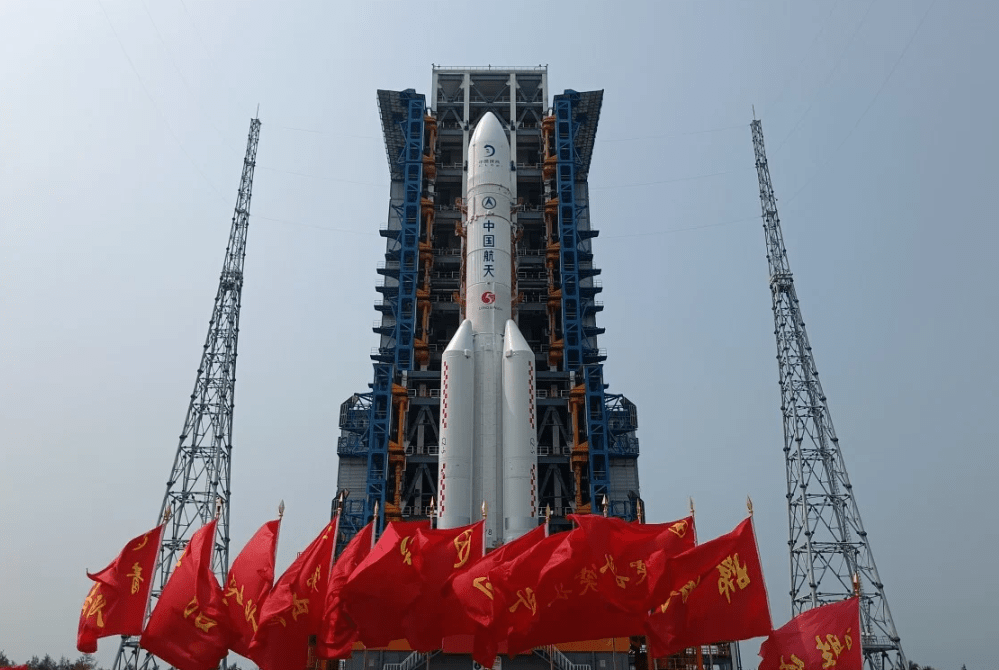
Image (Credit): China’s Chang’e 6 lunar probe at the Wenchang Space Launch Site in Hainan province prior to the launch on Friday. (CNSA)
Last Friday, China launched the Chang’e-6 lunar probe towards the moon with the goal of returning the first lunar soil sample from the far side of the Moon. An earlier mission in 2020, Chang’e-5, successfully returned lunar soil samples from the near side of the Moon for the first time in 44 years. Before that, in 2019, China place a rover on the far side of the Moon via the Chang’e-4 mission.
China is making some bold strides in space with, it might be added, some help from the Europeans. While the US bans any cooperation with the Chinese, France, Italy and Sweden have contributed to the Chang’e-6 mission. For example, Sweden added the Negative Ions at the Lunar Surface (NILS) instrument to the lunar probe.
Maybe one day we can join the Chinese on some of these missions, but that day seems to be far away. That said, we were able to find a way with the Russians, which allowed for the ongoing success of the International Space Station.
Image (Credit): Chicagoans watch the April 8, 2024 eclipse. (Brian Cassella/Chicago Tribune)
The image of the week relates to the Total Solar Eclipse that captured the nation’s attention. Goofy glasses like the ones shown in TheChicago Tribune (above) and Wired magazine (below) were worn across the country to watch this rare event.
Image (Credit): Eclipse watchers in Washington, DC. (Chip Somodevilla/Getty Images)
Image (Credit): View of the KPLO above the lunar surface. (NASA/GSFC/Arizona State University)
The grainy image above may remind you of some of the UFO images that circulated years ago. However, in this case, the image is from the Moon as captured by NASA’s Lunar Reconnaissance Orbiter.
What you are seeing is a Korean spacecraft going thousands of miles per hour (hence the blurred, elongated image). Named the Korea Pathfinder Lunar Orbiter (KPLO), or the Danuri, the spacecraft is part of South Korea’s first lunar mission launched in August 2022. Korea is the seventh nation to send an orbiter to the Moon.
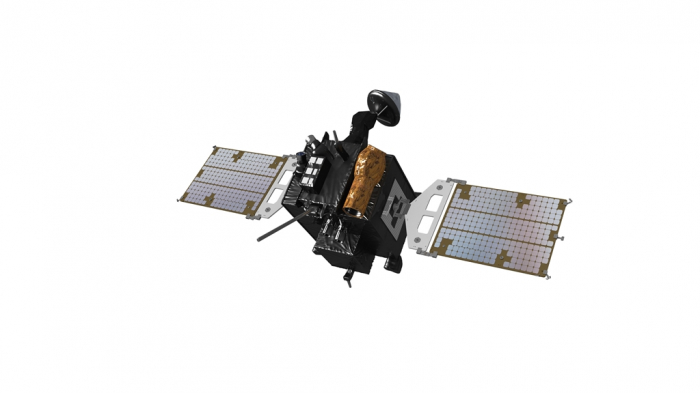
Below is an image of the KPLO minus the blurring speed. The spacecraft was designed to orbit the Moon for one year collecting data, though it is still going strong after hitting its year anniversary back in December. As part of its mission, it is carrying a NASA camera, the ShadowCam, to observe shadowed areas on the Moon.
The Moon is a busy place these days.
Image (Credit): Illustration of the KPLO. (The Korean Economic Daily)
For months now, the most distant spacecraft to Earth – Voyager 1 – has been talking gibberish on the interplanetary ‘radio’. The repetitive jumble of 1s and 0s it’s sending back to our planet, 24 billion kilometers (15 billion miles) away, has made no sense to scientists until now. Turns out, officials at NASA just needed to give the oh-so-distant craft a bit of a ‘poke’ to ask it how it was feeling. The system returned a software readout to Earth that scientists have now used to confirm about 3 percent of its memory is corrupted. Which is why turning the FDS on and off didn’t resolve the issue back in November of 2023.
Along with funding the commercial development of new rockets, Artemis moon landers and new spacesuits, NASA is pressing ahead with plans to buy an unpressurized moon rover that can carry astronauts, science payloads — or both — across the rugged terrain of the lunar south pole, officials said Wednesday. The agency announced contract awards to three companies to develop competing designs for a Lunar Terrain Vehicle, or LTV, similar in concept to the rovers that carried the last three Apollo crews across the moon’s surface more than 50 years ago.
After two decades of work, scientists and engineers at the Department of Energy’s SLAC National Accelerator Laboratory and their collaborators are celebrating the completion of the LSST Camera. Once mounted on Vera C. Observatory’s Simonyi Survey Telescope, the 3200-megapixel camera will help researchers observe our Universe in unprecedented detail. During its ten-year Legacy Survey of Space and Time, the LSST Camera will generate an enormous trove of data on the southern night sky that researchers will mine for new insights into dark energy, dark matter, the changing night sky, the Milky Way and our Solar System.
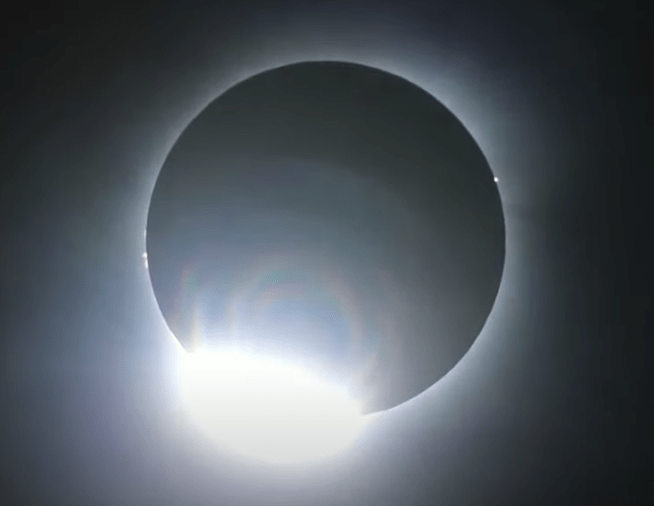
Image (Credit): TheTotal Solar Eclipse as seen in Houlton, Maine. (David Bowman of NASA Langley Research Center)
If you missed the Total Solar Eclipse or just want to see what it looked like in other parts of the country, NASA and other observatories have you covered. Check out the NASA video, “2024 Total Solar Eclipse: Through the Eyes of NASA (Telescope Feed),” showing the eclipse from Texas to Maine.





 Our Awesome Universe