Image (Credit): An artist’s rending of NASA’s VIPER at the Moon’s south pole. (NASA/Daniel Rutter)
You have until midnight today to submit your name to NASA and be part of the Agency’s first robotic Moon rover, called Volatiles Investigating Polar Exploration Rover (VIPER). Go to this link and provide your name and PIN code to ensure your name goes to the Moon (and you also get your boarding pass as a virtual souvenir).
VIPER is expected to head to the Moon in late 2024 as part of NASA’s Commercial Lunar Payload Services initiative. Once on the lunar surface, it will spend 100 days on the Moon’s south pole to sample the soil and locate frozen water.
If you missed the chance to have your name aboard the Europa Clipper, you still have a chance to be part of this local moon mission.
New research suggests there’s less oxygen on the icy surface of Jupiter’s moon Europa than thought — and that could affect what, if any, life might be lurking in the moon’s underground ocean. Even with little or no oxygen, microbes might still be bustling around in the ocean believed to exist miles beneath Europa’s frozen crust. As for what else, “who knows,” said NASA scientist Kevin Hand, who was not involved in the study published Monday in Nature Astronomy.
The best measurements from Hubble show the universe is now expanding faster than predicted based on observations of how it looked shortly after the big bang. These observations were made by the Planck satellite mapping of the cosmic microwave background radiation – sort of a blueprint for how the universe would evolve structure after it cooled down from the big bang. The simple solution to the dilemma is to say that maybe Hubble observations are wrong due to some creeping inaccuracy in its deep-space yardstick. Then along came the James Webb Space Telescope to crosscheck Hubble’s results. Webb’s sharp infrared views of Cepheids agreed with Hubble data. Webb confirmed that the Hubble telescope’s keen eye was right all along.
A trio of small rovers that will explore the Moon in sync with one another are rolling toward launch. Engineers at NASA’s Jet Propulsion Laboratory in Southern California recently finished assembling the robots, then subjected them to a punishing series of tests to ensure they’ll survive their jarring rocket ride into space and their travels in the unforgiving lunar environment.Part of a technology demonstration called CADRE (Cooperative Autonomous Distributed Robotic Exploration), each solar-powered rover is about the size of a carry-on suitcase.
Image (Credit): Moving the Artemis I mission into place. (NASA)
With the recent glitches related to the two commercial Moon missions, an earlier NASA video on the Artemis program became all too relevant. In the video, “Farther and Faster: NASA’s Journey to the Moon with Artemis,” we hear that the stakes are high as we attempt to return to the Moon, and how we could be the generation that loses the Moon if we don’t get it right.
In addition to the risks, the video also highlights the great successes already with the Artemis I mission, as you may recall from back in 2022:
Over the course of 25.5 days, Orion performed two lunar flybys, coming within 80 miles (129 kilometers) of the lunar surface. At its farthest distance during the mission, Orion traveled nearly 270,000 miles (435,000 kilometers) from our home planet. On Dec. 11, 2022, NASA’s Orion spacecraft successfully completed a parachute-assisted splashdown in the Pacific Ocean at 9:40 a.m. PST (12:40 p.m. EST) as the final major milestone of the Artemis I mission.
Artemis I set new performance records, exceeded efficiency expectations, and established new safety baselines for humans in deep space. This is a prelude to what comes next—following the success of Artemis I, human beings will fly around the Moon on Artemis II.
It is worth pondering what we have ahead of us. NASA may be having a few issues with its commercial partners, but the main mission has done well. We cannot be discouraged with a few delays as long as we keep the course. We have done it before and there is no reason we cannot do it again. I say slow and steady.
Mars is the goal, but we need to prove ourselves with the Moon. Check out the video and determine for yourself if we have already made a fair amount of progress.
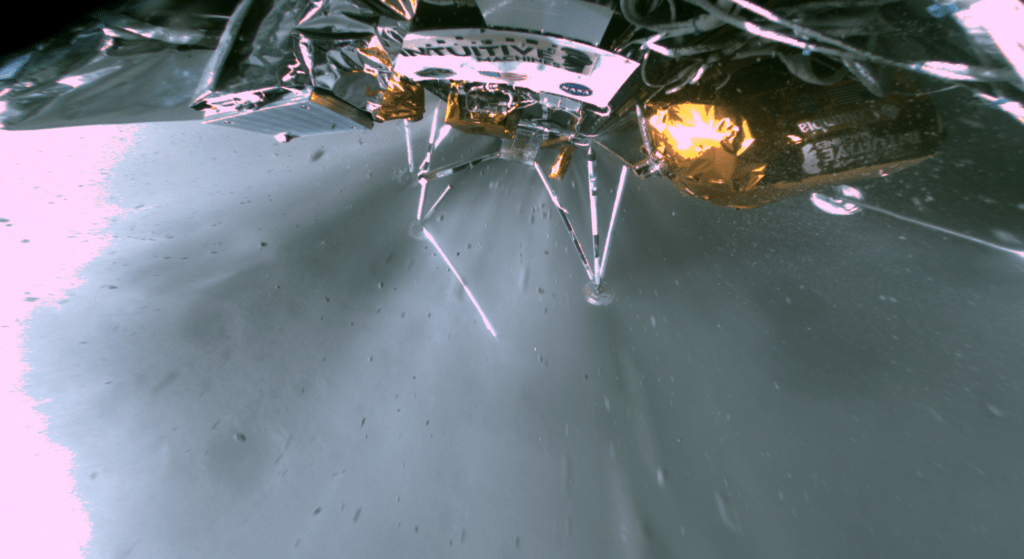
This image retrieved from the lander on February 27 captures Odysseus’ landing strut during landing on February 22nd performing its primary task, absorbing first contact with the lunar surface. Meanwhile, the lander’s liquid methane and liquid oxygen engine is still throttling, which provided stability. The Company believes the two insights captured in this image enabled Odysseus to gently lean into the lunar surface, preserving the ability to return scientific data.
NASA tried to put its best spin on the science coming out of the tilted lander, which suffered solar array and communication issues related to its tilted position, stating:
Mission challenges and successes were discussed during the briefing including more than 350 megabits of science data downloaded ready for analysis. During transit, all powered NASA payloads operated and received data. During descent and landing, guidance and navigation data was collected that will help improve landing precision in the future, and all three payloads that were designed to operate on the surface have received data.
What is left unsaid is whether the data received during this landing was close to what was anticipated and necessary for future safe missions. Saying some data was received does not tell us much. Only complete and useful data really matters here. I expect more information will be shared shortly.
I have not read too much about the fate of the other commercial cargoes. I doubt they fared much better.
Fortunately, the lunar lander communicated with Earth until early this morning, outlasting earlier expectations.
Could it come alive again like the Japanese lander? We shall see. As Intuitive Machines said earlier today, “Goodnight, Odie. We hope to hear from you again.”
A recent study suggests NASA’s DART mission, designed to test asteroid deflection methods, may have revealed more than planned. While successfully altering the target asteroid’s trajectory, scientists now believe the impact also significantly changed its shape, hinting at a surprising composition. Previously thought to be a solid rock, Dimorphos, the impacted asteroid, may actually be a loose collection of debris. This conclusion stems from the unexpected level of deformation observed after the collision. Unlike a typical crater, the impact appears to have caused a broader, flatter dent, resembling an M&M candy.
India on Tuesday introduced four crew members for its maiden ‘Gaganyaan’ space voyage, as it aims to become the world’s fourth country to send a crewed mission into space just months after a historic landing on the south pole of the moon. Gaganyaan, or “sky craft” in Hindi, is the first mission of its kind for India and will cost about 90.23 billion rupees ($1.1 billion). It involves the launch of a habitable space capsule over the next year to an orbit of 400 km (250 miles) and its return via a landing in the Indian Ocean.
Japan’s space agency made contact with its SLIM moon lander Sunday, despite the spacecraft not being expected to function after lunar night. Contact with the Smart Lander for Investigating Moon (SLIM) spacecraft was reestablished on Sunday, Feb. 25, the Japan Aerospace Exploration Agency (JAXA) announced via its dedicated SLIM account on X, formerly known as Twitter, early Feb. 26.



 Our Awesome Universe