Japanese Moon Mission: It’s Not Pretty, But it’s There

Image (Credit): Japan’s SLIM moon lander, as viewed by small rover LEV-2. (JAXA/Takara Tomy/Sony Group Corporation/Doshisha University)

If you were wondering about the status of the latest Japanese Moon mission, you can rest assured that the Smart Lander for Investigation Moon (SLIM) lander is now safe on the surface of the moon. It also had time to release two small Lunar Excursion Vehicle (LEV) rovers on the lunar surface.

Above is an image from one of those LEV rover’s showing a precariously placed lander. It appears to be standing on its head. Unfortunately, the solar panels are facing west rather than east, as planned.

As noted earlier, it is possible that the SLIM lander could get enough sunlight in the next few days to reactivate for a short period, but after that the lunar evening will drop to -200°F. The lander and rovers are not built for such temperatures.

Update: Good news! As of earlier today (January 29), SLIM has power again and it is back online.

The End of Two Moon Missions?

Image (Credit): Artist’s rendering of Japan’s SLIM mission over the Moon. (JAXA)

Within a two day period, we saw one Moon lander become a burning wreck plummeting towards Earth and another land on the Moon with an immediate problem that threatened its mission. The Moon may be closer, but it is becoming a hazardous place for space missions, similar to Mars.

First, the NASA-contracted Astrobotic Peregrine lander mission ended yesterday as the spacecraft entered the Earth’s atmosphere and burned up. The $108 Moon mission burned up with its cargo, including NASA’s scientific instruments, various rovers, and the DNA remains of humans whose families hoped would be at rest on the Moon’s surface. I expect a few Native Americans may be saying “I told you so” to themselves.

It was almost comical reading a Scientific American article trying to put a good spin on the lost cargo:

In addition, all nine of the payloads that were designed to communicate with Peregrine successfully returned data to Earth. Iris, a rover built by Carnegie Mellon University, sent back a “Hello Earth!” message. COLMENA, a set of five small rovers built by the Mexican Space Agency, also succeeded in sending data back—making it the first Mexican scientific instrument to operate in the moon’s vicinity.

I expect “Hello Earth!” fell far below the ground crew’s expectations, but I guess you take what you can get. And Mexico will probably hold off on any celebrations for the moment.

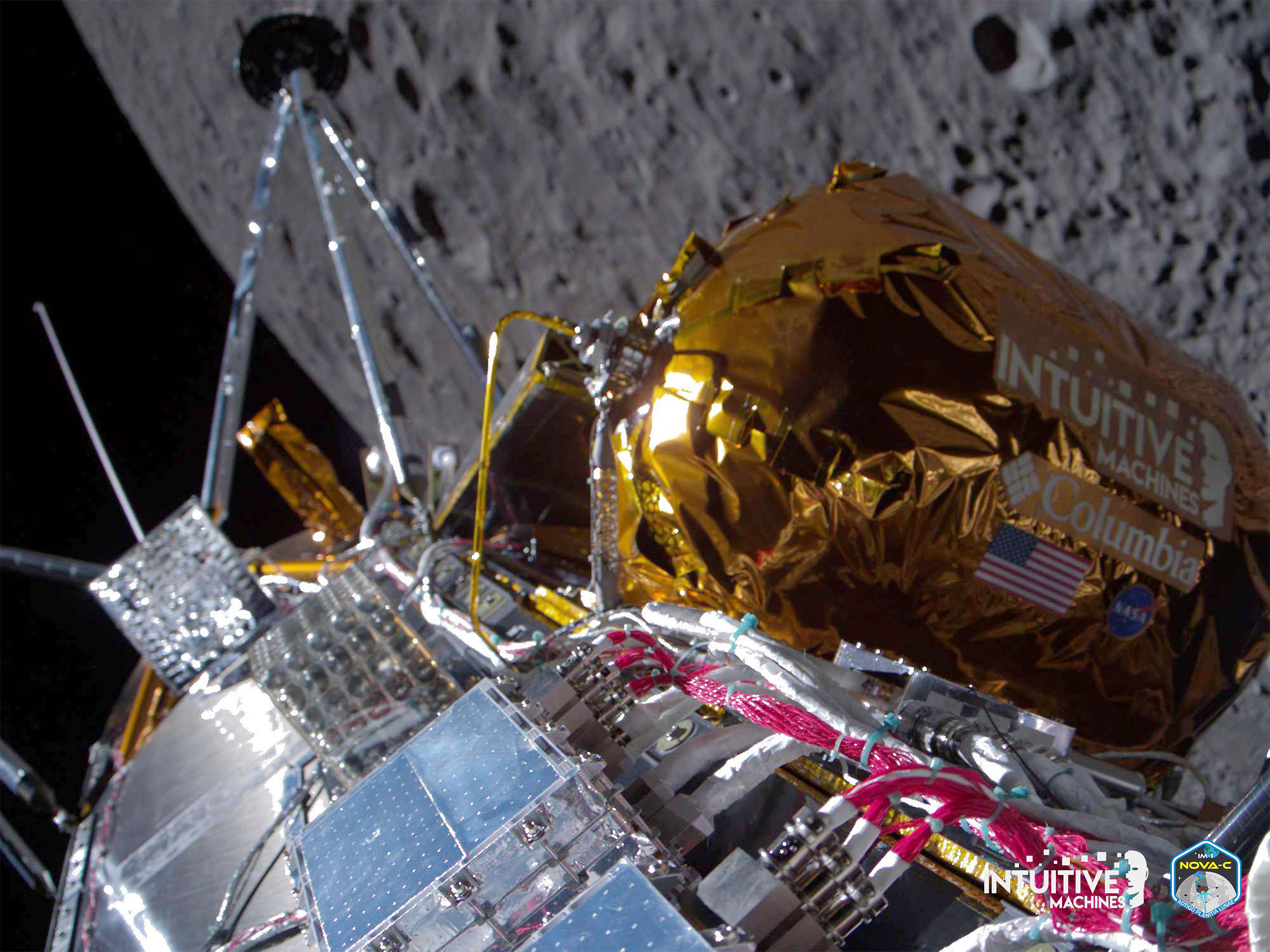
The second set of bad news related to the latest Japanese Moon mission. The good news is that the Smart Lander for Investigation Moon (SLIM) spacecraft was a success in terms of a soft landing on the Moon. The problem is that the solar array is not getting sufficient solar power for the lander to remain operational for more than a few hours. It is possible that the situation may correct itself as the sunshine shifts over time, but this is not a good start to the mission.

Whatever happens, Japan can still claim to be the fifth nation to successfully land on the Moon. It is not perfect, but the Japanese have more reason to celebrate than the Mexicans at this point.

Will China Beat Us to the Moon?

Image (Credit): A manufactured image, but it may be a reality soon enough. (Asia Times)

With the newly announced delays related to the Artemis lunar program, it is fair to ask whether the U.S. might fall behind the Chinese when it comes to a crewed lunar mission (of course, we won that battle 50 years ago, but you know that I mean).

All reports indicate that the Chinese wants to place humans on the Moon by 2030, but they are not expected to beat the Artemis timetable of a lunar landing in 2026. Of course, it is important that NASA stick to this timetable.

NASA Administrator Bill Nelson recently stated:

I do not have a concern that China is going to land before us…I think that China has a very aggressive plan. I think they would like to land before us, because that might give them some PR coup. But the fact is that I don’t think they will. I think it is true that their date that they announced keeps getting earlier. But specifically, with us landing in September of ’26, that will be the first landing.

Obstacles remain on what will prove to be a difficult mission even if it is a repeat. We already saw Russia’s failed attempt to simply land on the Moon last year, and the problems with last week’s NASA-funded commercial launch towards the Moon was worrying.

Nothing can be taken for granted in this new space race.

Sidebar: The Griffin Mission

Image (Credit): Griffin lunar lander. (Astrobotic)

I did not follow up on yesterday’s post when Astrobotic said it was moving onto its Griffin mission. What is that?

The Griffin mission involved a lunar lander as well, but this time the destination will be the Moon’s South Pole. The lander will deploy NASA’s Volatiles Investigating Polar Exploration Rover (VIPER), which will be searching for water.

The Griffin/VIPER duo was supposed to be on the Moon already, but we already know about delays. I expect the delays will only lengthen as NASA and Astrobotic try to better understand what happened earlier this week with the Peregine lunar lander. NASA does not want to lose a rover.

NASA’s launch website now still has the VIPER landing scheduled for late 2024.

You can read more about the Griffen lander specs here.

Moon Malaise This Week – Two Missions Impacted

Image (Credit): Apollo 11 Lunar Module captured by NASA’s Lunar Reconnaissance Orbiter. (NASA)

NASA said we would have weeks like this one.

First we have the compromised Peregrine Lunar Lander floating in space. Astrobotic posted this update earlier today:

Given the propellant leak, there is, unfortunately, no chance of a soft landing on the Moon. However, we do still have enough propellant to continue to operate the vehicle as a spacecraft. The team has updated its estimates, and we currently expect to run out of propellant in about 40 hours from now — an improvement from last night’s estimate. The team continues to work to find ways to extend Peregrine’s operational life. We are in a stable operating mode and are working payload and spacecraft tests and checkouts. We continue receiving valuable data and proving spaceflight operations for components and software relating to our next lunar lander mission, Griffin.

Second, we now have an official delay of the Artemis II and III missions, which is the crewed trips around the Moon and then to the surface of the Moon. NASA made the following statement:

NASA will now target September 2025 for Artemis II, the first crewed Artemis mission around the Moon, and September 2026 for Artemis III, which is planned to land the first astronauts near the lunar South Pole. Artemis IV, the first mission to the Gateway lunar space station, remains on track for 2028.

Rumors about a delay in the Artemis missions has been floating around for some time based on earlier audit reports, so this is not a big surprise. It is possible that NASA decided to dump the Artemis news this week to get everything on the table with this latest Peregrine problem rather than have two bad weeks.

We will just need a little more patience.

Image (Credit): Artemis II map. (NASA)
Image (Credit): Artemis III map. (NASA)