Image (Credit): Astronaut Thomas Kenneth Mattingly II. (NASA)
Last month we lost another astronaut who almost flew on the Apollo 13 mission and later flew on the Apollo 16 mission. Thomas Kenneth Mattingly II died on late last month at the age of 87 in Arlington, Virginia.
In addition to his work on the Apollo missions, he also flew on two space shuttle missions.
Mr. Mattingly is best remembered for his efforts to bring the Apollo 13 mission safely back to Earth after his lost his seat in that very mission when he was exposed to rubella. All of this was well documented in the 1995 Ron Howard film Apollo 13.
While NASA seeks to maintain an uninterrupted human presence in low Earth orbit, an agency official said a short-term gap between the International Space Station and commercial successors would not be “the end of the world.” NASA’s current approach to its future in LEO counts on supporting development of commercial space stations with the goal of having at least one such station ready to support NASA astronauts and research by 2030, when the ISS is scheduled for retirement. A key question, though, will be whether any of the several companies working on such concepts will be ready by the end of the decade.
Hundreds of tech and science jobs will be lost in California if NASA moves forward with a plan to cut funding from the Mars Sample Return (MSR) mission, according to state lawmakers. U.S. Senator Alex Padilla (D-Calif.) and Representative Adam Schiff (D-Calif.-30), sent a letter on Wednesday to NASA Administrator Bill Nelson to reverse a decision to slash the mission’s funding. The funding cut would “result in the loss of hundreds of California jobs, prevent the Jet Propulsion Laboratory (JPL) from making its 2030 launch window, and lead to the cancellation of billions of dollars in contracts supporting American businesses,” the lawmakers wrote.
The Canadian Space Agency announced two astronauts will fly to space in the coming years on Wednesday (Nov. 22) as the country continues a historic ramp-up of its human space program in 2023. François-Philippe Champagne, the Minister of Innovation, Science and Industry of Canada, announced the assignments in front of a crowd of hundreds gathered in the lobby of Canadian Space Agency headquarters in Longueuil, Quebec.
The bottom line is that we should not rush towards permanent settlements at either location until we know more about the human body, the human mind, and human politics (good luck with the last one).
The conversation covers a variety of risks, including the effects of gravity on the human body, the ability to procreate in space, and the effectiveness of treaties as nations plan to settle and mine the Moon and Mars. The authors note that we have not had ample time to study all of these issues even with the International Space Station (ISS) in orbit because this has not been the focus of many space efforts to date. For instance, the ISS does not test the impact of radiation on humans because it is in low Earth orbit within the protection of the planet’s magnetic field.
Overall, the authors advise time and more study before jumping into a settlement. This may mean putting off permanent settlements for a few hundred years.
And what about Elon Musk’s plan to start shipping colonists to Mars in his lifetime? As with many things related to Mr. Musk, he does oversell ideas. His energy in the infrastructure realm is good, but his predictions related to humanity in general are usually unreliable.
Image (Credit): Artist’s rendering of a Martian space city. (SpaceX)
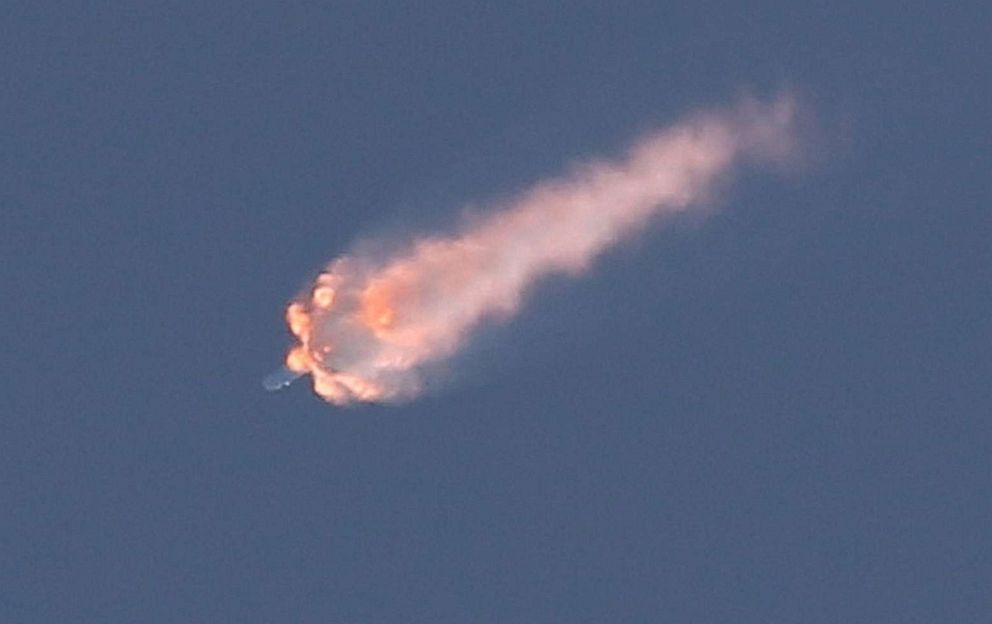
Image (Credit): 2015 explosion of a SpaceX Falcon 9 rocket. (ABC News)
SpaceX may have suffered a rocket loss yesterday, but everyone agrees that this is part of the process when trying something big.
What can we then say about Mr. Musk creating a second loss last week, but in this case it was a loss of confidence in his leadership at Twitter (yes, the site is also oddly called “x” even though the web address is still twitter.com)? Is that also part of the process when trying something big, or is he simply becoming a loss leader that is getting in his own way. And, more importantly to this site, is he squandering his other assets, including SpaceX?
The latest incident involves his support of an earlier post on Twitter that defamed the American Jewish community. It is unclear why Mr. Musk cannot act like an adult and focus on his businesses, but his actions have led to multiple firms pulling their advertising dollars from Twitter.
I agree his irresponsible behavior is nothing new, but it is starting to raise even more eyebrows as his businesses become more entangled with US Government missions. He is not just pushing a declining social app and electric cars, but rather he is also launching critical military satellites, bringing astronauts to the International Space Station, and planning to heavily support our return to the Moon.
Exhibit A – Kelsey D. Atherton, Chief Editor at the Center for International Policy, had this to say recently about Mr. Musk and SpaceX:
In the immediate term, Congress needs to investigate whether Musk’s public comments present a breach of contract on ethical or reliability grounds. Congress could require that any company that receives launch contracts must go public, ensuring at least some mechanism for shareholders to oust a CEO should they become a public or security liability.
I recommend reading the entire article. It is one voice at the moment, but the evidence is growing that Mr. Musk may be the wrong person to rely on in these times when he clearly cannot control himself. His “Rapid Unscheduled Disassembly” is painful to watch and something we need to guard against.
Earlier today, SpaceX lost contact with its Starship rocket about 10 minutes into the launch. This happened after the second-stage separation, so while a successful landing of the rocket did not occur, the rocket had more success than the launch earlier this year.
After what appeared to be a self-detonation of the Starship rocket, the Federal Aviation Administration stated, “The anomaly resulted in a loss of the vehicle. No injuries or public property damage have been reported.” That includes the launchpad, which was basically destroyed during the last launch.
Baby steps.
It is not clear if this latest incident will lead to another long delay before another attempt is possible. And such tests are increasingly expensive when your reusable parts continue to blow up rather than land.
A lot is riding on these launches, as well as the reusable feature, given that NASA is estimating that as many as 20 Starship launches will be necessary under the Artemis III moon mission. Of course, if someone asked NASA to schedule 20 Space Launch System launches in this way, I doubt we would even be talking about an Artemis program.
Mr. Musk has promised a lot to the US space program. We need his full attention on this project.





 Our Awesome Universe