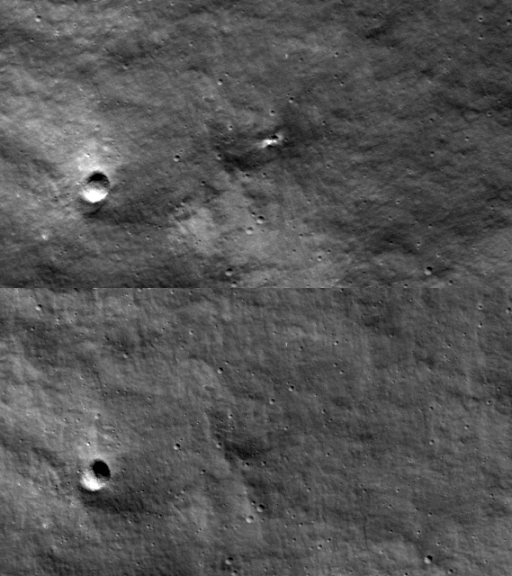
Image (Credit): Contrast between two views of the lunar surface from June 27, 2020, and Aug. 24, 2023, which is before and after the crash of Russia’s Luna-25 spacecraft. (NASA’s Goddard Space Flight Center/Arizona State University)
If President Putin wanted to leave a mark, he has done so on the Moon. NASA’s Lunar Reconnaissance Orbiter (LRO) has apparently located the spot where the Luna-25 spacecraft crashed, as shown in the before and after shot above.
Given that craters can last for billions of years on the Moon’s surface, we can rest assured that the Russians have made an indelible mark on a distant land.
Russia, let’s call it a win and recall those troops from Ukraine.
By the way, maybe we should call the new crater Putin’s Sunset.
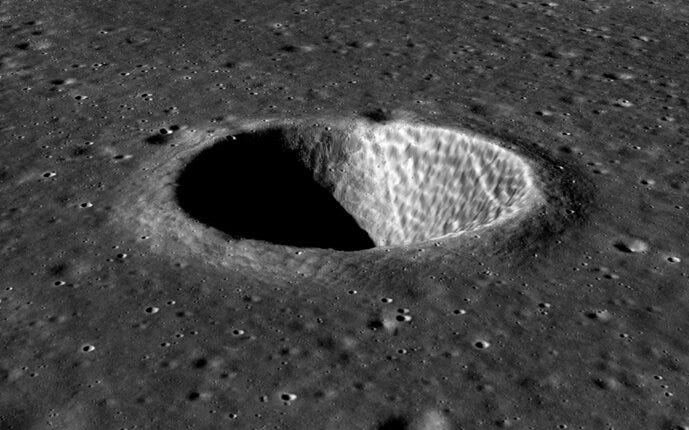
Image (Credit): 3D view of a crater on the Moon generated from images captured by Chandrayaan 2 orbiter’s Terrain Mapping Camera in 2019. (ISRO)
“…a comparison with India is illuminating: India’s economy was about half the size of Russia’s when the Berlin Wall came down in 1989. Today, India’s economy is 50 percent bigger than Russia’s. Forget about keeping pace with the United States: Russia can’t keep up with India.”
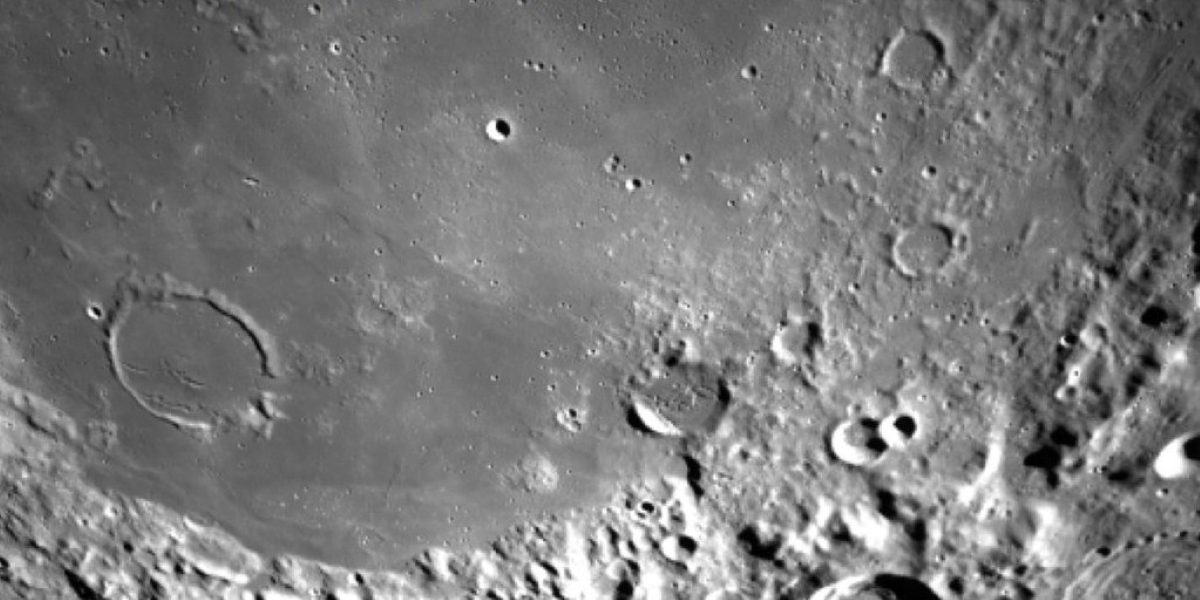
Image (Credit): Lunar surface as captured by India’s Chandrayaan-3 spacecraft. (ISRO)
This week’s image is an shot of the far side of the Moon captured by India’s Chandrayaan-3 spacecraft, which landed on the Moon yesterday. This was part of a set of photos posted to Twitter by the Indian Space Research Organization (ISRO). The various images were used by the spacecraft as it attempted to find a safe landing spot, which it fortunately found.
Image (Credit): The ISRO mission control room celebrating the successful landing of the Chandrayaan-3 mission on the Moon. (ISRO)
Now that is a clear message from S. Somanath, chairman of the Indian Space Research Organization (ISRO). The Chandrayaan-3 spacecraft landed on the lunar surface at 8:34 am ET today.
India is now the fourth nation to land on the moon, not that other nations haven’t tried.
This victory is all the sweeter following Russia’s loss of the Luna-25 spacecraft. We needed some good news this week.
Congratulations ISRO on your successful Chandrayaan-3 lunar South Pole landing! And congratulations to India on being the 4th country to successfully soft-land a spacecraft on the Moon. We’re glad to be your partner on this mission!
NASA provided the mission with a passive laser retroreflector array for lunar ranging studies.
The mission rover (shown below) should be moving about south pole soon enough to start its experiments in the vicinity.
You can learn more about the mission and equipment at this ISRO site.
Image (Credit): Images of the Moon from India’s Chandrayaan-3 spacecraft after it entered lunar orbit more than two weeks ago. (Indian Space Research Organisation)
We are down to one spacecraft approaching the Moon’s south pole – India’s Chandrayaan-3 mission, which is expected to land as early as tomorrow. This is India’s second try for a Moon landing after the loss of Chandrayaan-2, so fingers crossed. Chandrayaan-1 also sent a probe that impacted the Moon, but that was the plan.
We shall see if Indian patience beats Russian bravado.
India Prime Minister Modi put a possible spin on the past missions. Regarding Chandrayaan-1, he said:
Chandrayaan-1 is considered to be a path-breaker among global lunar missions as it confirmed the presence of water molecules on the moon. It featured in over 200 scientific publications around the world.
Even the failed second mission has its successes:
Chandrayaan-2 was equally pathbreaking because data from the Orbiter associated with it detected the presence of chromium, manganese and sodium for the first time through remote sensing. This will also provide more insights into the moon’s magmatic evolution. The key scientific outcomes from Chandrayaan 2 include the first ever global map for lunar sodium, enhancing knowledge on crater size distribution, unambiguous detection of lunar surface water ice with IIRS instrument and more. This Mission has featured in almost 50 publications.



 Our Awesome Universe