Space Stories: Russia Sticks with ISS, Czechs Join Artemis Accords, and China Plans for Sample Return from Far Side of Moon

Image (Credit): The International Space Station. (Roscosmos)

Here are some recent stories of interest.

Phys.org: “Russia Will Use International Space Station ‘Until 2028’

Russia said Wednesday it planned to use the International Space Station until 2028, an apparent reversal of an earlier announcement to quit the orbiting laboratory after 2024. On Wednesday, the head of Russian space agency Roscosmos, Yuri Borisov, said Moscow’s participation in the international space project had been extended. “By the decision of the government, the operation of the International Space Station has been extended until 2028,” Borisov told President Vladimir Putin during a televised meeting, referring to the Russian segment.

SpaceNews.com: “Czech Republic signs Artemis Accords

The Czech Republic became the 24th country to sign the Artemis Accords May 3, growing Europe’s presence in the U.S.-led agreement. In a brief ceremony at NASA Headquarters, Jan Lipavský, minister of foreign affairs for the Czech Republic, formally signed the accords in the presence of officials from NASA and the U.S. State Department. Representatives of several other countries who previously signed the Artemis Accords also attended…Neither U.S. nor Czech officials announced specific plans to cooperate on the Artemis lunar exploration campaign as a result of signing the accords, but suggested the signing opened the door for future discussions. 

Space.com: “China to Launch 1st-ever Sample Return Mission to Moon’s Far Side in 2024

China will attempt to collect the first samples from the far side of the moon next year with its Chang’e 6 mission. The complex, four-spacecraft mission will launch on a Long March 5 rocket from Wenchang in May 2024, according to Wu Yanhua, chief designer of China’s Deep Space Exploration Major Project, speaking at a deep-space exploration conference on April 25 in the Chinese city of Hefei.

Space Stories: Lost Lunar Lander, Exoplanet Elements, and the Molten Middle of Mars

Image (Credit): Artist’s rendering of the HAKUTO-R Mission 1 Lunar Lander orbiting the Moon. (ispace)

Here are some recent stories of interest.

Astronomy.com:Japanese Lunar Lander Loses Contact Moments Before Touchdown

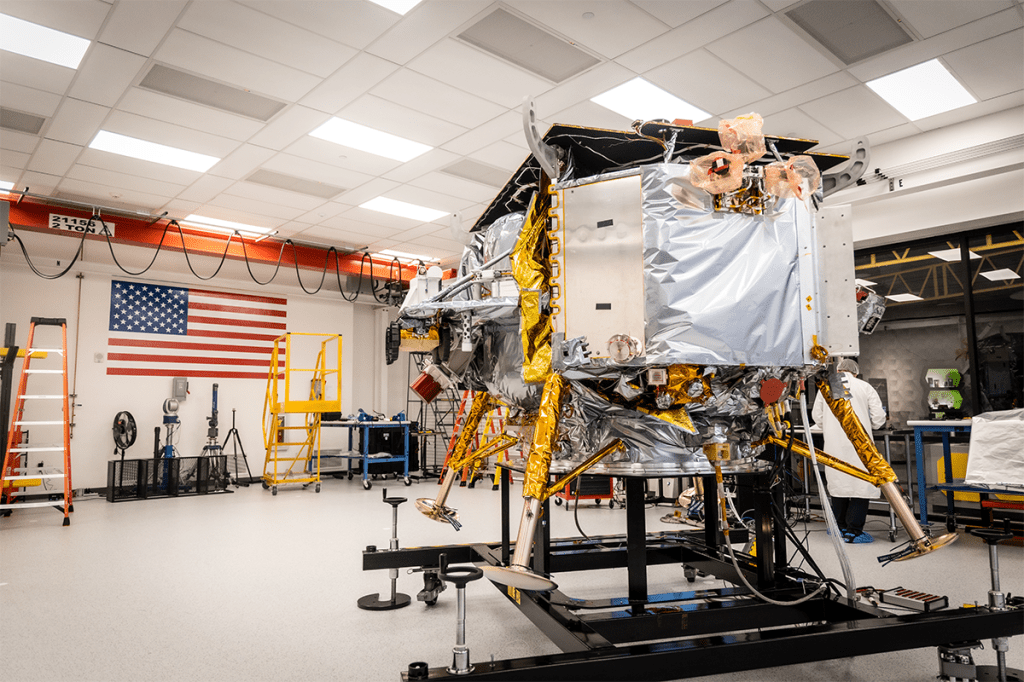
The Japanese start-up ispace attempted to become the first private company to successfully soft-land a commercial spacecraft on the Moon today (Tuesday, April 25). However, it now appears that the landing attempt — like several other such attempts in recent years — has failed…Ispace currently plans to attempt at least two more lunar landings over the next few years, applying lessons learned during today’s landing attempt to increase their odds of success.

Phys.com:Scientists Discover Rare Element in Exoplanet’s Atmosphere

The rare metal terbium has been found in an exoplanet’s atmosphere for the first time. The researchers at Lund University in Sweden have also developed a new method for analyzing exoplanets, making it possible to study them in more detail…”Detecting heavy elements in the atmospheres of ultra-hot exoplanets is another step towards learning how the atmospheres of planets work. The better we get to know these planets, the greater chance we have of finding Earth 2.0 in the future,” concludes Nicholas Borsato.

NASA:NASA InSight Study Provides Clearest Look Ever at Martian Core

While NASA retired its InSight Mars lander in December, the trove of data from its seismometer will be pored over for decades to come. By looking at seismic waves the instrument detected from a pair of temblors in 2021, scientists have been able to deduce that Mars’ liquid iron core is smaller and denser than previously thought.

Space Stories: Sagan as Scripture, Chinese Lunar Plans, and Outer Space in NYC

Credit: Ballantine Books

Here are some recent stories of interest.

Gizmodo.com: “New NASA Official Took Her Oath of Office on Carl Sagan’s ‘Pale Blue Dot’”

When Dr. Makenzie Lystrup was sworn in as the new director of NASA’s Goddard Space Flight Center last week, she didn’t take her oath of office on the Bible or the U.S. Constitution, but rather on a tome revered by space enthusiasts everywhere: Carl Sagan’s Pale Blue Dot. The book, published in 1994, is named after an iconic image of Earth, snapped by the Voyager I probe, that depicts the planet as a small speck smothered by the emptiness of space. That photo inspired astronomer Carl Sagan to write: “Look again at that dot. That’s here. That’s home. That’s us.” For many, the book serves as a reminder of humanity’s place in the universe and the need to preserve our home planet, which makes it similar to holy scripture for a newly appointed NASA director.

Time: “In Five Years, China Will Start Building a Lunar Base With Bricks Made From Moon Soil

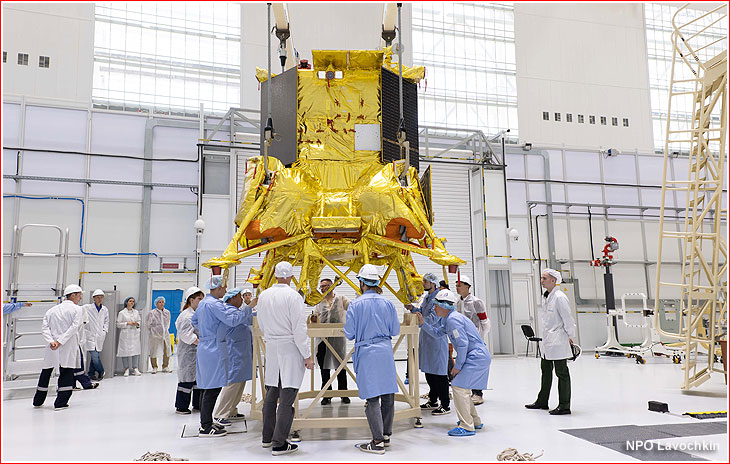
China plans to start building a lunar base in about five years, kicking off with bricks made of moon soil, according to scientists with ties to the project, the South China Morning Post reported. Ding Lieyun, a top scientist at Huazhong University of Science and Technology, told local media that the first brick would be made from moon soil during the Chang’e 8 mission around 2028.

AFAR: “NASA Teams With NYC Museum on New Immersive Outer Space Exhibit

With its blazing city lights, New York is one of the worst places to go stargazing. But space aficionados will want to visit lower Manhattan this spring—dark skies or not—thanks to a new digital art exhibit created with participation from NASA and CNES (the French space agency) that opened April 7 at Hall des Lumières, the city’s first permanent immersive art center. An earlier iteration of this show premiered at Hall des Lumières’ sister museum in Paris, Atelier des Lumières, in 2021. Destination Cosmos: The Immersive Space Experiencewill run for eight weeks through June 4, 2023, at Hall des Lumières, which opened in 2022 in the former Emigrant Savings Bank across from City Hall.

If You Thought the Skies Were Crowded, Just Wait

Credit: Starlink.

The Washington Post recently published a story, “China’s military aims to launch 13,000 satellites to rival Elon Musk’s Starlink,” that can only terrify astronomers here on Earth trying to view the stars. The title says it all – the space race continues to clutter the skies with more and more low-Earth satellites broadcasting back to the surface. It is a dippy Dyson Sphere that contains scientists rather than energy.

Starlink’s success in Ukraine really bothers the Chinese, who see the network as a lifeline for Taiwan as well. The article quotes Chinese military researchers, who state:

Once the Starshield is completed, it will be tantamount to installing networked surveillance cameras all over the world. At that time, military operations including the launch of ballistic missiles, hypersonic missiles and fighter jets will hardly escape the monitoring of the United States.

I would prefer the space race between the US and China focused on the Moon or Mars rather than local invasions, but that is the state of the world at the moment. Not that the race to the Moon was a completely tame affair. For instance, the US contemplated exploding a nuclear bomb on the surface of the Moon to impress the Russians and everyone else. Fortunately, Project A119 never happened.

Artemis Mission Astronauts Announced

Image (Credit): Newly-announced Artemis astronauts Commander Reid Wisemam, Pilot Victor Glover, Mission Specialist Jeremy Hansen, and Mission Specialist Christina Hammock Koch. (NASA)

Another step was taken today to get us closer to a Moon landing. Earlier today NASA announced the names of the four astronauts on the next Artemis II mission:

The Artemis II mission will require the four astronauts to take an Orion capsule around the Moon to test a variety of systems and ensure the safety of a later Moon landing as part of Artemis III. You can see a graphic of the Artemis II mission below.

At today’s ceremony announcing the crew, NASA Administrator Bill Nelson stated:

The Artemis II crew represents thousands of people working tirelessly to bring us to the stars. This is their crew, this is our crew, this is humanity’s crew…NASA astronauts Reid Wiseman, Victor Glover, and Christina Hammock Koch, and CSA astronaut Jeremy Hansen, each has their own story, but, together, they represent our creed: E pluribus unum – out of many, one. Together, we are ushering in a new era of exploration for a new generation of star sailors and dreamers – the Artemis Generation.

You can also watch NASA’s full announcement of the new crew here.

Credit: NASA