Reason Magazine Discusses the Space Age

The December issue of Reason Magazine has plenty of fun articles on space travel, the ethics of terra-forming, science fiction books and films, and more. The magazine tends to favor privatization of just about everything, so expect some cheering for space billionaires like Elon Musk and Jeff Bezos, but overall it is a nice collection of thought-provoking articles.

Here is a sample of the articles:

Space Quote: The White House’s View of the Moon

Image (Credit): View of the Earth from the Apollo 11 Command and Service Module. (NASA)

“Lunar orbit would be filled with many more satellites, including a lunar GPS network and a human space station capable of housing human astronauts that serves as a rest stop before they land on the moon’s surface. While there are no plans for a lunar city, there are proposals for a permanent outpost on the south pole of the moon, where crews might one day spend six-month rotations (China and Russia have announced plans for a lunar outpost, too). If NASA has its way, the lunar surface might eventually include a series of nuclear power plants, a resource extraction operation, and even something akin to moon internet. Given these plans, the US government estimates that the level of human activity in cislunar space over the next decade could exceed everything that’s happened there between 1957 and today, combined.”

-Quote from a November 22 Vox article, “The White House’s Plan to Colonize the Moon, Briefly Explained.” The article comments on the recently released report by the White House’s National Science & Technology Council, National Cislunar Science & Technology Strategy. By the way, the term “Cislunar space” in the report refers to “…the three-dimensional volume of space beyond Earth’s geosynchronous orbit that is mainly under the gravitational influence of the Earth and/or the Moon. Cislunar space includes the Earth-Moon Lagrange point regions…, trajectories utilizing those regions, and the Lunar surface.”

Space Stories: Chinese Lunar Nuclear Station, Helium Exoplanets, and the UAE Lunar Rover

Image (Credit): Artist’s rendering of a lunar exploration base. (NASA/Dennis Davidson)

Here are some recent stories of interest.

Republic World: “China Plans Development Of New Nuclear System To Power Its Bases On Moon By 2028

China is developing a nuclear system that will be used to power its lunar station planned to be developed on the Moon’s South Pole. Wu Weiren, chief designer of the Chinese lunar exploration programme, told Chinese broadcaster CCTV that this new system will fulfill the ‘high-power energy demands’ of the station, the South China Morning Post (SCMP) reported. Notably, the station is being developed by the China National Space Administration (CNSA) and the Russian space agency Roscosmos and is expected to complete by 2028.

University of Chicago: “Many Planets Could Have Atmospheres Rich in Helium, Study Finds

For centuries, no one knew if we were alone in the universe—or if there were even other planets like ours. But thanks to new telescopes and methods in the past decades, we now know there are thousands and thousands of planets out there circling faraway stars, and they come in all sorts of shapes and sizes—large and small, rocky and gaseous, cloudy or icy or wet. A study by scientists with the University of Chicago, the University of Michigan and the University of Maryland suggests another for the list: planets with helium atmospheres. Moreover, the discovery may suggest a new step in our understanding of planet evolution. Their simulations found that it’s likely that helium would build up in the atmospheres of certain types of exoplanets over time. If confirmed, this would explain a decades-long puzzle about the sizes of these exoplanets.

Astronomy.com: “China and United Arab Emirates Plan Lunar Rover Mission

The United Arab Emirates’ fledgling space program took another step forward last month, securing an agreement to collaborate on China’s planned Chang’e 7 lunar mission, set to land near the Moon’s south pole in 2026. The Mohammed bin Rashid Space Center (MBRSC) in Dubai will build a small robotic rover, which will hitch a ride on the Chang’e 7 lander, according to the agreement signed Sept. 16 between MBRSC and the China National Space Administration (CNSA).

Orion Spacecraft: Successful Flyby of the Moon

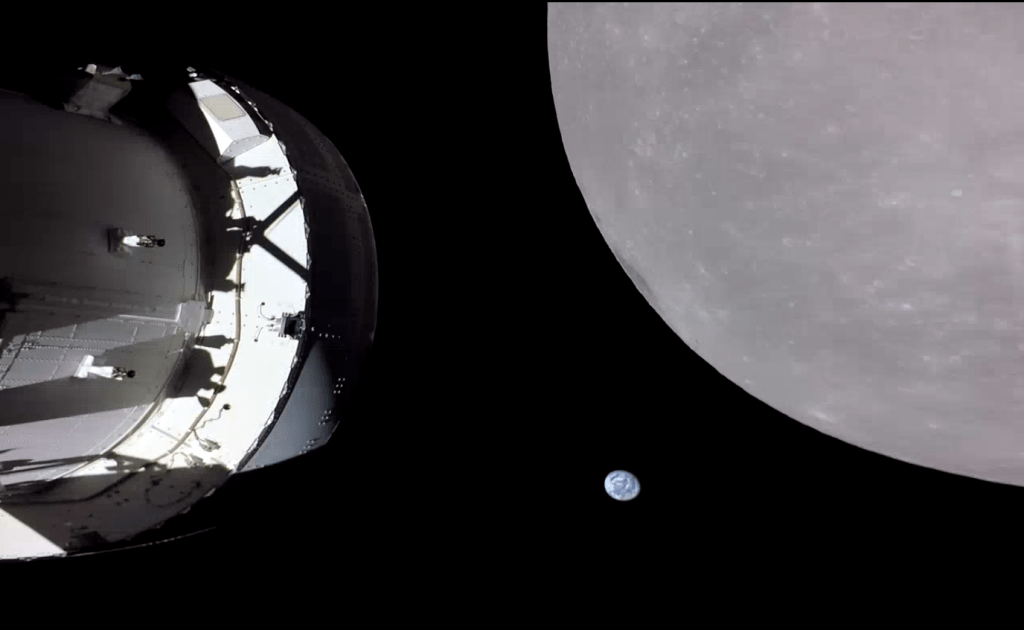
Image (Credit): The Earth is seen setting from the far side of the Moon just beyond the Orion spacecraft in this video taken on the sixth day of the Artemis I mission by a camera on the tip of one of Orion’s solar arrays. (NASA)

The Artemis I mission is going well. On day six (November 21), the Orion capsule had a successful flyby of the moon and traveled to within 81 miles of the lunar surface. After a slow start to the launch, NASA engineers must be somewhat relieved.

NASA provided an update on the mission yesterday. You can find many more details on the mission in that one hour briefing.

Stay tuned for some space records later this week, as noted by NASA:

Orion will travel about 57,287 miles beyond the Moon at its farthest point from the Moon on Nov. 25, pass the record set by Apollo 13 for the farthest distance traveled by a spacecraft designed for humans at 248,655 miles from Earth on Saturday, Nov. 26, and reach its maximum distance from Earth of 268,552 miles Monday, Nov. 28.  

And be sure to stay abreast of the mission via the Artemis blog.

Japan Supports the ISS Through 2030 and Expands Support for the Lunar Gateway

Image (Credit): Graphic showing Lunar Gateway elements from commercial and international partners. (NASA)

Late last week, the White House announced that Japan plans to support the operations of the International Space Station (ISS) through 2030 as well as further collaborate with the United States on the Artemis Lunar Gateway platform that will orbit the Moon.

On November 17, Vice President Kamala Harris stated:

The United States welcomes Japan’s intention to extend its support of International Space Station (ISS) operations through 2030, following the United States’ announcement of our ISS extension one year ago. In addition, our two countries are taking a step forward by reaching an agreement on collaboration on the Lunar Gateway orbiting platform, which will pave the way for the return of humanity to the Moon.

Under a previous agreement that has been expanded further, Japan’s JAXA has promised a number of contributions to the Lunar Gateway, including:

  • Critical components of the International Habitation (I-HAB) module that will provide the heart of the Gateway space station’s life support capabilities, as well as space for crew to live, conduct research, and prepare for lunar surface activities during Artemis missions. Japan will provide I-HAB’s Environmental Control and Life Support System (ECLSS), thermal control system functions, and cameras.
  • Batteries for I-HAB, the Habitation and Logistics Outpost (HALO) module, the initial crew cabin for astronauts visiting the Gateway, and the European System Providing Refueling Infrastructure and Telecommunication (ESPRIT) refueling module.
  • The JAXA HTV-XG spacecraft for launch and delivery of a logistics resupply mission for Gateway, scheduled for no later than 2030.

With the successful start of Artemis I lunar mission, it is good to hear that partner nations are increasing their support for a return to the Moon as well as plans to travel to Mars. While the United States went to the Moon alone last century, the Artemis partnership ensures this century’s return to the Moon is an international project.