Space Stories: Approaching Lucy, Chinese Space Ambitions, and Conan the Bacterium

Image (Credit): Image from NASA’s Lucy spacecraft showing the Earth and Moon from 890,000 miles away (look closely – the moon on the left is a very pale dot). (NASA/Goddard/SwRI)

Here are some recent stories of interest.

—NASA.gov: â€œNASA’s Lucy Spacecraft Captures Images of Earth, Moon Ahead of Gravity Assist“

On October 13, 2022, NASA’s Lucy spacecraft captured [the above] image of the Earth and the Moon from a distance of 890,000 miles (1.4 million km). The image was taken as part of an instrument calibration sequence as the spacecraft approached Earth for its first of three Earth gravity assists. These Earth flybys provide Lucy with the speed required to reach the Trojan asteroids — small bodies that orbit the Sun at the same distance as Jupiter. On its 12 year journey, Lucy will fly by a record breaking number of asteroids and survey their diversity, looking for clues to better understand the formation of the solar system.

—SpaceNews.com: â€œChina Considering Mission to Ceres and Large Dark Matter Space Telescope“

The Chinese Academy of Sciences is considering potential missions including a Ceres orbiter and a huge telescope to hunt for clues about the nature of dark matter. More than 20 candidates are vying for funding for further study under the Chinese Academy of Sciences Strategic Priority Program on Space Science, also known as the New Horizon Program, and are currently undergoing evaluation.

—Space.com: â€œExtremophiles on Mars Could Survive for Hundreds of Millions of Years“

One of Earth’s toughest microbes could survive on Mars, lying dormant beneath the surface, for 280 million years, new research has shown. The findings increase the probability that microbial life could still exist on the Red Planet. Deinococcus radiodurans, nicknamed “Conan the Bacterium,” is one of the world’s toughest microbes, capable of surviving in radiation strong enough to kill any other known life-form. Experiments have now shown that if Conan the Bacterium or a similar microbe existed on Mars, it could survive 33 feet (10 meters) beneath the surface, frozen and dried out, for 280 million years.
Study Findings: Fusible Mantle Cumulates Trigger Young Mare Volcanism on the Cooling Moon

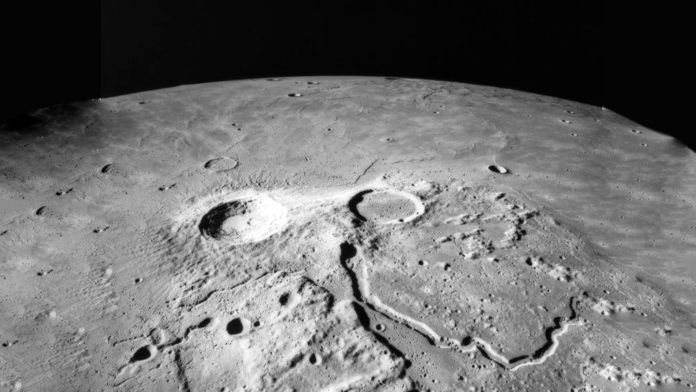
Image (Credit): The Moon’s snakelike Schroeter’s Valley, believed to have been created by lava flowing over the surface. (NASA/Johnson)

Science Advances abstract:

[China’s] Chang’E-5 (CE5) mission has demonstrated that lunar volcanism was still active until two billion years ago, much younger than the previous isotopically dated lunar basalts. How the small Moon retained enough heat to drive such late volcanism is unknown, particularly as the CE5 mantle source was anhydrous and depleted in heat-producing elements. We conduct fractional crystallization and mantle melting simulations that show that mantle melting point depression by the presence of fusible, easily melted components could trigger young volcanism. Enriched in calcium oxide and titanium dioxide compared to older Apollo magmas, the young CE5 magma was, thus, sourced from the overturn of the late-stage fusible cumulates of the lunar magma ocean. Mantle melting point depression is the first mechanism to account for young volcanism on the Moon that is consistent with the newly returned CE5 basalts.

Citation: Su, B., Yuan, J., Chen, Y., et al. Fusible mantle cumulates trigger young mare volcanism on the cooling Moon. Science Advances (2022).
https://doi.org/10.1126/sciadv.abn2103

Study-related stories:

The National Air and Space Museum is Open for Business

Image (Credit): The “Destination Moon” exibition at the refurbished National Air and Space Museum. (Smithsonian Museum)

If you have been awaiting the refurbishing of the Smithsonian’s National Air and Space Museum, then you will be happy to know that the museum reopened on October 14th. Only now you cannot simply stroll into the museum. Instead, you need to obtain a free timed-entry pass. Unfortunately, this seems to be the current system used by numerous museums to control traffic as well as capture all of your personal information so they can swamp you with junk mail and offers. Anyway…

Here are the a few of the new exhibits the museum is highlighting (go here for the full list):

  1. “Walking On Other Worlds”: Experience what it’s like in distant parts of our solar system in the “Walking on Other Worlds” interactive experience in the Kenneth C. Griffin Exploring the Planets Gallery. This immersive media exhibit presents visitors with a seven-minute “tour” of seven different worlds: Venus, Earth’s Moon, Mars, Jupiter, Saturn’s moon Titan, asteroid Ryugu, and comet 67P.
  2. Science Fiction Artifacts: New to display is a full-sized T-70 X-wing Starfighter “flown” by Poe Dameron (Oscar Isaac) in Star Wars: The Rise of Skywalker (2019). The screen-used vehicle is on long-term loan from Lucasfilm and is displayed hanging outside the planetarium. Star Trek is also represented in the new exhibitions. 
  3. ISS Cupola: In the One World Connected gallery, put yourself in the shoes of astronauts on the International Space Station (ISS) with the ISS Cupola interactive. Every 90 minutes, astronauts on board the ISS can see the Sun rise from the station’s Cupola, a European Space Agency-built observatory module. 

Given that NASA’s Artemis 1 mission is shooting for the Moon again, the timing is perfect. Of course, in December 2022 it will have been 50 years since the last human walk on the Moon’s surface, so we have a lot to celebrate as well as a lot of time to make up. Let’s hope a future update to the National Air and Space Museum includes models of spacecraft used to get humans to Mars.

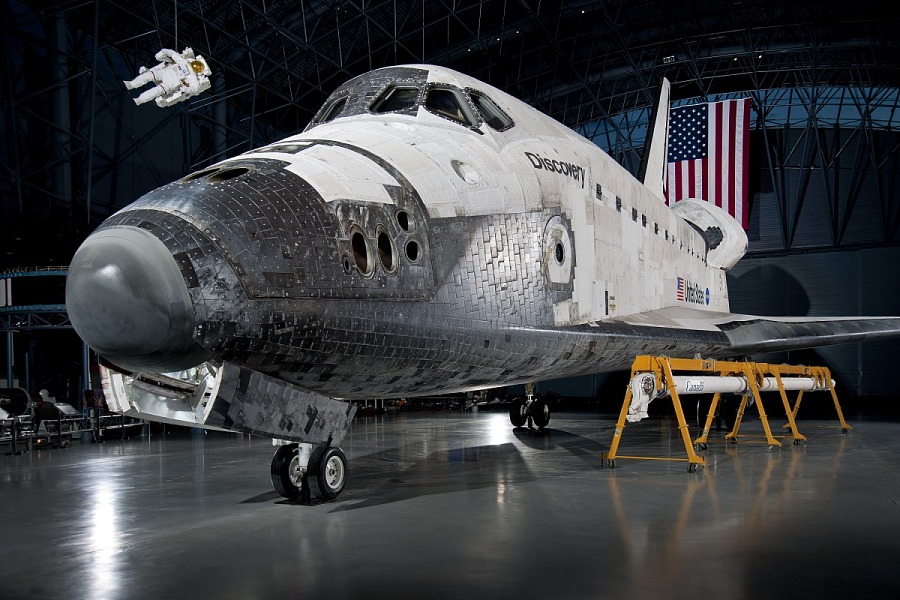
And remember, you can also visit the Steven F. Udvar-Hazy Center outside the Washington Beltway that contains large planes, jets, and spacecraft that cannot fit in the DC museum, including the Space Shuttle Discovery. Last time I went there I could walk right in without using a timed-entry pass.

Image (Credit): Space Shuttle Discovery at the Steven F. Udvar-Hazy Center. (Smithsonian Museum)

In Case You Missed It/Podcast: Retelling the Story of the Mission to the Moon

Image: Chesley Bonestell art printed in “The Conquest of the Moon” (1953). Mr. Bonestell’s art is mentioned in the Moonrise podcast.

If you are looking for a good story that you to listen to during your next car trip, you cannot do better than the Washington Post’s Moonrise podcast. It has a bit of everything, including science fiction stories, Nazi war machines, Russian persecution, American post-WWII politics, and a bit of astronomy as well.

Here is how the program sells itself:

Want to uncover the real origin story behind the United States’ decision to go to the moon? In the 50 years since the moon landing, as presidential documents have been declassified and secret programs revealed, a wild story has begun to emerge. “Moonrise,” a Washington Post audio miniseries hosted by Lillian Cunningham, digs into the nuclear arms race of the Cold War, the transformation of American society and politics ⁠— and even the birth of science fiction ⁠— to unearth what really drove us to the moon. Come along with us on a fascinating journey from Earth to the moon.

You can learn how President Kennedy tried to get the Soviet Union to join the Apollo program – twice. You can also hear about the Apollo 11 mission competing with a Soviet spacecraft trying to land on the Moon at the same time. And have you heard about the civil rights protests at the Apollo 11 launch site?

The podcast is a well crafted story trying to weave together many threads in a mostly successful way. It is still astonishing that the early Space Race was really lead by a former Nazi representing the United States and a former political prisoner representing the Soviets. Today the Apollo story is mostly a warm blur from the past, but I believe it is worth your time to listen to the full story. It is the foundation of our space exploration efforts, for better or worse.

Artemis I: If at First You Don’t Succeed…

NASA is ready to try the uncrewed Artemis I mission again next month. The planned date is November 14, with November 16 and 19 as back up dates.

Should you need it, here is a quick summary of the Artemis I mission again:

Artemis I will be the first integrated flight test of NASA’s deep space exploration system: the Orion spacecraft, Space Launch System (SLS) rocket and the ground systems at Kennedy Space Center in Cape Canaveral, Florida. The first in a series of increasingly complex missions, Artemis I will be an uncrewed flight that will provide a foundation for human deep space exploration, and demonstrate our commitment and capability to extend human existence to the Moon and beyond. During this flight, the uncrewed Orion spacecraft will launch on the most powerful rocket in the world and travel thousands of miles beyond the Moon, farther than any spacecraft built for humans has ever flown, over the course of about a three-week mission. 

I am tired of crossing my fingers, so let’s just hope these launch dates work.

Image (Credit): Artemis I mission map. (NASA)