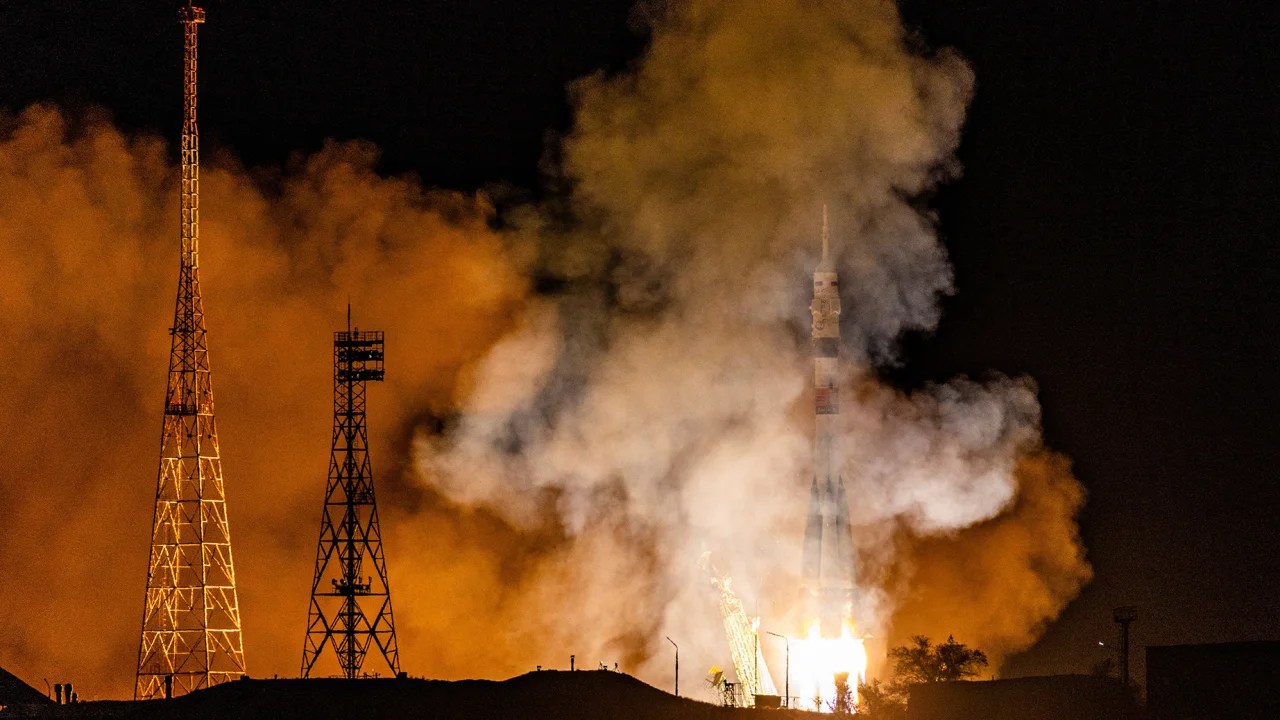
Image (Credit): The Soyuz MS-24 spacecraft blasts off to the ISS from the Baikonur Cosmodrome, Kazakhstan on September 15, 2023. (Maxim Shemetov/Reuters)
Earlier today, US astronaut astronaut Loral O’Hara as well as Roscosmos cosmonauts Oleg Kononenko and Nikolai Chub departed from Kazakhstan on a Soyuz rocket that will take them to the International Space Station (ISS). The space station will be crowded again until the three relieved crew members, including US astronaut Frank Rubio, can return to Earth.
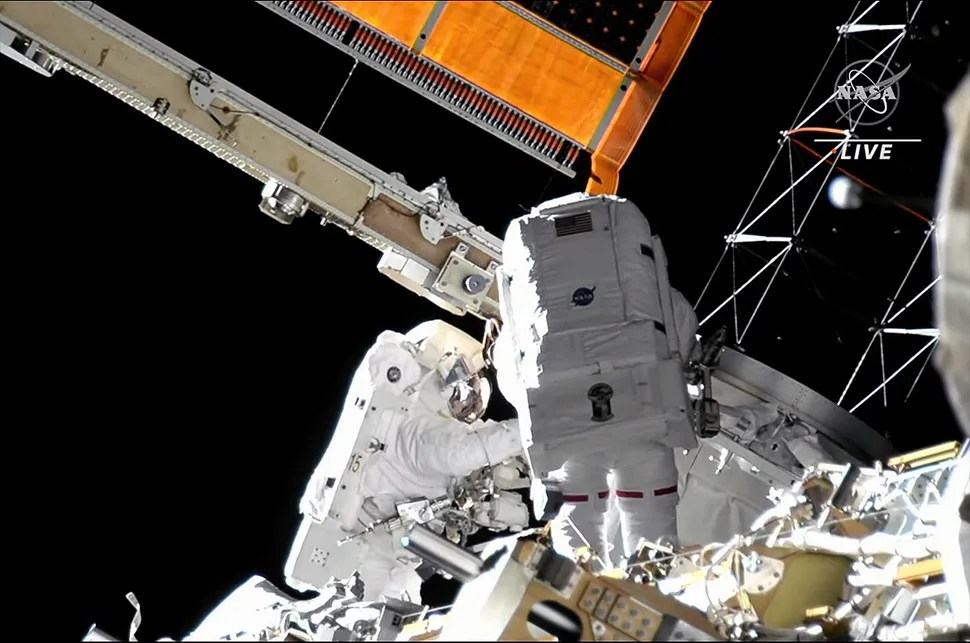
Image (Credit): NASA astronauts Frank Rubio (left) and Josh Cassada (back to camera) working outside the ISS last November. (NASA TV)
This week’s image shows astronaut Frank Rubio hard at work last year outside the International Space Station (ISS). He has now exceeded the U.S. space duration record, which was 355 days. All of this was unplanned, come as the result of a faulty Russian capsule that kept him on the station longer than his scheduled six month tour.
Mr. Rubio is set to return to Earth on September 27. At that point, he will have spent 371 days in space.
This CBS News segment discusses some of the risks related to a longer stay on the station.
Nearly a year ago, NASA successfully smashed an asteroid for the first time, in a landmark test to see whether we could divert a killer space rock before disaster — but now, the asteroid in question is behaving strangely. As New Scientist reports, a schoolteacher and his pupils seem to have discovered that the orbit of Dimorphos, the space rock socked by the Double Asteroid Redirection Test (DART) last September, has apparently continued slowing down, unexpectedly, in the year since the refrigerator-sized craft smashed into it.
Researchers from Japan predict, based on computer simulations, the likely existence of an Earth-like planet in the distant Kuiper Belt. There are many unexplained anomalies in the orbits and distribution of trans-Neptunian objects, small celestial bodies located at the outer reaches of the solar system. Now, based on detailed computer simulations of the early outer solar system, researchers from Japan predict the possibility of an undiscovered Earth-like planet beyond Neptune orbiting the Sun. Should this prediction come true, it could revolutionize our understanding of the history of the solar system.
The Japan Aerospace Exploration Agency’s (JAXA) X-Ray Imaging and Spectroscopy Mission (XRISM) lifted off on a H-IIA rocket from the Tanegashima Space Center in Japan at 08:42 JST / 00:42 BST / 01:42 CEST on 7 September 2023. The successful launch marks the beginning of an ambitious mission to explore the growth of galaxy clusters, the chemical make-up of the Universe, and the extremes of spacetime. XRISM is a collaboration between JAXA and NASA, with significant participation from ESA.
Image (Credit): Astronaut James Lovell and Marilyn Lovell at a 1969 news conference. (Paul Shane/AP)
Marilyn Lovell died on August 27th in Lake Forest, Illinois at the age of 93. She is the wife of astronaut James A. Lovell Jr., who commanded the troubled Apollo 13 mission. You can read her full obituary at the Washington Post site.
I just wanted to highlight one interesting piece from the obituary. It relates to the Lovell’s viewing the 1969 film Marooned shortly before the 1970 Apollo 13 crisis. The film, starring Gregory Peck and Gene Hackman, was a fictional account of three astronauts in a capsule facing possible destruction after a rocket failure. A short time later her husband would be one of the three astronauts facing a real crisis in a crippled capsule, while she worried below.
They say life is stranger than fiction. Luckily, Apollo 13 ended better for the crew. You way want to check out this trailer for Marooned and even rent it one of these days.
As for Marilyn Lovell, she led an amazing life here on Earth with her husband (now 95) and large family.
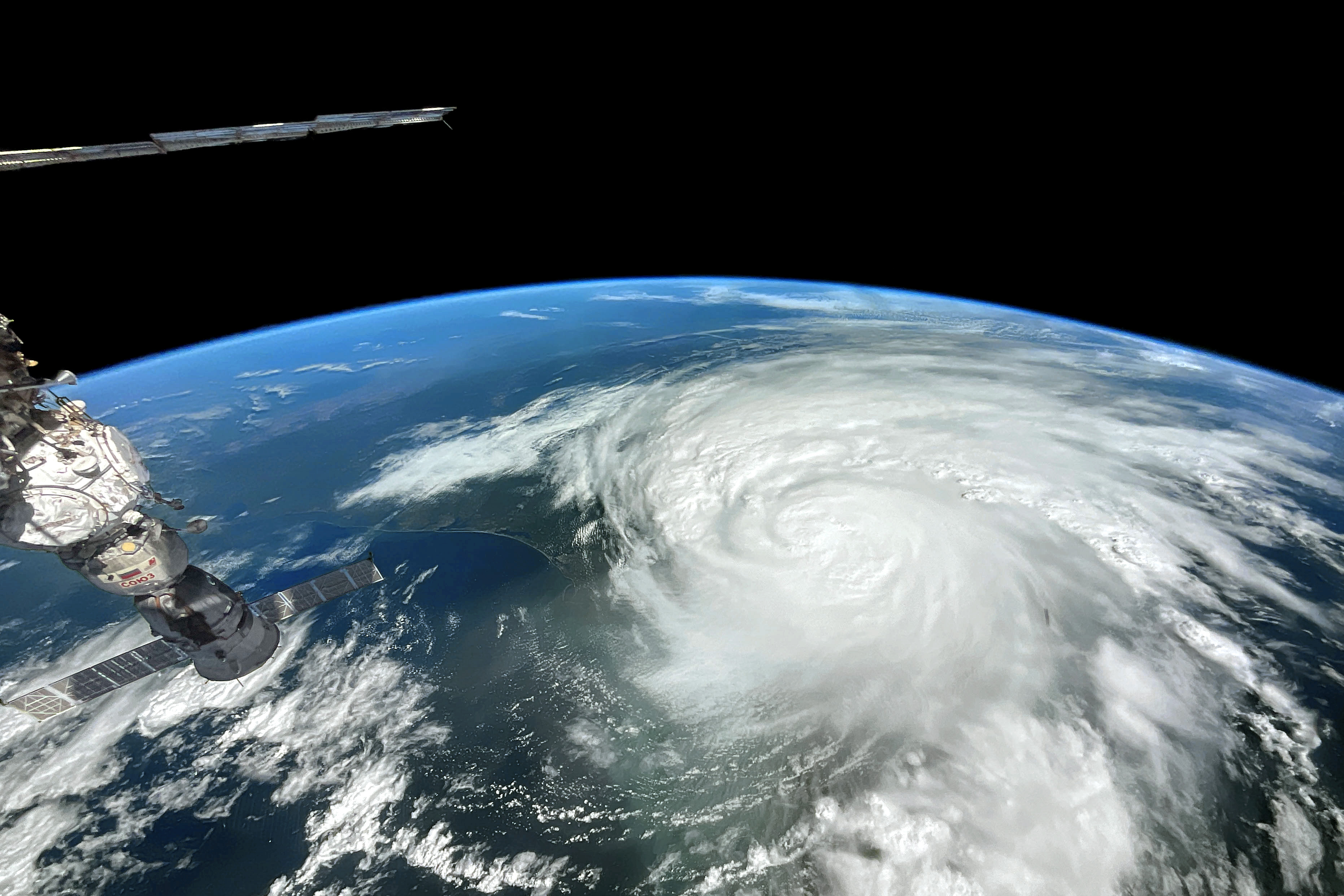
Image (Credit): Hurricane Idalia as it travels over Florida. (NASA)
The image above showing Idalia hitting Florida was captured from the International Space Station on August 30, 2023.
Here is the full explanation about the image from the site:
An astronaut on the International Space Station used a handheld camera to capture the second photo (below) at 10:44 a.m. Eastern Time (14:44 Universal Time) on August 30, several hours after landfall. Idalia had weakened to a category 1 storm by this time with sustained winds of 150 kilometers (90 miles) per hour. It continued to weaken as it moved northeast over Georgia, South Carolina, and then offshore over the Atlantic Ocean on August 31.



 Our Awesome Universe