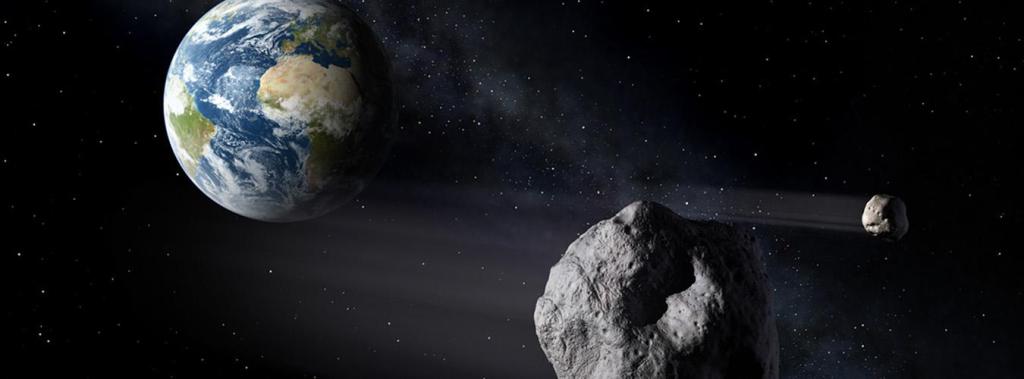
This Friday, June 30th, is International Asteroid Day as adopted by the United Nations to “…observe each year at the international level the anniversary of the Tunguska impact over Siberia, Russian Federation, on 30 June 1908, and to raise public awareness about the asteroid impact hazard.”
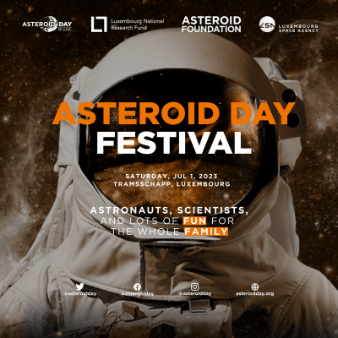
NASA has set up page to celebrate the day, as has the European Space Agency. And the Asteroid Foundation is sponsoring a few days of activities leading up to the July 1 Asteroid Day Festival in Luxembourg.
Or you can simply watch your favorite asteroid disaster film on Friday evening.
However you mark the day, enjoy yourself, and look up!
NASA has been seeking innovative solutions from the private sector to lower the retrieval costs, but the mission may be on hold for some time. Getting rocks from the Moon and even an asteroid seems easy by comparison.
Maybe NASA needs to seen another private sector solution – a study of Martian rocks on the surface of Mars. It may be easier to land a laboratory and conduct long-term experiments in situ rather than attempting a journey back to Earth. It is something to consider for now and may give us quicker access to the rocks.
Of course, we can always wait until Elon Musk lands on the Red Planet and retrieves them.
“OceanGate is doing for deep sea exploration, discovery, and research what companies like SpaceX, Blue Origin, World View, and Virgin Galactic are doing for space exploration and discovery…I look forward to supporting OceanGate’s effort to document the Titanic and its role as a deep ocean artificial reef when I join the expedition as a crewmember this summer.“
-Statement by NASA planetary scientist Alan Stern in an OceanGate press release from March 2022. Dr. Stern is best known for his role as the principal investigator of the New Horizons mission to explore Pluto and the Kuiper Belt. The press release also discusses NASA’s assistance to OceanGate in the development of the Titan submersible that is still lost in the Atlantic after a mission to take tourists to see the late Titanic. While Dr. Stern mentions exploration and discovery, this was simply tourism gone wrong. Tourism is a lucrative aspect of the four space companies listed above, but it is not without its risks. Fortunately, Dr. Stern had a good trip last summer, and we can only hope the five individuals on the Titan will also return safely to the surface.
On this day in 1983, astronaut Sally Ride became the first American woman in space, traveling aboard the shuttle Challenger. And 20 years earlier on the same date, Russian cosmonaut Valentina Tereshkova, the first Russian female in space, returned to Earth aboard Vostok 6, after orbiting the planet 48 times. She still remains the only woman to travel into space on a solo mission.
Astronomers peering into the night sky always talk about exoplanets located in the “Goldilocks Zone,” or “Habitable Zone,” similar to the Earth’s location from the sun. But what if that is too limited? What if we should also be focusing on colder regions as well as exomoons?
The new study released this week based on data from NASA’s spacecraft Cassini has found that Saturn’s moon Enceladus contains the ingredients for life as we know it. The study states:
Saturn’s moon Enceladus harbours a global ice-covered water ocean. The Cassini spacecraft investigated the composition of the ocean by analysis of material ejected into space by the moon’s cryovolcanic plume. The analysis of salt-rich ice grains by Cassini’s Cosmic Dust Analyzer enabled inference of major solutes in the ocean water (Na+, K+, Cl–, HCO3–, CO32–) and its alkaline pH. Phosphorus, the least abundant of the bio-essential elements, has not yet been detected in an ocean beyond Earth. Earlier geochemical modelling studies suggest that phosphate might be scarce in the ocean of Enceladus and other icy ocean worlds. However, more recent modelling of mineral solubilities in Enceladus’s ocean indicates that phosphate could be relatively abundant.
Again, this represents the building blocks of life and it is the first time all these ingredients have been discovered in our solar system outside of Earth. We did not find it on Venus or Mars, two other planets in the Goldilocks Zone. No, it was found in a much colder part of the solar system on a tiny moon.
This discovery certainly mixes up the situation and provides a much broader region for life to appear in other solar systems. It’s not a new idea, but it has more credibility now that we know a little more about our own neighborhood.
Maybe Goldilock’s concerns about something being too cold was not such a problem after all.
Note: It seems James Cameron figured this out years ago. The planet visited in the Avatar movies, Pandora, is portrayed as a moon (or exomoon) in the Alpha Centauri System.
Image (Credit): Pandora and its host gas giant Polyphemus from the movie Avatar. (20th Century Fox)






 Our Awesome Universe
