NASA OIG: Artemis Partnerships with International Space Agencies

I was looking through audit reports from the Government Accountability Office and NASA’s Office of Inspector General (OIG) to see what was being said about NASA’s programs. The only report of interest so far pertained to the Artemis mission and the need for greater coordination among the various partners. Audit reports often make these same recommendations over and over again, yet it does make sense that NASA’s largest outreach program since the International Space Station (ISS) should have all the pieces in place, yet it does not.

Here is the first finding in the OIG report:

Interest in the Artemis campaign is high across the international space community, as evidenced by NASA’s 54 Artemis-related international instruments and the 23 signatories to the Artemis Accords. However, the Agency lacks an overarching strategy to coordinate Artemis contributions from international space agencies and entities. Except for the Gateway Program, the Artemis campaign does not have comprehensive forums—boards, panels, and working groups— for its international partners to routinely discuss topics such as flight and mission planning, safety, and research integration. In contrast, the ISS Program–seen as a model of long-term international space cooperation–employs these forums as well as on-site representation from partner agencies.

The OIG report makes a number of recommendations related to this issue and other identified by auditors. The report also includes some helpful graphics and tables that illustrate all of the pieces going into the three Artemis missions as well as the parties contributing those pieces. This looks significantly more complex than the ISS, so I would think good coordination would be even more critical.
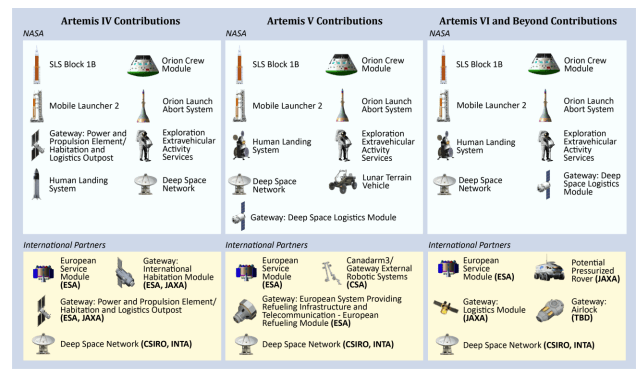
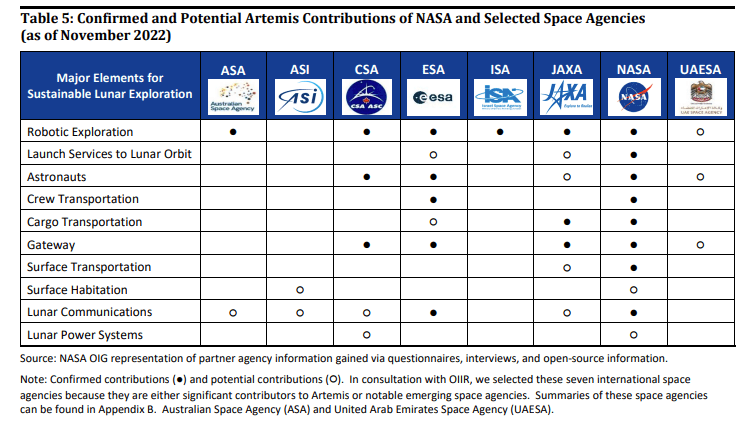
Image (Credit): Contributions to the Artemis Program by NASA and partners. (NASA OIG)
Image (Credit): A table from the NASA OIG report IG-23-004. (NASA OIG)

NASA’s Workers are Happy, and Why Not?

What could be better than studying the planets and stars? Not much, apparently, for the workers at NASA. For the eleventh year in a row, NASA has been rated as the “Best Place to Work in the Federal Government” by its own employees. The rating here applies to large agencies, with NASA being followed next by the Department of Health and Human Services and the intelligence community (see the full list here). Other agencies of small and medium sizes have separate ratings.

Federal employees rated their agencies and departments back in June and July 2022. Most of this information was captured via the Office of Personnel Management’s Federal Employee Viewpoint Survey.

Any federal agency that can send satellites and rovers to distant planets, launch telescopes that see back in time, and prepare for a return to the Moon needs to have dedicated employees to make it all possible. Of course, I hope that all of the federal employees can enjoy their work and find meaning, but NASA adds so much fun and adventure was well to the mix.

Good work, NASA!

Pic of the Week: ISS Expedition 68 Resupply

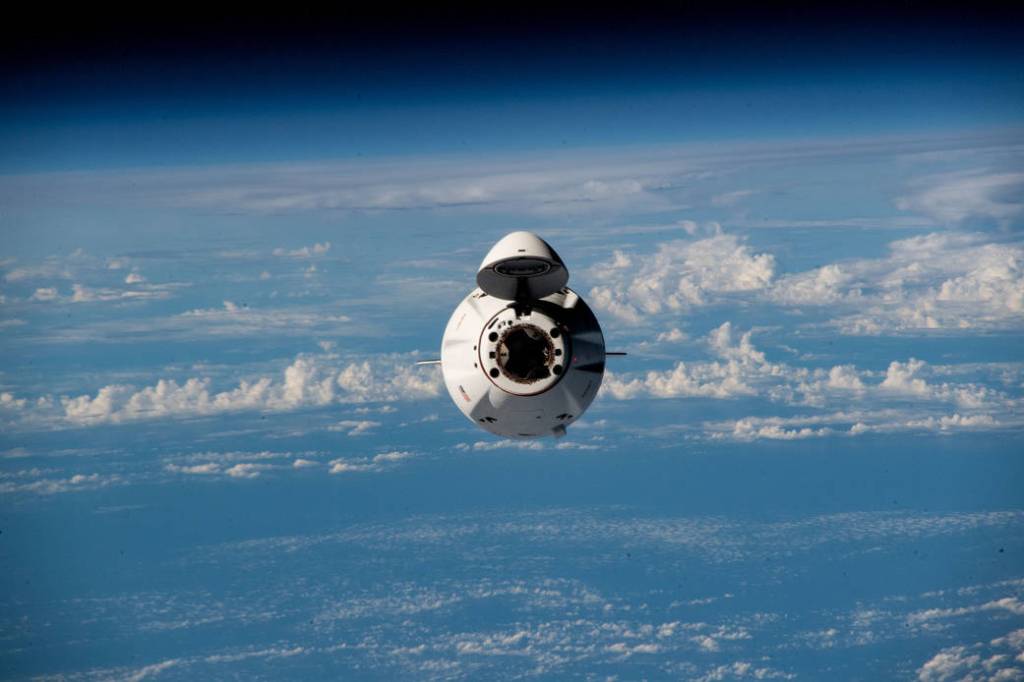
Image (Credit): SpaceX Dragon approaching the ISS. (NASA)

This week’s image comes from NASA showing a Dragon cargo ship approaching the International Space Station (ISS) earlier this month with supplies for the Expedition 68 crew. In this photo, the Dragon is above the Indian Ocean near Madagascar.

It is an amazing image each and every time. What a workplace and what a view. Telework just isn’t the same.

Pic of the Week: Martian Sample Depot

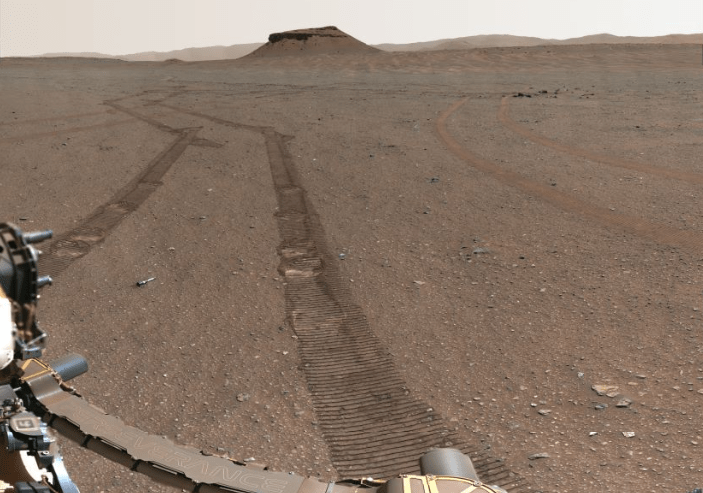
Image (Credit): NASA’s Perseverance Mars rover captured this portrait of its recently completed sample depot on Jan. 31, 2023. (NASA/JPL-Caltech/ASU/MSSS)

This week’s image shows the Perseverance Mars rover looking back on its work – the depositing of 10 titanium sample tubes on the surface of the Red Planet should they be needed as backups (see image below marking the sample locations). The rover is carrying the official samples, but this depot was set up just in case something happens to the rover.

Here is a little more from NASA:

Eight of those tubes are filled with rock and regolith (broken rock and dust), while one is an atmospheric sample and one is a “witness” tube...

The depot represents a backup collection of samples that could be recovered in the future by the Mars Sample Return campaign, a joint effort between NASA and ESA (European Space Agency) that aims to bring Mars samples to Earth for closer study. The rover began building the depot on Dec. 21, 2022, precisely spacing the tubes in case they need to be retrieved at a future date.

The primary tubes reside in the belly of Perseverance, which would pass them, along with future samples taken during the mission to a Sample Retrieval Lander as part of the campaign. If anything were to happen to the rover to prevent it from delivering tubes directly to the lander, samples could be retrieved from the depot instead. (Learn more about all 18 samples taken so far.)

Image (Credit): NASA’s Perseverance Mars rover captured this portrait of its recently completed sample depot on Jan. 31, 2023. The locations of the 10 samples are clearly marked. (NASA/JPL-Caltech/ASU/MSSS)

Blast from the Past: Adventures on Mars

Credit: NASA

Back in 2016, NASA put a few fun posters online advertising opportunities on Mars. The posters were originally originally commissioned by NASA to be part of an exhibit at the Kennedy Space Center Visitor’s Complex in 2009.

Visit the NASA poster site if you want the files for these images and others. They are great for framing, note cards, or post cards.

Credit: NASA