The Rescue Mission to the ISS has Started

Image (Credit): Launch of Russia’s Soyuz M-23 mission to the ISS. (NASA)

Yesterday, Russia launched the uncrewed Soyuz M-23 mission from the Baikonur Cosmodrome in Kazakhstan (it was actually “today” in Russian time). The spacecraft will replace the damaged M-22 capsule attached to the International Space Station (ISS).  As a result, the earlier M-22 crew of Russian cosmonauts Sergey Prokopyev and Dmitri Petelin, and NASA astronaut Frank Rubio, will return in this replacement capsule.

NASA noted that the M-22 capsule will be studied by the Russian upon its return in March:

The damaged Soyuz MS-22 is scheduled to undock from the station in late March and return to Earth for an uncrewed parachute-assisted landing in Kazakhstan, and post-flight analysis by Roscosmos.

Given recent leaks on two Russian spacecraft, let’s hope the M-23 mission goes without a hitch. Fingers crossed.

SpaceX will also be shipping a new crew up to the ISS next week, so the space traffic continues even with these hiccups.


What’s Going on at the International Space Station?

Image (Credit): The Progress 82 cargo craft approaches the ISS on October 27, 2022. (NASA)

It appears that we now have two problematic capsules attached to the International Space Station (ISS). Late last year, we learned about a liquid coolant lead in the Russian Soyuz Crew Return Vehicle (Soyuz MS-22 crew ship), and now we have a leak in the second Russian capsule as well (Progress 82 cargo capsule). This is not a good sign for the seven ISS crew members, some of whom were already scheduled to go home.

After inspecting the Progress 82 spacecraft, it was set loose on Friday to burn up over the Pacific Ocean, as noted by NASA:

Loaded with trash, Progress 82 undocked from the space station’s Poisk module at 9:26 p.m. EST Friday, Feb. 17. The Progress deorbit was delayed about 24-hours while Roscosmos engineers analyzed imagery acquired after undocking of the radiator area of the spacecraft, which is the suspected region where a coolant leak occurred on Feb. 11.

As a result of this second incident, the Russian launch of a replacement capsule (Soyuz MS-23), scheduled for this week, may need to be delayed until the issues with both spacecraft are fully discussed and understood. In a discussion about the two leaks, an NPR commentator noted:

Analysts say Russia’s supply chain has been stretched thin due to the war in Ukraine.

This is not good news for anyone. If we cannot rely on the Russian missions, the SpaceX and Northrop Grumman will be doing double duty.

Martian Climate in New England

Image (Credit): The weather tower at the Mount Washington Observatory. (Robin Lubbock/WBUR)

With all of the excitement last week regarding Chinese balloons, which is continuing into this week with two “unidentified object” incidents in Alaska and Canada, I forgot to mention the -108 F wind chill temperature at the top of Mount Washington in New Hampshire on February 3rd. The Washington Post reported that this may be the lowest temperature ever reported in U.S. history.

In fact, the Mount Washington temperature was lower than the temperature experienced that day by the Curiosity rover in Gale Crater on Mars. It is still autumn in the crater, so temperatures could still fall to -225 F during winter. Let’s not try that in New Hampshire.

Europe may be complaining about the unusually warm mountain temperatures this year, but you will not hear this talk from the Yankees up north. They are getting the full Martian treatment and staying close to their wood stoves.

Image (Source): Early February temperatures experienced by the Mars Curiosity rover. (NASA)

Space Stories: Jovian Moons, Charon’s Canyons, and a New Space Telescope

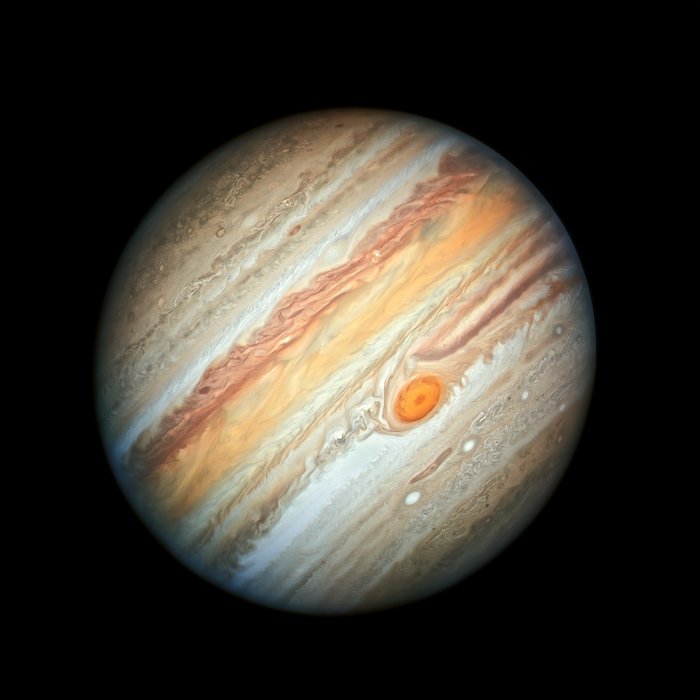
Image (Credit): Jupiter as seen by the NASA/ESA Hubble Space Telescope. (NASA, ESA, A. Simon (Goddard Space Flight Center), and M.H. Wong (University of California, Berkeley)

Here are some recent stories of interest.

Live Science: “Jupiter Officially has the Most Moons in the Solar System, Discovery of 12 New Satellites Confirms

Jupiter was already the king of the solar system, and new discoveries give the massive planet another way to reign supreme: It now has the most moons. Twelve new moons discovered orbiting Jupiter have been confirmed, bumping the count from 80 to 92, and knocking Saturn — which has 83 moons — down a peg. 

Phys.org: “Models Explain Canyons on Pluto’s Large Moon Charon

In 2015, when NASA’s New Horizons spacecraft encountered the Pluto-Charon system, the Southwest Research Institute-led science team discovered interesting, geologically active objects instead of the inert icy orbs previously envisioned. An SwRI scientist has revisited the data to explore the source of cryovolcanic flows and an obvious belt of fractures on Pluto’s large moon Charon. These new models suggest that when the moon’s internal ocean froze, it may have formed the deep, elongated depressions along its girth but was less likely to lead to cryovolcanoes erupting with ice, water and other materials in its northern hemisphere.

Big Think: “NASA’s Habitable Worlds Observatory to Finally Answer the Epic Question: “Are we Alone?”

…perhaps the biggest question of all — that of “Are we alone in the Universe?” — remains a mystery. While the current generation of ground-based and space-based telescopes can take us far into the Universe, this is a question that’s currently beyond our reach. To get there, we’ll need to directly image Earth-like exoplanets: planets with sizes and temperatures similar to Earth, but that orbit Sun-like stars, not the more common red dwarf stars like Proxima Centauri or TRAPPIST-1. Those capabilities are precisely what NASA is aiming for with its newly announced flagship mission: the Habitable Worlds Observatory. It’s an ambitious project but one that’s well worth it. After all, finding out we’re not alone in the Universe would quite possibly be the biggest revolution in all of science history.

Space Quote: Nukes in Space

Image (Credit): NASA’s Cassini spacecraft lifts off on Oct. 15, 1997, atop a Titan IVB rocket. (NASA)

“NASA should educate the public about why nuclear propulsion is not only something nice to have, but is a necessity if human civilization is to spread beyond the Earth on a greater scale than a few explorers. Access to the mineral and energy resources of the solar system would be a boon to all humankind and would be worth the infinitesimal risk of launching nuclear fuel into space.”

-Statement by Mark R. Whittington in an editorial in The Hill titled “Will the NASA-DARPA nuclear engine test cause environmental protests?” In his piece, Mr. Whittington discusses plans to build a nuclear-powered rocket for a Mars mission and highlights how protests surrounded the 1997 launch of the nuclear-powered Cassini probe to Saturn, with one scientist estimating that “an explosion on the launch pad could spread radioactive plutonium across Central Florida, potentially cause more than 1 million casualties…” Mr. Whittington is the author of various space exploration studies, such as Why is It So Hard to Go Back to the Moon?