Space Stories: The End of Geotail, a Galactic Map, and Sweden Gets a Spaceport

Image (Credit): An artist’s rendering of the Geotail spacecraft. (NASA)

Here are some recent stories of interest.

NASA: “NASA’s Geotail Mission Operations Come to an End After 30 Years

After 30 years in orbit, mission operations for the joint NASA-JAXA Geotail spacecraft have ended, after the failure of the spacecraft’s remaining data recorder. Since its launch on July 24, 1992, Geotail orbited Earth, gathering an immense dataset on the structure and dynamics of the magnetosphere, Earth’s protective magnetic bubble. Geotail was originally slated for a four-year run, but the mission was extended several times due to its high-quality data return, which contributed to over a thousand scientific publications. While one of Geotail’s two data recorders failed in 2012, the second continued to work until experiencing an anomaly on June 28, 2022. After attempts to remotely repair the recorder failed, the mission operations were ended on November 28, 2022.

Phys.org: “Billions of Celestial Objects Revealed in Gargantuan Survey of the Milky Way

Astronomers have released a gargantuan survey of the galactic plane of the Milky Way. The new dataset contains a staggering 3.32 billion celestial objects—arguably the largest such catalog so far. The data for this unprecedented survey were taken with the Dark Energy Camera, built by the US Department of Energy, at the NSF’s Cerro Tololo Inter-American Observatory in Chile, a Program of NOIRLab.

Advanced Television: “Sweden Inaugurates Rocket Launch Site

While much of the world’s press recently focused on Virgin Orbit’s failed ‘horizontal’ aircraft launch of a batch of 9 small satellites from Spaceport Cornwall, other rivals are gearing up to tap into the growing demand for satellite launches. Sweden has claimed the crown as “mainland Europe’s first orbital launch site”. Ursula von der Leyen, President of the European Commission, helped cut the ribbon at Kiruna, Sweden, saying: “This spaceport offers an independent European gateway to space. It is exactly the infrastructure we need, not only to continue to innovate but also to further explore the final frontier.”

Exoplanet TOI-700e Could Sustain Life

Image (Credit): Artist’s rendering of exoplanet TOI-700e. (NASA/JPL-Caltech/Robert Hurt)

The search for another Earth continues, and a professor from Michigan State may have found a perfect candidate. Joey Rodriguez, an assistant professor in MSU’s Department of Physics and Astronomy, was working with researchers involved with NASA’s Transiting Exoplanet Survey Satellite (TESS) when the discovery was made. Since being launched in 2018, the TESS spacecraft is surveying 200,000 stars looking for exoplanets that transit in front of their parent star and thereby periodically block part of the star’s light.

Back in 2020, the TESS team spotted the 100 light-year distant solar system and three exoplanets, but the latest finding includes Earth-size TOI-700e, which orbits in the habitable zone around parent star TOI-700. Its orbit is closer to that of Venus than Earth, yet still within the habitable zone.

In the Lansing State Journal article reporting the finding, Emily Gilbert, a postdoctoral fellow at NASA’s Jet Propulsion Laboratory in Southern California leading the project, stated:

This is one of only a few systems with multiple, small, habitable-zone planets that we know of,…That makes the TOI-700 system an exciting prospect for additional follow-up.

A closer look at the planet’s atmosphere will tell scientists more about the likelihood of life on the surface. Maybe this will be another candidate for the James Webb Space Telescope (JWST). The JWST has already probed other exoplanets to learn more about their atmosphere.

You can learn more about the new exoplanet at this NASA link.

Space Stories: JWST Confirms Earth-Size Exoplanet, Russia Sending Rescue Mission to ISS, and IO Erupts

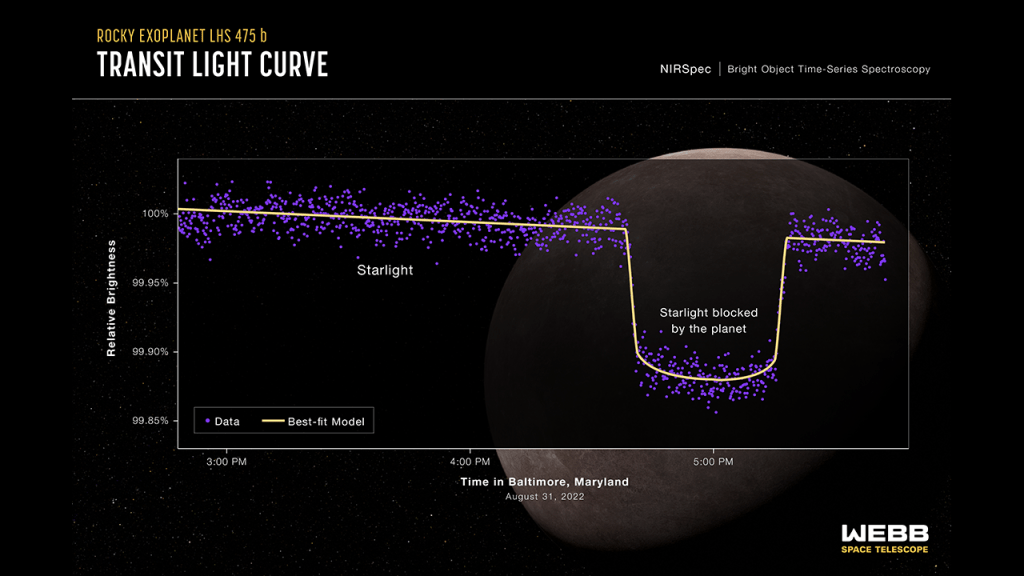
Image (Credit): James Webb Space Telescope (JWST) data associated with exoplanet LHS 475 b. (NASA, ESA, CSA, Leah Hustak (STScI))

Here are some recent stories of interest.

Webb Space Telescope: “NASA’s Webb Confirms Its First Exoplanet

Researchers confirmed an exoplanet, a planet that orbits another star, using NASA’s James Webb Space Telescope for the first time. Formally classified as LHS 475 b, the planet is almost exactly the same size as our own, clocking in at 99% of Earth’s diameter. The research team is led by Kevin Stevenson and Jacob Lustig-Yaeger, both of the Johns Hopkins University Applied Physics Laboratory in Laurel, Maryland.

ABC News: “Russia Will Launch New Capsule to Return Space Station Crew

Russia will send up a new capsule next month to bring back three space station crew members whose original ride home was damaged, officials said Wednesday. The two Russians and one American will stay several extra months at the International Space Station as a result of the capsule switch, possibly pushing their mission to close to a year, NASA and Russian space officials told reporters.

MSN Science Alert: “Massive Volcanic Outburst Detected on Jupiter’s Hellish Moon Io

In the space around Jupiter, a torus of plasma created and fed by Io’s volcanic emissions grew significantly richer between July and September of last year and persisted until December, showing the moon underwent a spate of volcanic activity that released a huge amount of material. For something that’s just a little bit bigger than Earth’s Moon, Io is an absolute beast of volcanism. It’s bristling with volcanoes, with around 150 of the 400 known volcanoes erupting at any given time, creating vast lakes of molten lava.

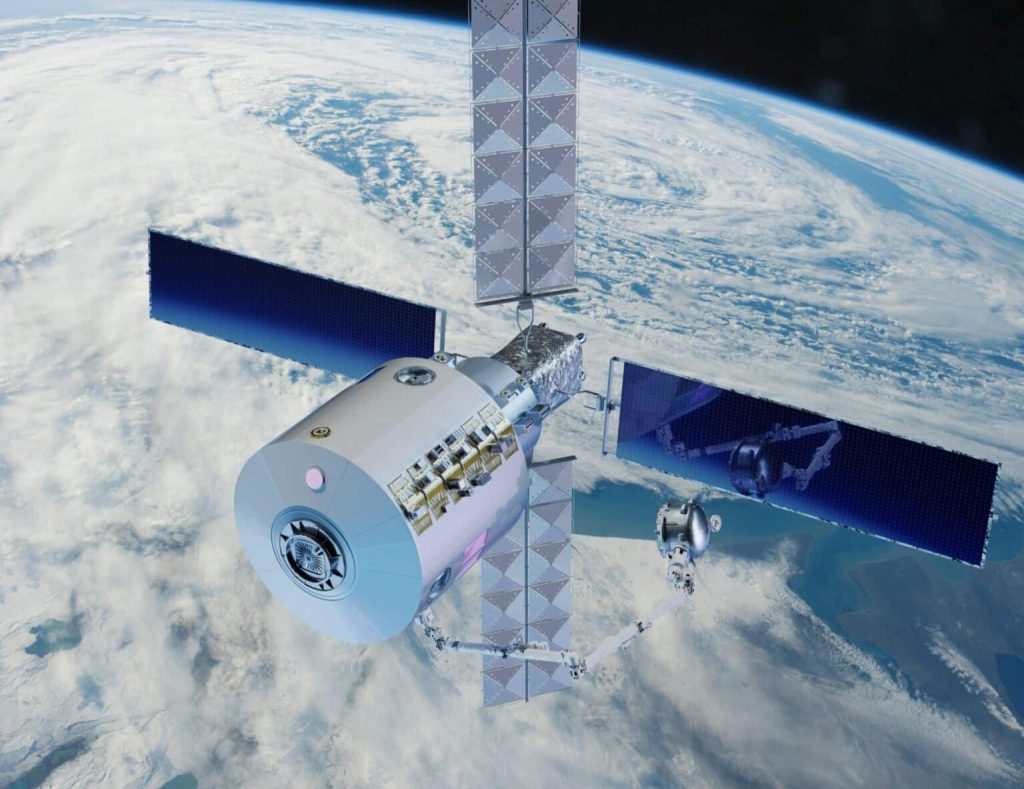
Space Quote: Starlab to Replace the ISS

Image (Credit): Image of Starlab from the Voyager Space website. (Voyager Space)

“This partnership with Voyager Space is the first step toward fielding the next generation of space stations to serve international astronauts. We are excited to support a project aimed at changing history…This collaboration is an important step in making Starlab a reality, providing a foundation for long-lasting European and American leadership in space. Our team is looking forward to diving in on the technology and putting our best engineers to work.”

-Statement by Jean-Marc Nasr, Executive Vice President of Space Systems at Airbus Defence and Space, in a press release regarding Voyager Space and Airbus Defence and Space partnering to develop and operate Starlab in 2028. The Low-Earth Orbit space station will serve NASA, ESA, and others in the scientific community following the retirement of the International Space Station. NASA has already awarded $160 million to Voyager and Nanoracks, its operating company, to create the new space station.

Space Stories: Passing of Apollo Astronaut Walter Cunningham, Opal on Mars, and Juno Recovers

Image (Credit): Walter Cunningham adjusts his pressure suit before the Apollo 7 launch on October 11, 1968. (NASA)

Here are some recent stories of interest.

NASA: “Apollo Astronaut Walter Cunningham Dies at 90

Former astronaut Walter Cunningham, who flew into space on Apollo 7, the first flight with crew in NASA’s Apollo Program, died early Tuesday morning in Houston. He was 90 years old. “Walt Cunningham was a fighter pilot, physicist, and an entrepreneur – but, above all, he was an explorer. On Apollo 7, the first launch of a crewed Apollo mission, Walt and his crewmates made history, paving the way for the Artemis Generation we see today,” said NASA Administrator Bill Nelson. “NASA will always remember his contributions to our nation’s space program and sends our condolences to the Cunningham family.”

New Atlas: “Curiosity Finds Opal on Mars – a Possible Water Source for Astronauts

NASA’s Curiosity rover has discovered opal on Mars. The deposits may prove to be valuable to future Martian explorers not as jewelry but as a potential source of water. Opal is formed when water weathers silica-rich rocks, forming a solution that settles into cracks and crevices in the rock. Over time, this solution hardens into a solid lump that can be cloudy and dull or a dazzling display of color. Most supplies come from either Australia or Ethiopia, but now a new source has been discovered – Mars.

Space.com: “Juno Spacecraft Recovering its Memory After Mind-blowing Jupiter Flyby, NASA Says

NASA’s Juno probe is continuing to recover its memory at Jupiter after a data disruption interrupted communications between the spacecraft and its operators on Earth following a flyby of the giant planet in December. The Juno spacecraft’s latest flyby of Jupiter, its 47th close pass of the planet, was completed on Dec. 14. But as its operators at NASA’s Jet Propulsion Laboratory were receiving science data from the flyby they found they could no longer directly access the spacecraft’s memory. The team successfully rebooted Juno’s computer and on Dec. 17 they placed the spacecraft into “safe mode” with only essential systems operating as a precaution.