Space Stories: Bezos on the Moon, Strange Oort Objects, and Europe Visits Venus

Image (Credit): Artist’s rending of the Blue Origin lunar cargo lander. (Blue Origin)

Here are some recent stories of interest.

Reuters: “Bezos’ Space Company Teams with Lockheed, Boeing for NASA Moon Lander Pitch

Jeff Bezos’ space company Blue Origin is partnering with Boeing Co and Lockheed Martin Corp to pitch a lunar lander to NASA as the agency seeks to send humans to the moon again, the companies announced on Tuesday. The joint moon lander proposal, led by Blue Origin, marks the companies’ second attempt to win a coveted moon lander contract as NASA seeks more options for getting astronauts to the lunar surface under its multibillion dollar Artemis program.

Western University: “‘Unexpected’ Space Traveller Defies Theories About Origin of Solar System

Researchers from Western have shown that a fireball that originated at the edge of the Solar System was likely made of rock, not ice, challenging long-held beliefs about how the Solar System was formed. Just at the edge of our Solar System and halfway to the nearest stars is a collection of icy objects sailing through space, known as the Oort Cloud. Passing stars sometimes nudge these icy travellers towards the Sun, and we see them as comets with long tails. Scientists have yet to observe any objects in the Oort Cloud directly, but everything detected so far coming from its direction has been made of ice. Theoretically, the very basis of understanding our Solar System’s beginnings is built upon the foundation that only icy objects exist in these outer reaches and certainly, nothing made of rock.

Universe Today: “ESA’s Upcoming Mission Will Tell us if Venus is Still Volcanically Active

The EnVision mission is ESA’s fifth medium-class mission to Venus. It’s being planned in a partnership between NASA and ESA, and NASA will be providing the synthetic aperture radar instrument, which will map the surface (much as Magellan did). In addition to the two radars, the orbiter will carry spectrometers to study the atmosphere and surface. They will monitor trace gases in the atmosphere and analyze surface composition. The idea is to look for surface changes that might be linked to signs of active volcanism. Along with the VERITAS and DAVINCI missions, EnVision should reveal all we need to know about volcanic activity on Venus.
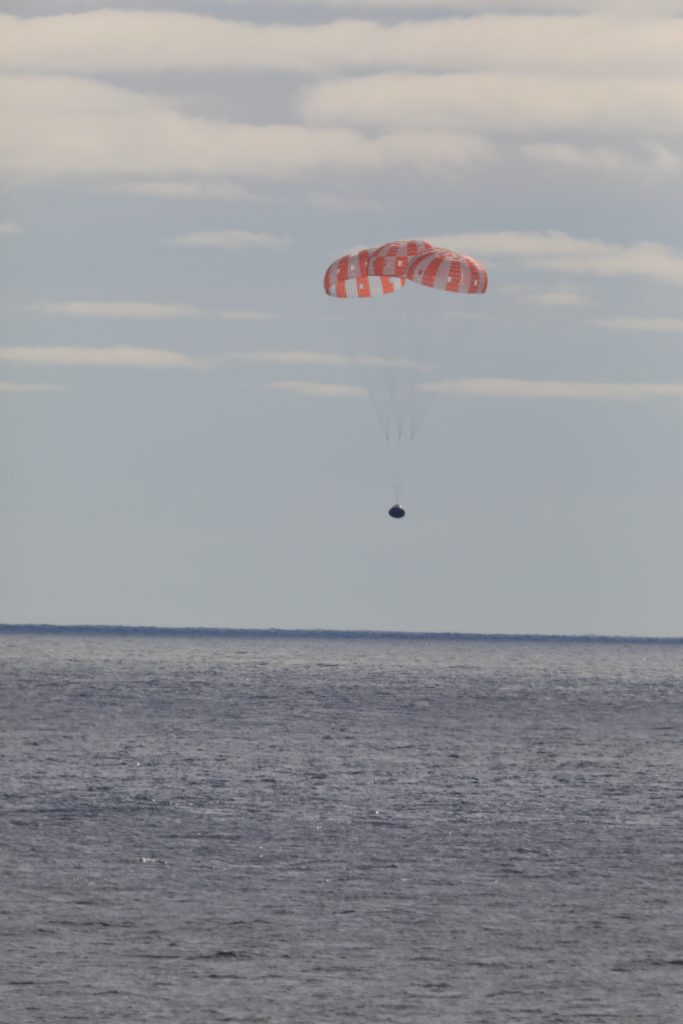
Orion Has Returned

Image (Credit): The return on the Orion capsule over the Pacific Ocean on December 11th. (NASA)

The Orion has landed, or splashed down to be more accurate. The Artemis I mission had a successful finish with the Orion capsule parachuting down into the Pacific at 12:40 p.m. EST today. At the time of this posting, the capsule was still afloat in the water while awaiting a review by engineers before being taken aboard the USS Portland.

Now we can start talking about Artemis II.

Orion Re-Entry: Don’t Miss It

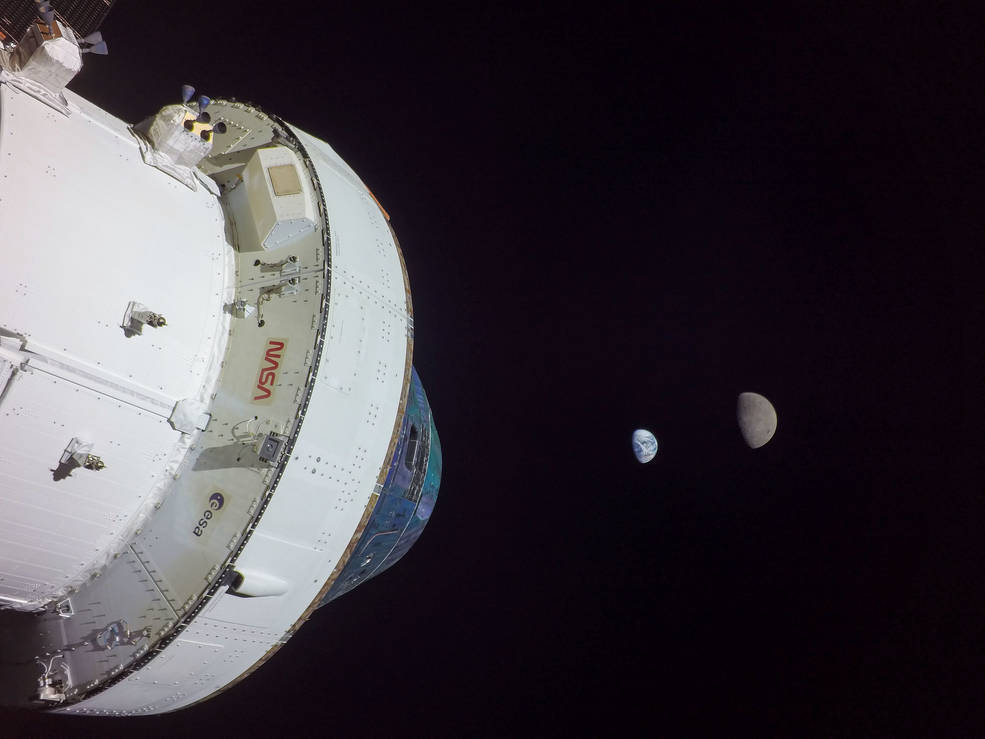
Image (Credit): November 28, 2022 image from NASA’s uncrewed Orion spacecraft when it was nearly 270,000 miles from Earth during the Artemis I flight test. (NASA)

This Sunday, November 11th, will see the return of the Orion spacecraft. Tune into NASA to watch Orion’s re-entry and spashdown. Live splashdown coverage will begin at 11 a.m. EST. The splashdown itself is scheduled for 12:39 p.m. EST. You can watch all of the coverage live on NASA TV, the agency’s website, and the NASA app.

Image (Credit): The Artemis I recovery team aboard the USS Portland in the Pacific Ocean. The team is out at sea ahead of the Dec. 11 Orion splashdown. (NASA)

In Case You Missed It: Poop for the Ages

Image (Credit): A trasch bag lying beneath the Apollo Lunar Module in 1969. (NASA)

Back in July 2019, Vox had a great article about the waste astronauts left behind on the Moon. In the article, “Apollo Astronauts Left Their Poop on the Moon. We Gotta Go Back for That Shit.,” we learn about approximately 96 bags of human waste left behind on the moon. The topic is relevant today because (1) we are talking about returning to the Moon under the Artemis mission and (2) we probably want to learn more about the lifespan of this waste before we continue to deposit it on the Moon, Mars, and elsewhere. So maybe it is time to revisit the poop.

Earlier, The Atlantic had another article that listed much more human debris on the Moon than just the 96 bags (of urine, feces, and vomit, mind you). Here is the incomplete list:

  • more than 70 spacecraft, including rovers, modules, and crashed orbiters;
  • 5 American flags;
  • 2 golf balls;
  • 12 pairs of boots;
  • TV cameras;
  • film magazines;
  • 96 bags of urine, feces, and vomit;
  • numerous Hasselbad cameras and accessories;
  • several improvised javelins;
  • various hammers, tongs, rakes, and shovels;
  • backpacks;
  • insulating blankets;
  • utility towels;
  • used wet wipes;
  • personal hygiene kits;
  • empty packages of space food;
  • a photograph of Apollo 16 astronaut Charles Duke’s family;
  • a feather from Baggin, the Air Force Academy’s mascot falcon, used to conduct Apollo 15’s famous “hammer-feather drop” experiment;
  • a small aluminum sculpture, a tribute to the American and Soviet “fallen astronauts” who died in the space race—left by the crew of Apollo 15;
  • a patch from the never-launched Apollo 1 mission, which ended prematurely when flames engulfed the command module during a 1967 training exercise, killing three U.S. astronauts;
  • a small silicon disk bearing goodwill messages from 73 world leaders, and left on the moon by the crew of Apollo 11;
  • a silver pin, left by Apollo 12 astronaut Alan Bean;
  • a medal honoring Soviet cosmonauts Vladimir Komarov and Yuri Gagarin; and
  • a cast golden olive branch left by the crew of Apollo 11.

In the 2022 movie Moonshot, we sent Martian trash back to Earth. But that was not the case with the Moon. And now China and Russia are clamoring to do the same in the near future. Will the Moon someday be marked with more trash heaps than craters?

One might argue that explorers throughout time have had to leave something behind. Think of the piles of trash as well as corpses left on the top of Mount Everest. The great sea explorers also left plenty of men, material, and ships at the bottom of the sea where they would remain unclaimed.

But the interesting part of the Vox story is the potential of life remaining in that trash and even producing new life. If such biological material can seed new life, then who can say whether the Earth was simply a rest stop for aliens on their way somewhere else, and we are the product of their poop.

One more thing. If we do manage to let the Earth slip away from us and flip into another Venusian nightmare, the Moon poop may be the only human biology for a future alien to analyze. We sent the Voyager and other spacecraft out into the void with recordings and data, but no one thought about adding a biological component. Well, now we have that surviving piece on the Moon should it be needed. If we can figure out what a Tyrannosaurus was eating millions of years ago, maybe future visitors can figure out what the astronauts were eating in 20th century Texas.

Intense stuff, and worth reading about when you have a moment.

Pic of the Week: Stellar Glitter

Image (Credit): NGC 2260 in the constellation Vela. (NASA, ESA, and T. von Hippel (Embry-Riddle Aeronautical University); Processing: Gladys Kober (NASA/Catholic University of America))

This week’s image containing all of the sparkling stellar glitter is from the Hubble Space Telescope. Hubble continues to astound with an ongoing stream of amazing images.

Here is a little more from NASA on the image above:

This glittering group of stars, shining through the darkness like sparks left behind by a firework, is NGC 2660 in the constellation Vela, best viewed in the southern sky. NGC 2660 is an open cluster, a type of star cluster that can contain anywhere from tens to a few hundreds of stars loosely bound together by gravity. The stars of open clusters form out of the same region of gas and dust and thus share many characteristics, such as age and chemical composition. Unlike globular clusters – their ancient, denser, and more tightly-packed cousins – open clusters are easier to study since astronomers can more easily distinguish between individual stars. Their stars can be old or young, and they may disperse after a few million years into the spiral or irregular galaxies where they are born.

The spikes surrounding many of the stars in this image are “diffraction spikes,” which occur when the glow from bright points of light reflects off of Hubble’s secondary mirror support. The bright red object to the left with the very prominent diffraction spikes is a foreground star that is not part of the cluster. Hubble observed this open cluster as part of a program to study the ages of white dwarf stars in open clusters.