Image (Credit): NASA’s Space Launch System rocket carrying the Orion spacecraft launches on the Artemis I flight test, Wednesday, Nov. 16, 2022, from Launch Complex 39B at NASA’s Kennedy Space Center in Florida. (NASA/Bill Ingalls)
After multiple attempts, NASA’s Artemis I mission started earlier today when the Space Launch System took off from the Kennedy Space Center carrying the uncrewed Orion spacecraft. It was a successful start to 25 day mission.
For a third time now, I am providing the mission facts, which are more meaningful given that we have a true launch:
Launch date: Nov. 16, 2022
Mission duration: 25 days, 11 hours, 36 minutes
Total distance traveled: 1.3 miIlion miles
Re-entry speed: 24,500 mph (Mach 32)
Splashdown: Dec. 11, 2022
This first test of the rocket and capsule will get us to the Artemis II mission, which includes a crewed Orion capsule.
Apollo II Astronaut Michael Collins said “I think a future flight should include a poet, a priest and a philosopher . . . we might get a much better idea of what we saw.” At the moment we are sending dummies around the Moon, but let hopes the others follow shortly.
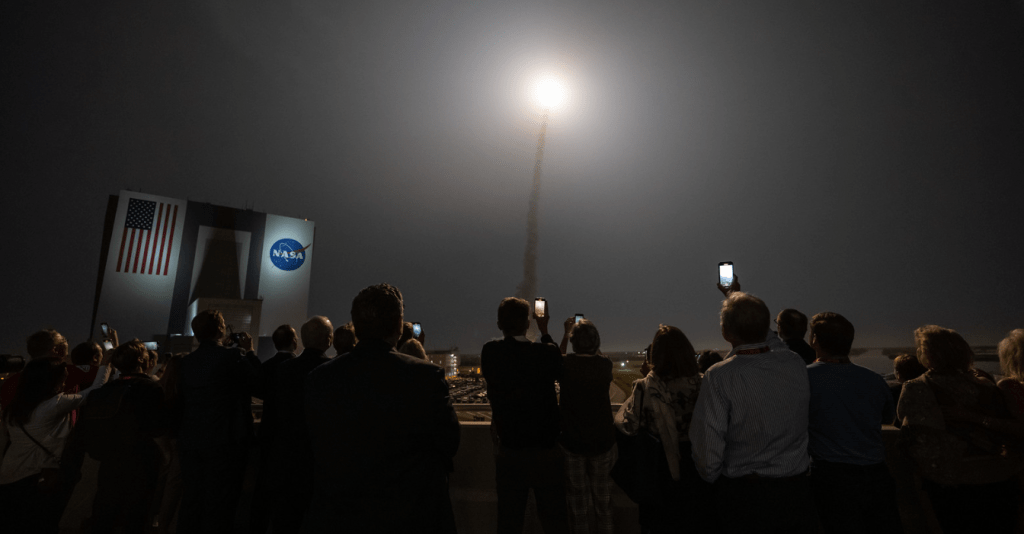
Image (Credit): Guests watch the Artemis I launch on November 16, 2022. (NASA/Bill Ingalls)
Image (Credit): Challenger STS-51L crew members Michael J. Smith, front row left, Francis R. “Dick” Scobee, Ronald E. McNair; Ellison S. Onizuka, back row left, S. Christa McAuliffe, Gregory B. Jarvis, and Judith A. Resnik. (NASA)
“The crew of the space shuttle Challenger honored us by the manner in which they lived their lives. We will never forget them, nor the last time we saw them, this morning, as they prepared for their journey and waved goodbye and ‘slipped the surly bonds of earth’ to ‘touch the face of God.'”
-Statement by President Ronald Reagan addressing the nation from the Oval Office at the White House on January 28, 1986 following the space shuttle Challenger disaster. It seems like a good time to remember the crew given the news this week about debris recovered from the space shuttle. You can find the entire White House address here.
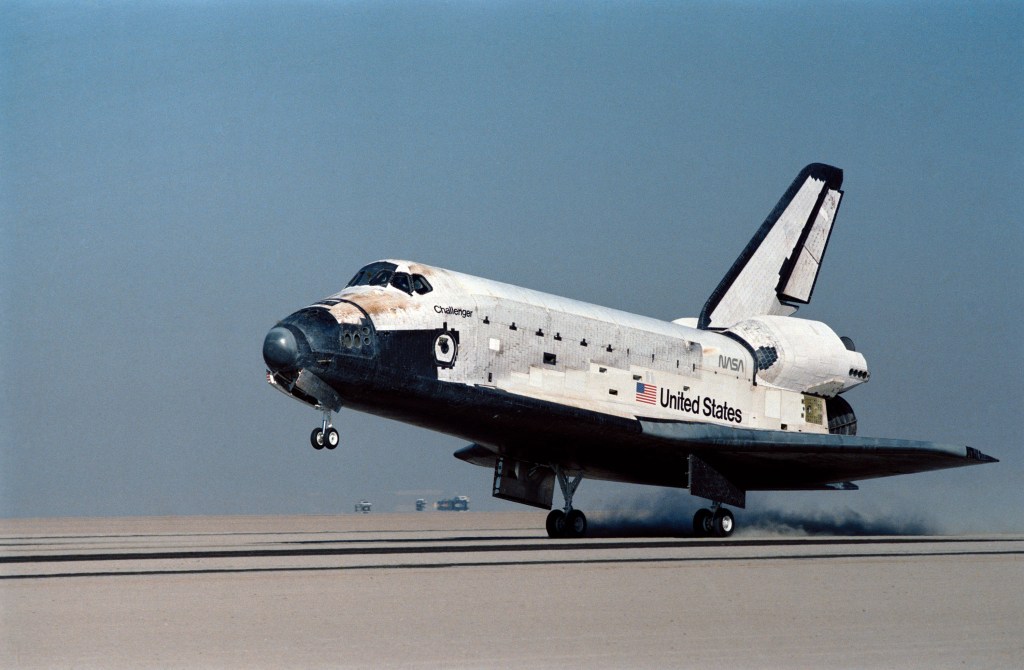
NASA leaders recently viewed footage of an underwater dive off the East coast of Florida, and they confirm it depicts an artifact from the space shuttle Challenger. The artifact was discovered by a TV documentary crew seeking the wreckage of a World War II-era aircraft. Divers noticed a large humanmade object covered partially by sand on the seafloor. The proximity to the Florida Space Coast, along with the item’s modern construction and presence of 8-inch square tiles, led the documentary team to contact NASA.
China has completed a first hot fire test of a fully-assembled powerful new engine that could power new launch vehicles and boost the country’s space capabilities. The full system test of the 500-ton-thrust, dual nozzle kerosene-liquid oxygen staged combustion cycle engine took place on Nov. 5, marking a milestone for the rocket engine.
A Northrop Grumman capsule delivered several tons of supplies to the International Space Station on Wednesday despite a jammed solar panel. The shipment arrived two days after launching from Virginia. Only one of the cargo ship’s two round solar panels opened following liftoff. Flight controllers tried in vain to open the stuck panel, but managed to draw enough power for the flight with just one.
Image (Credit): Status of Tropical Storm Nicole on Thursday morning. (The National Hurricane Center)
Florida does have its issues this time of year (and I don’t mean elections), making rocket launches more difficult. Now Tropical Storm Nicole is battering the state, leading to a delay in the upcoming Artemis I launch. The new launch date is November 16, as noted on NASA’s latest Artemis blog:
NASA is continuing to monitor Tropical Storm Nicole and has decided to re-target a launch for the Artemis I mission for Wednesday, Nov. 16, pending safe conditions for employees to return to work, as well as inspections after the storm has passed. Adjusting the target launch date will allow the workforce to tend to the needs of their families and homes, and provide sufficient logistical time to get back into launch status following the storm.
Image (Credit): Lego Lunar Research Base playset. (Lego)
While we await the Artemis III crew landing on the Moon and related lunar base, you might want to create your own mission with the Lego Lunar Research Base (shown above), which has “NASA-inspired” details. The playset has almost 800 Lego pieces, so you can build it yourself (to NASA specs, of course).
The playset comes with a “… lunar lander, VIPER rover and a domed accommodation module with laboratories, garage and air lock, plus 6 astronaut minifigures. I’m assuming the rocket that gets the astronaut minifigures to the Moon is sold separately.
It’s great to see that Lego is allowing kids to build their own space missions at home.
Image (Credit): Lego International Space Station playset. (Lego)
Some of you may have played with Star Wars and Star Trek sets as kids, but at least these latest Lego set have a ring of credibility. Star Wars helped you destroy the galaxy, whereas Star Trek seemed more interest in exploration and at least had the veneer of Artemis CXXV.
The Jiuquan Satellite Launch Center playset comes with a Long March 2F rocket and an authentic warning sign stating, “Those stealing secrets will be caught, once they’re caught they will be killed [decapitated].”
Maybe even reality is not always the best model for play.
Extra: You can find more Lego space models at the NASA gift shop.





 Our Awesome Universe