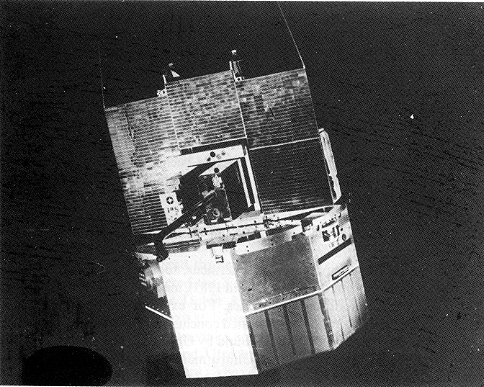
A Day in Astronomy: Launch of the Orbiting Solar Observatory 7

Image (Credit): Artist’s impression of NASA’s Orbiting Solar Observatory 7 circling the Earth. (NASA)

On this day in 1971, NASA launched the Orbiting Solar Observatory 7 satellite to study the Sun. It successfully completed its mission and remained in orbit through July 9, 1974.

According to a December 31, 1972 report by Ball Brothers Research Corporation, the goal of the Orbiting Solar Observatory program was to make observations and measurements contributing to:

  • Determination of details of the sun’s atmospheric structure, composition and physical state and the process of energy transport radially outward and inward;
  • Determination of origin, energy supply, and solar/terrestrial consequences of transient solar phenomena such as sun spots, flares, radio bursts, and particle bursts;
  • Prediction of transient solar events and their consequences by combining data with those from other spacecraft, rockets, balloons, and ground-based observations; and
  • Secondary objectives including study of the earth and celestial objects.

You can read more about the Orbiting Solar Observatory 7 mission here.

NASA launched eight successful Orbiting Solar Observatory missions in all, but the program had some problems along the way. One satellite launched in 1965 failed to reach orbit, with the satellite burning up in the atmosphere. In another case, a rocket motor test in 1964 went awry, killing three men and wounding eight others.

NASA News: An Eye on Hurricane Ian

Image (Credit): Images from the ISS’s instruments monitoring Hurricane Ian as the storm neared Cuba. (NASA/JPL-Caltech)

It may have been a bad week for NASA regarding the delayed launch of the Artemis I mission from Florida, but it has been a good week for NASA as it illustrates the benefits of monitoring Hurricane Ian as it crosses the Caribbean and heads towards Florida.

Two NASA instruments on the International Space Station (ISS) in particular are helping with this monitoring:

  • Compact Ocean Wind Vector Radiometer (COWVR) to measure the amount of rain in the atmosphere; and
  • Temporal Experiment for Storms and Tropical Systems (TEMPEST) to track the volume of ice particles pushed into the upper atmosphere by the storm.

Together these instruments give us a much better understanding of the storm hitting the eastern coast of the United States. In this type of situation, any additional details can assist civic leaders and potentially save lives.

We are all fascinated by NASA’s images showing dust storms sweeping across Mars or highlighting the Great Red Spot on Jupiter, which represents a violent storm that has marked the planet’s surface for hundreds of years. Enormous storms mark and transform the face of our Earth as well. Monitoring our own planetary storm systems is another worthwhile goal for our NASA scientists.

DART: Watch the Asteroid Impact

Image (Credit): Artist’s rendering of NASA’s DART spacecraft and the Italian Space Agency’s LICIACube prior to impact at the Didymos binary system. (NASA)

The Americans and Italians are putting on a show tomorrow night. NASA’s Double Asteroid Redirection Test (DART) spacecraft is ready to strike Dimorphos, which is a moonlet to the asteroid Didymos. All of it should be captured by Italy’s Light Italian CubeSat for Imaging Asteroids (LICIACub) in addition to DART’s own camera called the Didymos Reconnaissance and Asteroid Camera for Optical navigation (DRACO). Are you overwhelmed with acronyms yet?

The mission is a practice run on diverting an asteroid. While we are not threatened by this pair of asteroids, we may be threatened by others in the future, so what we learn here is critical.

You can view the impact later tomorrow via this NASA site starting at 6pm ET (the collision is expected at 7:14pm ET).

Extra: Here is another DART site to watch from The Johns Hopkins University Applied Physics Laboratory.

Image (Credit): NASA live broadcast for the DART mission. (NASA)

Update: The mission was a success. The video showing the DART spacecraft approaching the dirty potato called Dimorphos was impressive. The actual moonlet shown below is considerably different than the smooth asteroid in the artist’s rendering above.

Image (Credit): Moonlet Dimorphos as the DART spacecraft approaches. (NASA)

Artemis I Launch Set for September 27th

Image (Credit): Artemis I mission patch. (NASA)

This time of year the weather tends to be troublesome in the Florida region, but NASA still hopes to try again with its Artemis I uncrewed launch to the Moon on September 27th.

Here are the updated mission facts:

  • Launch date: Sept. 27, 2022
  • Mission duration: 38 days, 23 hours, 49 minutes
  • Total distance traveled: 1.3 million miles
  • Re-entry speed: 24,500 mph (Mach 32)
  • Splashdown: Nov. 05, 2022

CNN reports that “Concerns over the weather system forming in the Caribbean put the weather conditions at only 20% favorable for a launch.” So don’t get your hopes too high, but at least NASA has resolved the hydrogen leak.

Fingers crossed.

Update: You can uncross those fingers. The launch is being delayed due to weather.

Pic of the Week: Interacting Galaxy Pair

Image (Credit): Hubble image of colliding galaxies – NGC 169 (bottom) and IC 1559 (top). (ESA/Hubble & NASA, J. Dalcanton, Dark Energy Survey, DOE, FNAL/DECam, CTIO/NOIRLab/NSF/AURA, SDSS)

This week’s image comes again from the Hubble Space Telescope, which is keeping us entertained as the James Webb Space Telescope cycles through its required observations and spins off images from time to time.

While an earlier image appeared to show colliding galaxies, though it was believed to be an optical illusion, the collision above is real. Below is more on the image from the European Space Agency’s (ESA) Hubble site:

Galaxies can merge, collide, or brush past one another — each of which has a significant impact on their shapes and structures. As common as these interactions are thought to be in the Universe, it is rare to capture an image of two galaxies interacting in such a visibly dynamic way. This image, from the NASA/ESA Hubble Space Telescope, feels incredibly three-dimensional for a piece of deep-space imagery. 

The subject of this image is named Arp 282, an interacting galaxy pair that is composed of the Seyfert galaxy NGC 169 (bottom) and the galaxy IC 1559 (top). If you’re interested in learning more about Seyfert galaxies, you can read about the Seyfert galaxy NGC 5728 here. Interestingly, both of the galaxies comprising Arp 282 have monumentally energetic cores, known as active galactic nuclei (AGN), although it is difficult to tell that from this image. This is actually rather fortunate, because if the full emission of two AGNs was visible in this image, then it would probably obscure the beautifully detailed tidal interactions occurring between NGC 169 and IC 1559. Tidal forces occur when an object’s gravity causes another object to distort or stretch. The direction of the tidal forces will be away from the lower-mass object and towards the higher mass object. When two galaxies interact, gas, dust and even entire solar systems will be drawn away from one galaxy towards the other by these tidal forces. This process can actually be seen in action in this image — delicate streams of matter have formed, visibly linking the two galaxies.