A Fitting Tribute to Nichelle Nichols

Credit: Celestis

United Launch Alliance has announced that it will be sending the remains of Nichelle Nichols, also known as Star Trek’s Lt. Uhura, into space on a Vulcan Centaur rocket later this year in conjunction with the Celestis memorial program. About 150 memorial capsules in all with be part of what is named the “Enterprise Flight” (see the mission logo above). Others joining Ms. Nichols’ capsule include capsules for Star Trek creator Gene Roddenberry and his wife, as well as James Doohan, who played Scotty on the original Star Trek series.

The Enterprise Flight will launch from Cape Canaveral in Florida, with the capsules going more that 250 million miles into space. The Celestis website notes that more missions are being planned and memorial prices start at $2,495. However, if you want to be on the same flight as Lt. Uhura, prices start at $12,500 and you need to make your reservation by September 15th.

Mr. Roddenberry and others have been similarly honored as part of NASA’s space program. For instance, back in 1992 the remains of Gene Roddenberry were carried into space on Space Shuttle Columbia and later returned to Earth. It is not clear whether these same remains are now part of the Celestis mission. And let’s not forget the Carl Sagan Memorial Station on Mars, named back in 1997 (see below).

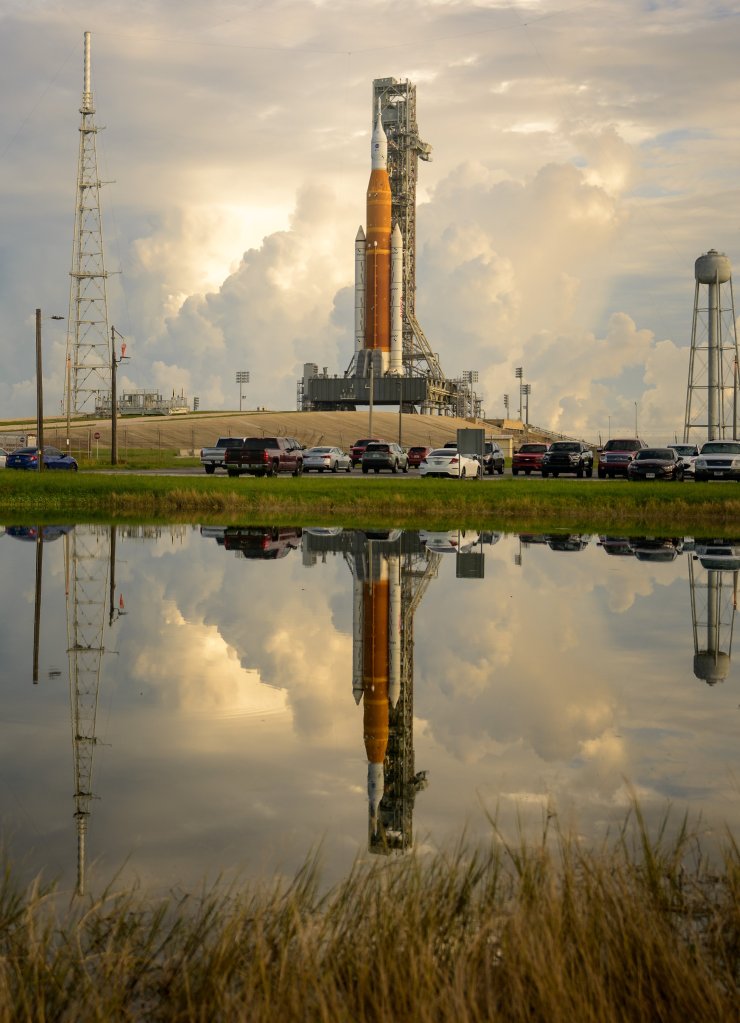
Image (Credit): NASA Mars Pathfinder mission site on Mars named the Carl Sagan Memorial Station. (NASA)

Artemis I: Failure is Not an Option

Image (Credit): Artemis I mission awaiting launch on September 3, 2022. (NASA)

This is the mission status from 11:22 am today:

The launch director waived off today’s Artemis I launch attempt at approximately 11:17 a.m. EDT. Teams encountered a liquid hydrogen leak while loading the propellant into the core stage of the Space Launch System rocket.  Multiple troubleshooting efforts to address the area of the leak by reseating a seal in the quick disconnect where liquid hydrogen is fed into the rocket did not fix the issue. Engineers are continuing to gather additional data.

An early September launch is not possible, so here are the future launch windows that NASA can consider:

September 19 – October 4 

  • 14 launch opportunities 
  • No launch availability on Sept. 29 and Sept. 30

October 17 – October 31 

  • 11 launch opportunities 
  • No launch availability on October 24, 25, 26, and 28 

November 12 – November 27 (preliminary) 

  • 12 launch opportunities 
  • No launch availability on November 20, 21, and 26 

December 9 – December 23 (preliminary) 

  • 11 launch opportunities 
  • No launch availability on December 10, 14, 18, and 23 

Artemis 1: Ready for Launch

Image (Credit): Lightening striking the Artemis I launch pad on August 27, 2022. (NASA)

Even after thunderstorms threatened the Artemis I launchpad over the weekend, everything is still a go for tomorrow’s scheduled launch at 8:33 am EDT of NASA’s Space Launch System rocket.

This NASA video shows you the entire plan for the Artemis I unmanned mission around the Moon. A few mission facts from the NASA site are also provided below.

Mission Facts:

  • Launch date: Aug. 29, 2022
  • Mission duration: 42 days, 3 hours, 20 minutes
  • Total distance traveled: 1.3 million miles
  • Re-entry speed: 24,500 mph (Mach 32)
  • Splashdown: Oct. 10, 2022

Now all we can do it await the new day.

Update: Given some engine problems Monday morning, it appears we will need to wait a little longer for this launch. The next window is September 2nd if NASA is ready. We have waited this long, so a few more days will not matter too much. I think the dummies on board are pretty patient.

Image (Credit): Artemis I mission patch. (NASA)

KSC: 60 Years and Going Strong

With the Artemis I mission ready to go on Monday, it is worth taking a moment to remember the Kennedy Space Center’s (KSC) 60th anniversary. As shown in the NASA graphic below, the KSC has been very busy over the years and has much more to do. This NASA site has more information and memories. This video also highlights some key moments in space history as well as some dreams about the future.

Credit: NASA

A Day in Astronomy: The End of Pluto as a Planet

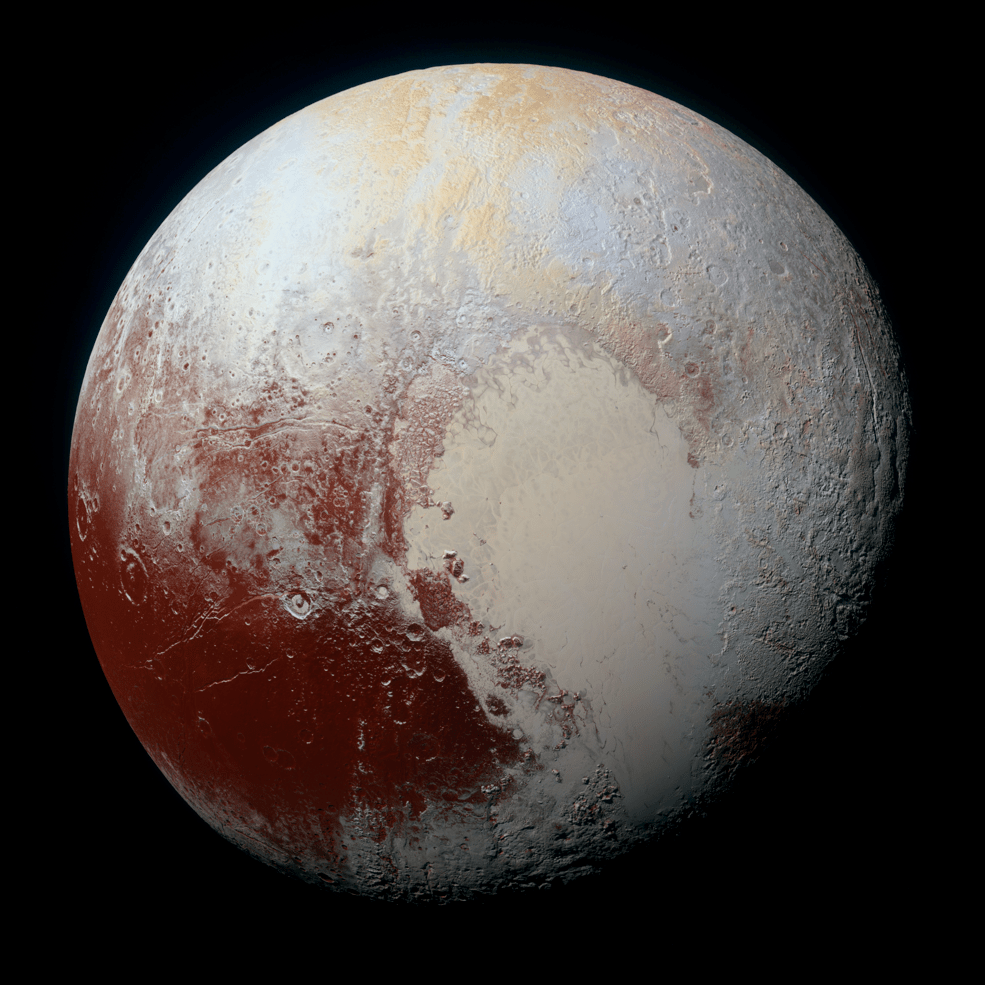
Image (Credit): Pluto as captured by NASA’s New Horizons spacecraft. (NASA/JHUAPL/SwRI)

On this day in 2006, the International Astronomical Union (IAU) approved a new definition of “planet” that excluded Pluto. The vote at the IAU approved the following definition of a planet:

  • is in orbit around the Sun,
  • has sufficient mass for its self-gravity to overcome rigid body forces so that it assumes a hydrostatic equilibrium (nearly round) shape, and
  • has cleared the neighborhood around its orbit.

Pluto fails this last test. In fact, many other objects, including at least one that may be larger (Eris), lie in the same orbit as Pluto around the Sun. However, Pluto does meet the definition of a “dwarf” planet:

  • is in orbit around the Sun,
  • has sufficient mass for its self-gravity to overcome rigid body forces so that it assumes a hydrostatic equilibrium (nearly round) shape,
  • has not cleared the neighborhood around its orbit, and
  • is not a satellite.

Hence, Pluto meets this definition whereas Europa, which is larger than Pluto, does not because it fails the last two tests – it has not cleared the neighborhood and it is a satellite.

The IAU vote was not popular. As one editorial argued, the third criteria about clearing the neighborhood makes little sense:

That last criterion states that a planet must be the gravitationally dominant object in the area of space in which it orbits. This rule makes sense for somewhere like, say, Earth, which is far more massive that the Moon and anything else along its orbital path. But out in the Kuiper Belt, where neighbouring bodies are far, far more distant than in the inner Solar System, Earth would not necessarily be able to clear its neighbourhood.

He continues:

This argument predates the flyby of Pluto in July 2015 of NASA’s New Horizons spacecraft, but the images returned by that spacecraft really help make the case: Pluto is an enigmatic world with towering ice mountains, vast glaciers of nitrogen ice, a tenuous atmosphere, a thick, outer icy carapace and a probably liquid water ocean below, all atop a huge rocky interior. By any geological measure – including the fact that there are surface processes acting on Pluto today – Pluto is a planet.

This will get more interesting once we throw in the exoplanets. Stay tuned.

Image (Credit): Some of the known dwarf planets. (Socratic.org)