Space Stories: Black Holes, X-Rays, and Exploding Stars

Image (Credit): Animation showing a binary system of a large, hot blue star and a black hole orbiting each other. (ESO/L.Calçada)

Here are some recent stories of interest.

SciTechDaily.com:Astronomers Have Discovered an Especially Sneaky Black Hole

VFTS 243 is a binary system, which means it is composed of two objects that orbit a common center of mass. The first object is a very hot, blue star with 25 times the mass of the Sun, and the second is a black hole nine times more massive than the Sun. VFTS 243 is located in the Tarantula Nebula within the Large Magellanic Cloud, a satellite galaxy of the Milky Way located about 163,000 light-years from Earth.

SpaceNews.com: ESA Scaling Back Design of X-ray Astronomy Mission

Faced within increasing costs, the European Space Agency is looking for ways to revise the design of a large X-ray space telescope, an effort that could have implications for NASA’s own astrophysics programs…That effort will involve potential changes to its instrument configuration as well as creation of a science “redefinition” team to reconsider science objectives. The goal will be to develop a revised concept, called a minimum disrupted mission, that will cost ESA no more than 1.3 billion euros but still perform science expected of a flagship-class mission.

NASA.gov:NASA Rocket Mission Using ‘Astronomical Forensics’ to Study Exploded Star

A NASA-funded sounding rocket mission will observe the remnants of an exploded star, uncovering new details about the eruption event while testing X-ray detector technologies for future missions. The High-Resolution Microcalorimeter X-ray Imaging, or Micro-X, experiment will launch Aug. 21 from the White Sands Missile Range in New Mexico. The mission’s target of study is some 11,000 light-years away from Earth, off the edge of the W-shaped constellation known as Cassiopeia. There, a massive bubble of radiant material known as Cassiopeia A, or Cas A for short, marks the site of a brilliant stellar death.

Space Mission: Preparing for a Launch to Europa in 2024

Image (Credit): Artist’s rendering of Europa orbiting Jupiter. (NASA)

Earlier this year, NASA’s Jet Propulsion Laboratory started assembling the Europa Clipper spacecraft so it is ready for its launch in 2024 (you can find the latest update here). Once it arrives at Jupiter, the spacecraft will have at least 50 flybys to study the Jovian moon and learn more about its inside, outside, and atmosphere.

Why Europa? NASA explains it this way:

Extraterrestrial life might exist under all sorts of conditions that humans would struggle to imagine. But we know of one set of conditions in which life flourishes in a multitude of shapes and sizes: the conditions found on Earth. Because we know Earth has the right conditions for life, humans can then sharply narrow down the search for extraterrestrial life by searching only in places that have the conditions that Earth life requires: a source of energy, the presence of certain chemical compounds, and temperatures that allow liquid water to exist. Jupiter’s icy moon Europa seems to be just such a place.

And water exists in abundance, as the NASA graphic shows below.

The Europa Clipper will not make it to Jupiter until 2030, so we have a long wait ahead of us. It also gives us plenty of time to guess about what we will find.

You can follow the status of the Europa Clipper here.

Image (Credit): Illustration comparing water on the Earth and Europa. (NASA)

Pic of the Week: Artemis I Heads for the Launchpad

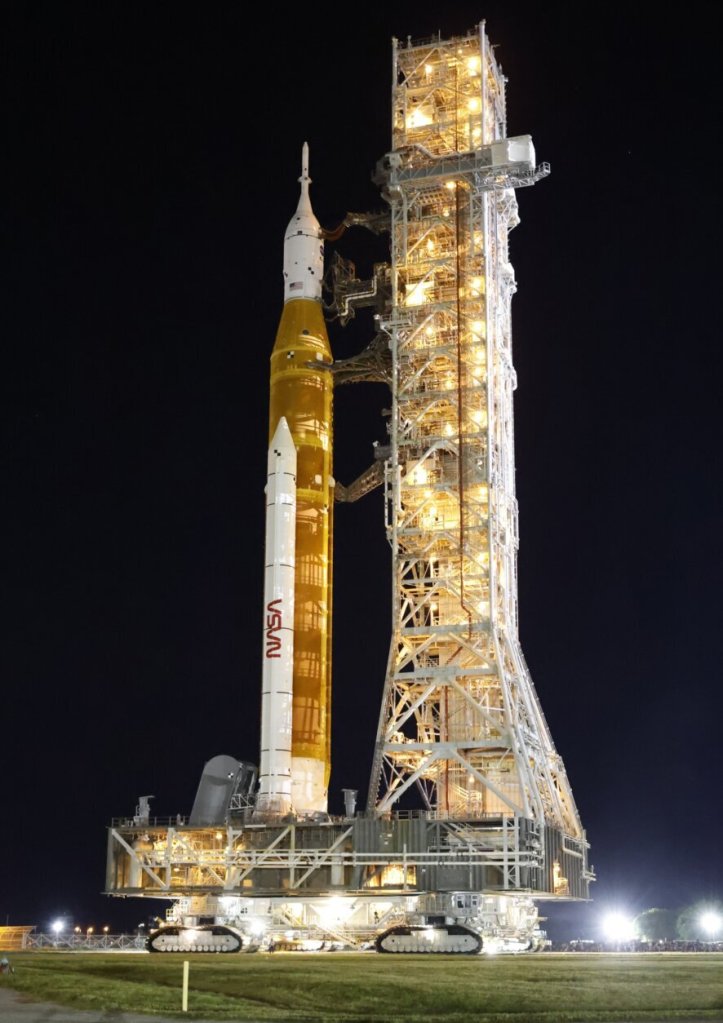
Image (Credit): NASA’s Space Launch System moving from the Vehicle Assembly Building to the launch pad at Cape Canaveral, Florida, on August 16, 2022. (NASA)

This week’s image highlights NASA’s actions to launch the first phase of the Artemis Mission. The image shows the Space Launch System and Orion capsule moving towards launch pad 39B at the Kennedy Space Center. The launch of the six-week unmanned mission around the Moon is planned for August 29th. The full mission for this first phase, or Artemis I, is shown below.

Image (Credit): Artemis I mission map. (NASA)

China Also Has a Secret Space Plane

Image (Credit): USAF’s X-37B Orbital Test Vehicle at Vandenberg AFB, California in June 2009. (USAF)

You may have heard of the U.S. Air Force’s (USAF) X-37B unmanned mini-space shuttle that has been sent into orbit many times in the past. It performed secretive missions for the USAF, yet it now falls under the U.S. Space Force. The X-37B is currently orbiting the Earth and has been doing so since May 2020. While it has been said to carry various NASA experiments, this is probably cover for its other work (given that the International Space Station is more than able to carry out these experiments).

So while we are still trying to figure out the real mission of the X-37B, China is experimenting with its own secret space plane and saying even less. On August 4th, China launched its space plane aboard a Long March 2F rocket for a spin around the globe. This is part of continuing experimental flights.

And just in case you might think Russia is falling behind, it already has spacecraft in orbit that seem to be tracking some U.S. satellites.

What are these nations up to? The role of the U.S. Space Force relates to:

…organizing, training, and equipping Guardians to conduct global space operations that enhance the way our joint and coalition forces fight, while also offering decision makers military options to achieve national objectives.

That does not sound like a scientific mission, which is why the USAF and not NASA owned the spacecraft years back.

More likely than not, while these spacecraft will be able to repair and protect the parent nation’s satellites, they will also be able to block, disable, and destroy the satellites of other nations. Yes, this is the militarization of space and all that means in a time or war – potentially endless debris threatening the missions of the other satellites orbiting the planet.

Like it or not, the space race continues on in many forms.

Note: The U.S. Air Force still has a page on the X-37B that highlights its mission. The page states:

The X-37B Orbital Test Vehicle, or OTV, is an experimental test program to demonstrate technologies for a reliable, reusable, unmanned space test platform for the U.S. Air Force. The primary objectives of the X-37B are twofold; reusable spacecraft technologies for America’s future in space and operating experiments which can be returned to, and examined, on Earth.

Here are the specs for the X-37B:

  • Primary Mission: Experimental test vehicle
  • Prime Contractor: Boeing
  • Height: 9 feet, 6 inches (2.9 meters)
  • Length: 29 feet, 3 inches (8.9 meters)
  • Wingspan: 14 feet, 11 inches (4.5 meters)
  • Launch Weight: 11,000 pounds (4,990 kilograms)
  • Power: Gallium Arsenide Solar Cells with lithium-Ion batteries
  • Launch Vehicles: United Launch Alliance Atlas V (501) and SpaceX Falcon 9

South Korea Shoots for the Moon

Image (Credit): The launch of the South Korean Danuri spacecraft on August 4, 2022 from Florida. (AP)

Last week, South Korea launched a spacecraft towards the Moon via a SpaceX rocket. As with other nations and programs (the U.S., Russia, the European Space Agency, Japan, China, Luxembourg, Israel, and India), South Korea hopes to learn more about the Moon and share it with the scientific community. NASA also has a role in this latest mission, having added instruments to the spacecraft.

The Korea Pathfinder Lunar Orbiter, dubbed the Danuri, will be South Korea’s first foray towards the Moon. It will not reach the Moon until December, and then remain in orbit for about a year. In terms of the overall mission of the spacecraft, NASA noted:

…the objectives are to develop indigenous lunar exploration technologies, demonstrate a ‘space internet,’ and conduct scientific investigations of the lunar environment, topography, and resources, as well as identify potential landing sites for future missions.

In addition to other equipment, NASA added a high-sensitivity camera called ShadowCam, which will look for evidence of ice in the lunar craters.

South Korea is also part of the Artemis Accords, which the U.S. and other nations signed to establish a lunar presence to be followed by travel to Mars. At the time of the signing, South Korea’s Minister of Science and ICT stated:

For successful space exploration, it is critical to implement space development activities transparently and responsibly by collaborating with the international community…With the signing of the Artemis Accords, Korea would be able to strengthen cooperation with nations participating in the Accords in exploring the outer space.

It is encouraging to see more cooperation in the space realm, even if things are rocky with Russia, one the the bigger players to date.