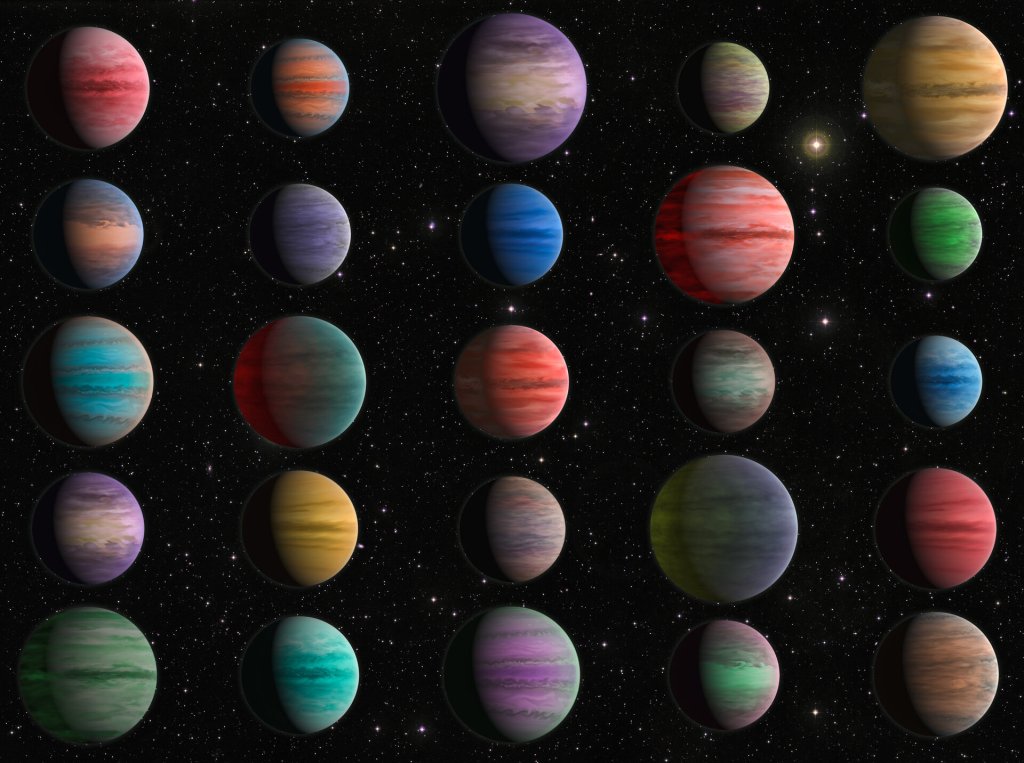
Image (Credit): Artist’s rendering of 25 hot Jupiters captured by the NASA/ESA Hubble Space Telescope that have been analysed by an international team of astronomers, enabling them to answer five open questions important to our understanding of exoplanet atmospheres. (ESA/Hubble, N. Bartmann)
“We are interested in understanding the diversity and atmospheric compositions of planets between the size of Earth and Neptune…“‘Super-Earths’ and ‘mini-Neptunes’ are the most common types of planets in our galaxy. But we only have a few examples of atmospheric measurements from these types of planets.”
-Statement by Johanna Teske, a staff scientist at the Carnegie Institution of Washington who is co-leading a Webb observation team with Natasha Batalha at NASA’s Ames Research Center in Northern California. She was discussing the James Webb Space Telescope’s role to better understand exoplanets. Her comments and more are included in a NASA news article, “Exoplanets: What NASA Will See with the Webb Telescope.”
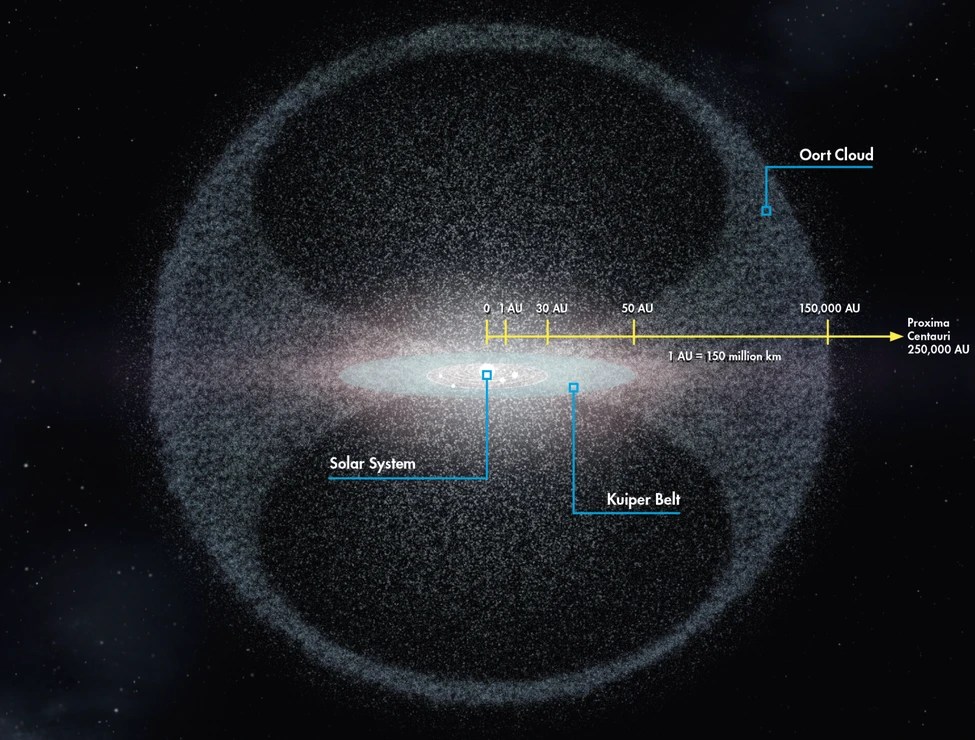
While NASA does not have any plans to send a specific missions to study the Oort Cloud, the most distant region in our solar system containing trillions of frozen objects, it has already sent five spacecraft in that direction. Two Voyager spacecraft, two Pioneer spacecraft, and the New Horizons spacecraft are all heading that way, but it is quite a distant.
For example, the Voyager spacecraft will not hit the Oort Cloud for another 300 years and will continue to travel through the cloud for another 30,000 years before escaping the solar system. As a result, all of these spacecraft will be dead as a rock before ever hitting that region and of no use to anyone back here, yet they will still carry messages from all of us to the stars. So in that sense, they still have a mission to perform should anyone be out there.
The Oort Cloud is still a theory since it has not been observed, but there is plenty evidence regarding its existence, including the comets that come into the center of our solar system from that region. The cloud itself is believed to be a sphere rather than on the same plane as the planets, so it forms a protective ring around the planets potentially becoming a hazard to any incoming or outgoing spacecraft. What this will mean for interstellar space travel, should that day come, is anyone’s guess at this point.
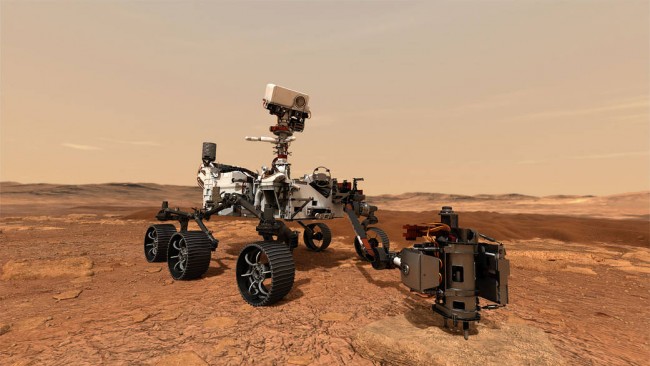
Image (Credit): Artist’s illustration of the Curiosity rover using its drill to core a rock sample on Mars. (NASA/JPL-Caltech)
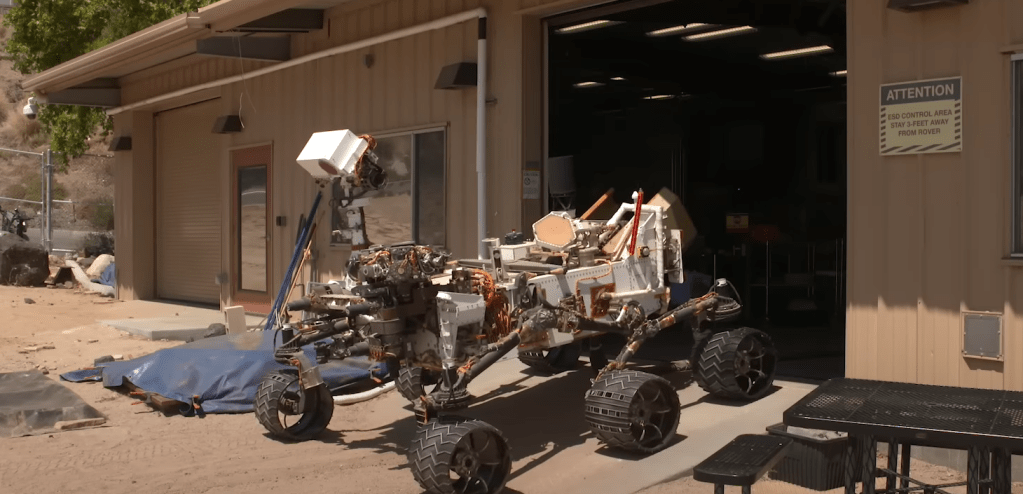
On this day in 2012, the Mars rover Curiosity landed on Mars (using Eastern Time). The rover was sent to the Red Planet to to explore the Gale crater and look for evidence that Mars had the conditions needed to support microscopic life in its past. A video from NASA walks you through the rover’s exploration to date and also highlights Maggie, Curiosity’s duplicate here on Earth.
An anniversary posting from NASA explains more about the mission, including issues with the rover’s drilling arm, wheels, and power supply. Life on Mars can be tough.
That said, the rover has already learned a lot after 10 years and it is expected to continue exploring in the years to come. NASA noted:
…most important, Curiosity has determined that liquid water as well as the chemical building blocks and nutrients needed for supporting life were present for at least tens of millions of years in Gale Crater. The crater once held a lake, the size of which waxed and waned over time. Each layer higher up on Mount Sharp serves as a record of a more recent era of Mars’ environment.
You can track the progress of the Curiosity rover using this website.
Image (Credit): NASA’s duplicate Mars rover called Maggie. (NASA/JPL-Caltech/ASU/MSSS/JHU-APL)
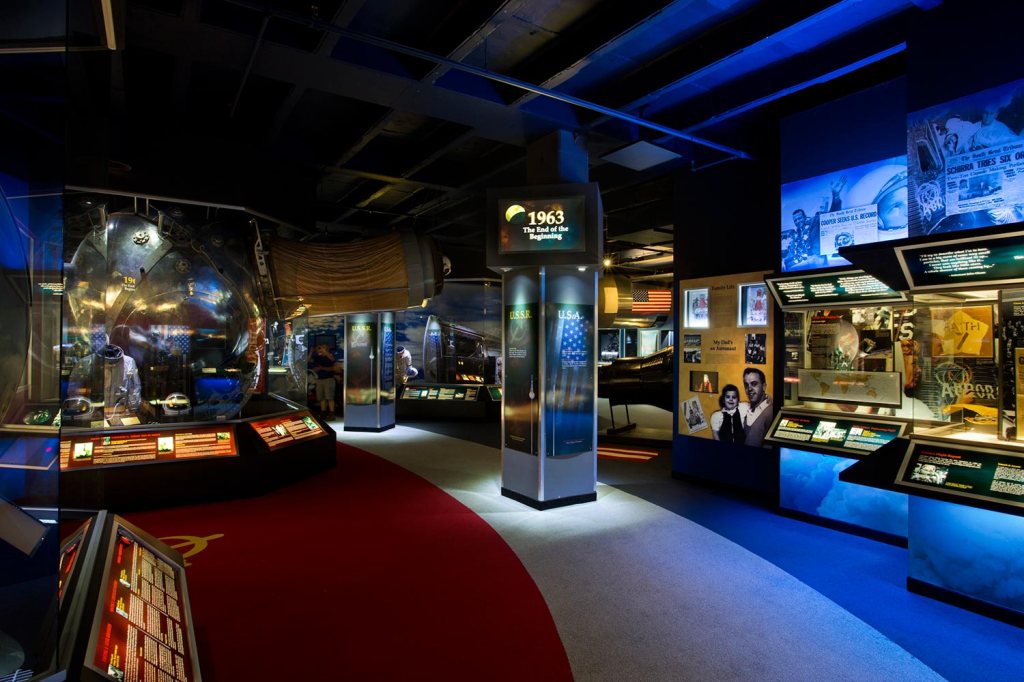
Image (Credit): Exhibits at the Cosmosphere’s Hall of Space Museum. (Cosmosphere)
You may have visited the Smithsonian National Air and Space Museum or ventured down to Florida to visit the Kennedy Space Center, but have you heard of the Cosmosphere in Kansas?
Started in 1962, the Cosmosphere in Hutchinson, Kansas claims to host “…the largest combined collection of U.S. and Russian space artifacts in the world and telling the comprehensive story of mankind’s race to space unlike anywhere else on Earth.”
For example, here are a few of the items you can view at the museum:
Flown Liberty Bell 7 Mercury spacecraft;
Flown Gemini X spacecraft;
Flown unmanned Russian Vostok;
Flown Apollo 13 command module, Odyssey;
Apollo space suits; and
Russian Sokul Spacesuit.
You can also find material related to German V-1 and V-2 rockets, Cold War spying, X-planes, and more. The expanded multinational coverage of space and conflict makes this a unique destination.
Image (Credit): AGerman V-1 rocket from World War II in the Hall of Space Museum. (Cosmosphere)
Image (Credit): The Cartwheel Galaxy, located about 500 million light-years away, as captured by the JWST. (NASA, ESA, CSA, STScI)
This week’s picture is one of the latest images from the James Webb Space Telescope (JWST). It shows the Cartwheel Galaxy, which is about 500 million light-years away. The Hubble’s view of this same galaxy is provided below.
NASA’s James Webb Space Telescope has peered into the chaos of the Cartwheel Galaxy, revealing new details about star formation and the galaxy’s central black hole. Webb’s powerful infrared gaze produced this detailed image of the Cartwheel and two smaller companion galaxies against a backdrop of many other galaxies. This image provides a new view of how the Cartwheel Galaxy has changed over billions of years.
The Cartwheel Galaxy, located about 500 million light-years away in the Sculptor constellation, is a rare sight. Its appearance, much like that of the wheel of a wagon, is the result of an intense event – a high-speed collision between a large spiral galaxy and a smaller galaxy not visible in this image. Collisions of galactic proportions cause a cascade of different, smaller events between the galaxies involved; the Cartwheel is no exception.
The collision most notably affected the galaxy’s shape and structure. The Cartwheel Galaxy sports two rings — a bright inner ring and a surrounding, colorful ring. These two rings expand outwards from the center of the collision, like ripples in a pond after a stone is tossed into it. Because of these distinctive features, astronomers call this a “ring galaxy,” a structure less common than spiral galaxies like our Milky Way.
The bright core contains a tremendous amount of hot dust with the brightest areas being the home to gigantic young star clusters. On the other hand, the outer ring, which has expanded for about 440 million years, is dominated by star formation and supernovas. As this ring expands, it plows into surrounding gas and triggers star formation.
Image (Credit): An image of the Cartwheel Galaxy taken with the NASA/ESA Hubble Space Telescope. (ESA/Hubble & NASA)



 Our Awesome Universe