Image (Credit): Test run of the Starship Booster on May 5, 2022. (SpaceX)
Earlier this week, SpaceX conducted another test of its Starship. However, the booster was damaged by an explosion during a pre-launch test and will now need to be inspected to determine whether it can be used in the inaugural launch of the Starship later this summer.
For more on the Starship, check out the Cool Worlds video titled “Why Starship Could Transform Astronomy.” It argues that reduced launch costs, reduced complexity, and heavier payloads would allow NASA to launch a fleet of telescopes within current budgets. For instance, the larger Starship payload would have allowed NASA to avoid all of the contortions necessary to fold the James Webb Space Telescope into a smaller rocket. The video also argues that SpaceX’s willingness to take risks is something NASA may want to emulate.
These are interesting times with NASA and SpaceX testing new rockets to place astronauts on distant objects. Even if Russia wants to sit this one out, we have a full blown space race underway domestically.
Image (Credit): Galaxy cluster SMACS 0723. (NASA, ESA, CSA, and STScI)
Earlier today, President Biden released one of the first images (shown above) from the James Webb Space Telescope (JWSP). A full release is scheduled for tomorrow at this location: https://www.nasa.gov/webbfirstimages.
The image shows galaxy cluster SMACS 0723, which represents thousands of galaxies in a patch of sky approximately the size of a grain of sand held at arm’s length by someone on the ground.
Here is a little more from NASA on what we are seeing:
The image shows the galaxy cluster SMACS 0723 as it appeared 4.6 billion years ago. The combined mass of this galaxy cluster acts as a gravitational lens, magnifying much more distant galaxies behind it. Webb’s NIRCam has brought those distant galaxies into sharp focus – they have tiny, faint structures that have never been seen before, including star clusters and diffuse features. Researchers will soon begin to learn more about the galaxies’ masses, ages, histories, and compositions, as Webb seeks the earliest galaxies in the universe.
Image (Credit): Russian cosmonauts Oleg Artemyev, Denis Matveev and Sergey Korsakov pose with a flag of the self-proclaimed Luhansk People’s Republic on the ISS in a photograph released July 4. (Roscosmos via Reuters)
“[NASA] strongly rebukes using the International Space Station for political purposes to support [the] war against Ukraine, which is fundamentally inconsistent with the station’s primary function among the 15 international participating countries to advance science and develop technology for peaceful purposes.”
-NASA statement, as quoted in the Washington Post, regarding the picture of three Russian cosmonauts on the International Space Station (ISS) holding a flag of the self-proclaimed Luhansk People’s Republic released earlier this month. Russia is probably try to clear up some earlier confusion about the colors worn by these same astronauts back in March (see below). We get it, you represent an aggressive nation preying on its neighbors.
Image (Credit): Russian cosmonauts clothing for their March arrival at the ISS . (Roscosmos)
Image (Credit): The Hubble Space Telescope. (NASA/ESA)
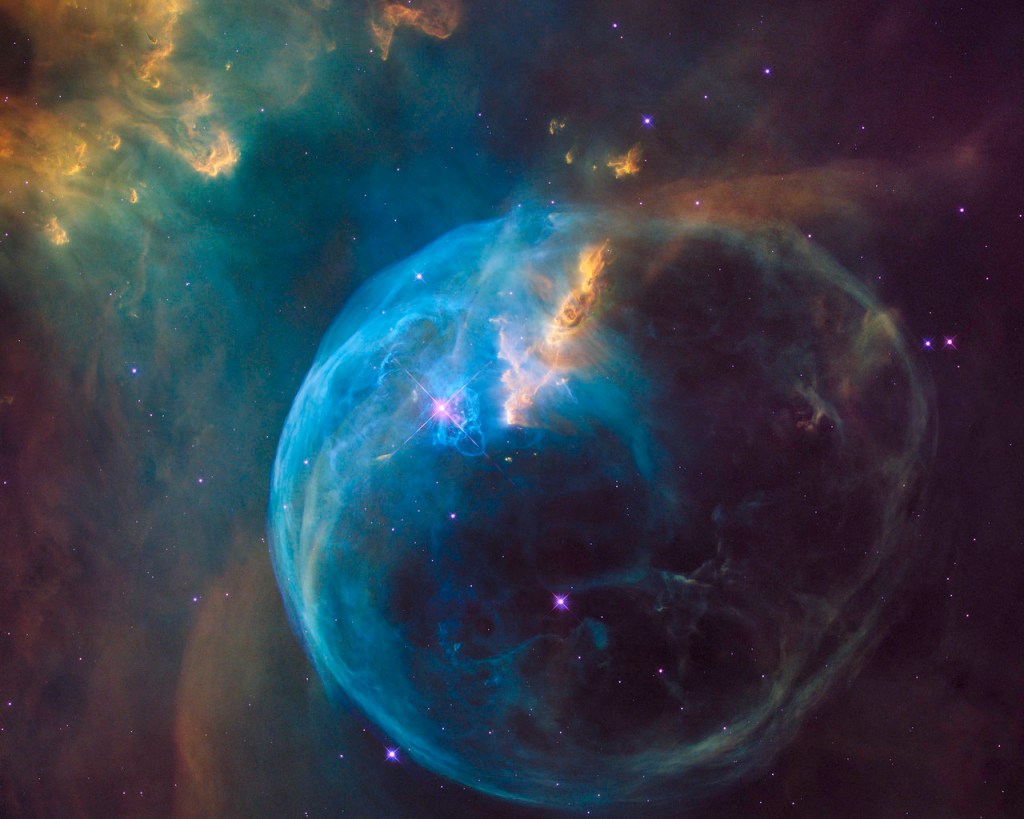
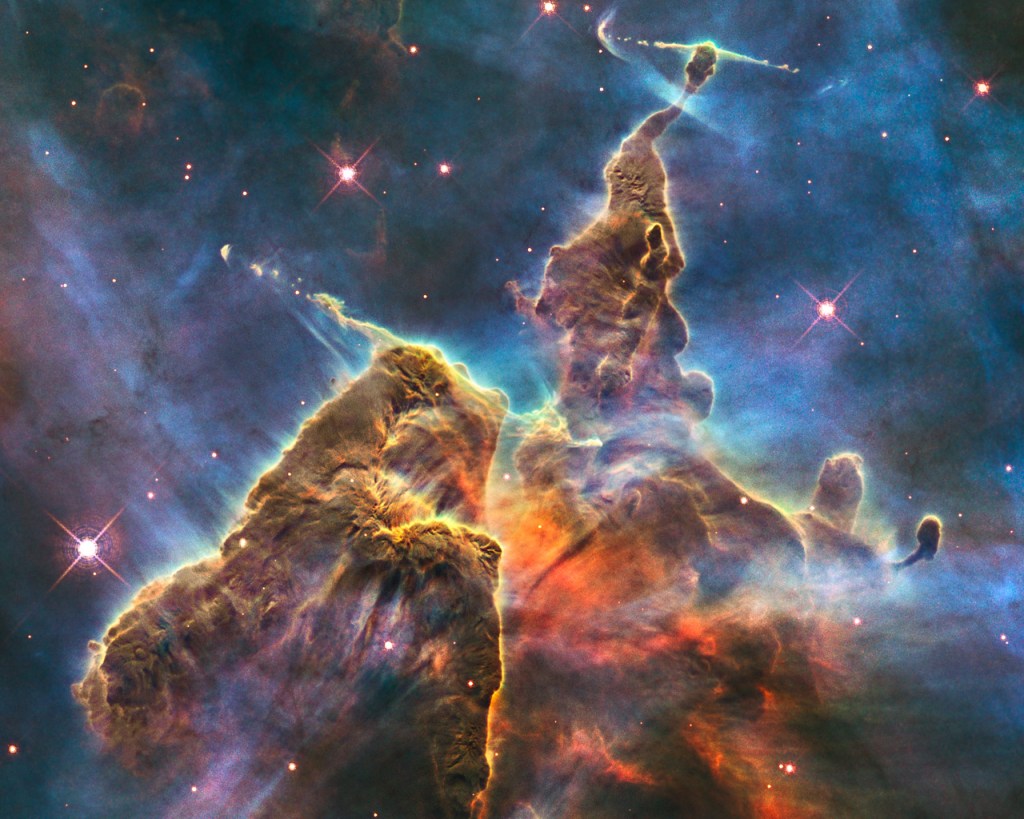
This week’s image is the Hubble Space Telescope, still going strong after more than 32 years. It left the Space Shuttle Discovery’s cargo bay on April 25, 1990. With all of the attention on the James Webb Space Telescope (JWST), it’s important to remember this dependable space telescope that brought us so many amazing images over the years, including those shown below.
Given the concern over the recent concerns about a micrometeroid impacting the JWST, let’s not forget that the Hubble had a few growing pains as well. Most importantly, it had to deal with a flawed mirror that required astronauts to visit the space telescope so they could add five pairs of corrective mirrors. More than three years had passed before the astronauts could make this correction. So the current issues with the JWST are pretty minor by comparison.
Image (Credit): The Bubble Nebula, also known as NGC 7635, located 8 000 light-years away. (NASA/ESA)
Image (Credit): A pillar of gas and clouds within the stellar nursery called the Carina Nebula, located 7500 light-years away in the southern constellation of Carina. (NASA/ESA).
On this week’s podcast program Sway, you can re-listen to a September 2020 interview between host Kara Swisher and Elon Musk. This was long before all the Twitter nonsense, when Mr. Musk was still focused on cars and space (mostly). The discussion covers plenty of topics, including the need to settle Mars (Mr. Musk disagress with Jeff Bezos who he said believes a space station will be enough to save humanity from an existential crisis), neural implants, and a return to the Moon.
You can tell the program is dated because Mr. Musk complains that NASA cannot find a way to return to the Moon, whereas today we have the Artemis lunar program that includes SpaceX as one of its contractors. Nonetheless, it is good to hear from the old Musk when he was a little more focused.
Then again, the neural implants still seem odd. Neuralink, a company he co-founded, is focusing on those with disabilities at the moment, but the application is expected to be more widespread:
Neuralink is currently focused on making medical devices. These devices have the potential to help people with a wide range of injuries and neurological disorders, and we hope to develop treatments for many of these conditions in the coming years. We expect that as our devices continue scale, and as we learn to communicate with more areas of the brain, we will discover new, non-medical applications for our [brain-machine interface] BMIs. Neuralink’s long-term vision is to create BCIs that are sufficiently safe and powerful that the general population would want to have them.
Helping paraplegics walk and curing brain disorders are certainly noble goals. And, hey, ordering a pizza just by thinking about it sounds cool. But many experts are concerned that Musk is seriously overhyping what Neuralink’s implants will be able to accomplish.
Elon Musk overhyping an idea? Never!
Check it out. You can download the podcast at the New York Times, the Apple Store, and elsewhere.




 Our Awesome Universe