Pic of the Week: Eerie Crater Marks the Spot

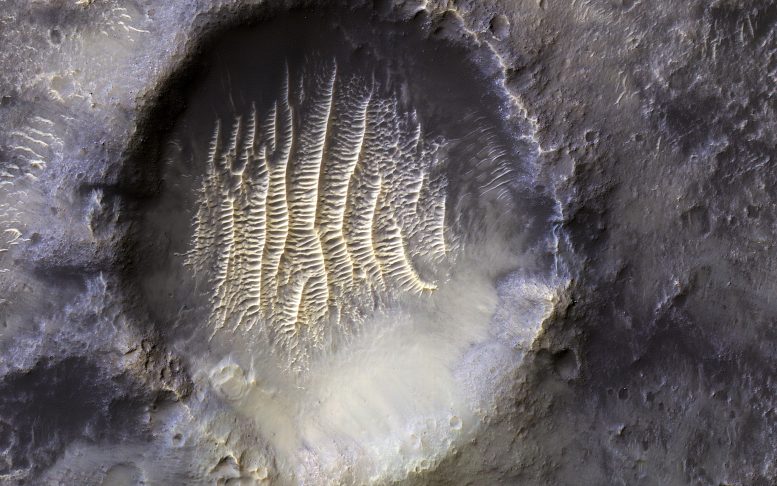
Image (Credit): Martian crater Airy-0. (NASA/JPL-Caltech/University of Arizona)

This week’s pic is an eerie crater within the Airy Crater on Mars that marks an important spot – 0° longitude on Mars. You can see this position of this smaller crater, Airy-0, within the larger crater below. NASA posted this image on Instagram with a few more details:

The larger crater that sits within this crater, called the Airy Crater, originally defined zero longitude for Mars, but as higher resolution photos became available, a smaller feature was needed. This crater, called Airy-0 (zero) was selected because it did not need to adjust existing maps.

This image was captured by the High-Resolution Imaging Science Experiment (HiRISE), on the Mars Reconnaissance Orbiter. The map is projected here at a scale of 50 centimeters (19.7 inches) per pixel.

The Airy Crater is names after Sir George Biddell Airy, the 7th Astronomer Royal, in 1850.

Image (Credit): Martian crater Airy. (Wikimedia Commons)

In Case You Missed It: Public Views on the Space Program

Image (Credit): Size of the Earth compared to Mars and the Moon. (hyperphysics.phy-astr.gsu.edu/)

Back in July 2019, the Pew Research Institute issued the results of earlier surveys about the US space program. Let’s look at the answers to six of the questions:

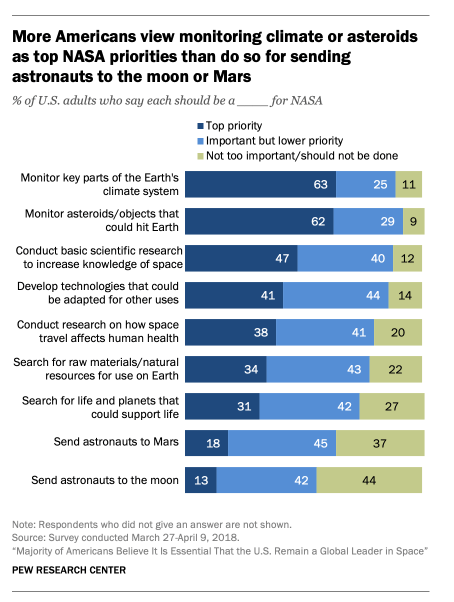
  1. Most Americans think sending astronauts to Mars or the Moon should be a lower priority for NASA – or say it should not be done at all (see graphic below).
  2. Americans see priorities other than a Moon or Mars landing as more pressing for NASA.
  3. Half of Americans think space travel will become routine during the next 50 years of space exploration.
  4. A majority of Americans say the U.S. must remain a global leader in space exploration, and that NASA’s continued involvement is essential.
  5. Americans have little confidence that private space companies will minimize space debris. 
  6. Americans are not enthusiastic about the idea of creating a military Space Force.

NASA may not be listening given that a trip back to the Moon was the lowest priority of Americans and yet is it the largest program currently in the U.S. space program, with a Moon satellite and trip to Mars as part of future plans. As far as minimizing space debris, the public seemed right on the mark regarding private space companies. If Elon Musk is any indicator, the commercial sector will not be deterred as it adds thousands of new satellites and related debris. And the ship has sailed on the Space Force question with the creation of the US Space Force in December 2019.

This would not be the first time Washington, DC goes down its own path regardless of public sentiment.

Image (Credit): Second question on the Pew survey on the space program. (Pew Research Institute)

Starliner: Third Time’s the Charm

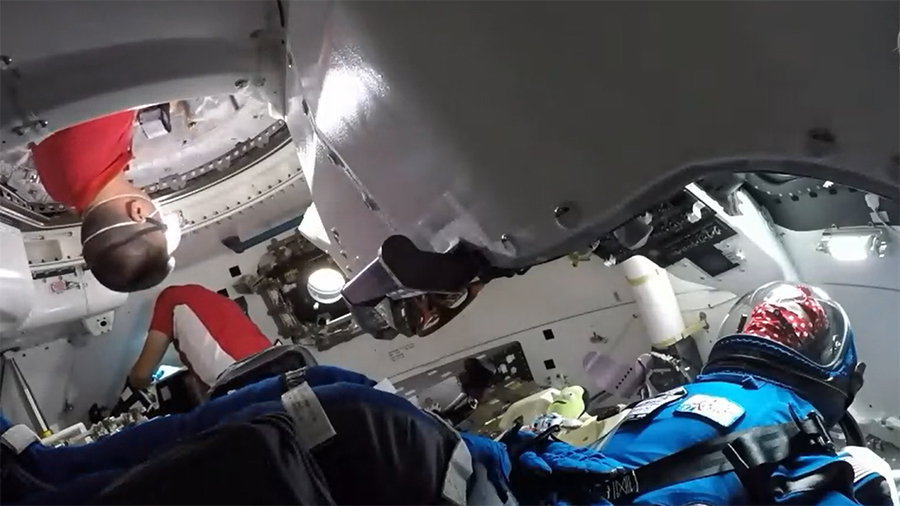
Image (Credit): NASA astronauts Bob Hines and Kjell Lindgren greet “Rosie the Rocketeer” inside the Boeing Starliner spacecraft shortly after opening its hatch. (NASA)

Finally, we have another spacecraft that appears capable of bringing astronauts into orbit. After two earlier tries, Boeing’s Starliner was successfully launched on Thursday and then connected with the International Spaced Stations (ISS) today. Now we just need it to undock on Wednesday and safely return.

In a press release, Jim Chilton, Boeing’s senior vice president for Space and Launch, stated:

Starliner has proven safe, autonomous rendezvous and docking capability…We’re honored to join the fleet of commercial spacecraft capable of conducting transportation services to the space station for NASA.

We needed this redundancy in our ISS program and now we have it.

You can read more about the mission here.

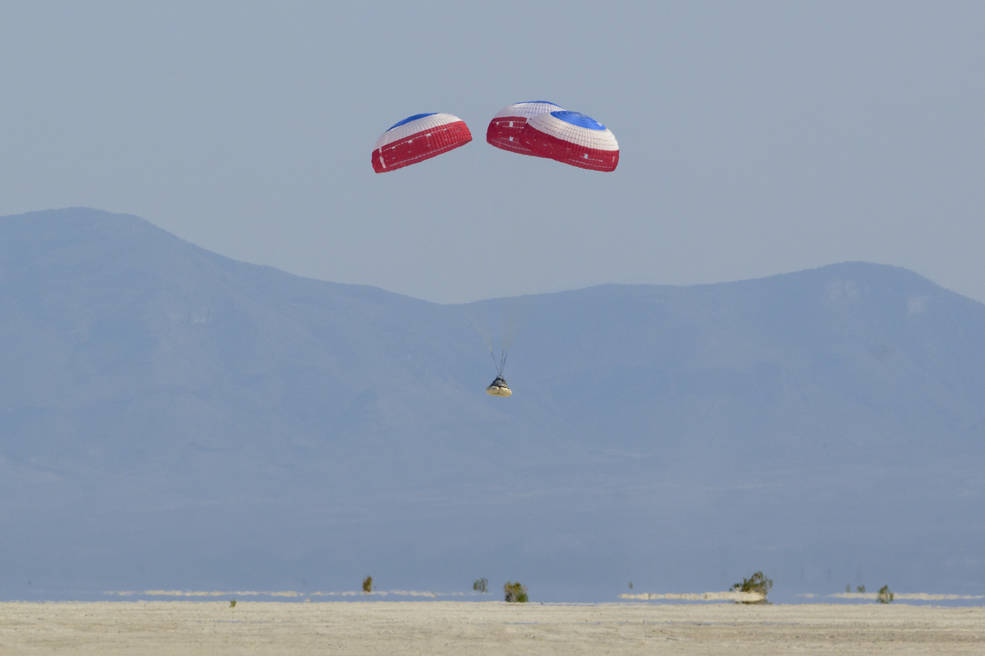
Update: The Starliner spacecraft safely returned to Earth on Wednesday, May 22nd. Joel Montalbano, manager of NASA’s International Space Station Program, stated:

Congratulations to the NASA and Boeing teams…I am excited to see the completion of a critical step in bringing another system online to transport long-duration crew members to and from the International Space Station. Soon, we hope to see crews arrive to the space station on Starliner to continue the important microgravity scientific research and discovery made possible by the orbiting laboratory.

Image (Credit): Boeing’s CST-100 Starliner spacecraft lands at White Sands Missile Range’s Space Harbor, Wednesday, May 25, 2022, in New Mexico. (NASA/Bill Ingalls)

A Day in Astronomy: Pioneer Venus

Image (Credit): Artist’s version of the Pioneer Venus Orbiter above Venus. (NASA)

On this day in 1978, NASA launched Pioneer Venus from Cape Canaveral, Florida. The mission had two components:

  • the Pioneer Venus Orbiter that remained in orbit around the planet until 1992 when it entered the Venusian atmosphere and burned up, and
  • the Pioneer Venus Multiprobe (known as Pioneer 13) that carried four probes later dropped into the Venusian atmosphere.

NASA described the descent of the four probes:

When the probes separated from the Multiprobe bus, they went “off the air” because they did not have sufficient on-board power or solar cells to replenish their batteries. Preprogrammed instructions were wired into them and their timers had been set before they separated from the bus. The on-board countdown timers were scheduled to bring each probe into operation again three hours before the probes began their descent through the Venusian atmosphere. On 9 December 1978, just 22 minutes before entry, the Large Probe began to transmit radio signals to Earth. Only 17 minutes before hurtling into the Venusian atmosphere at almost 42,000 km/hr (26,100 mph), all the Small Probes started transmitting.

All four probes were designed for a descent time of approximately 55 minutes before impacting the surface. None were designed to withstand the impact. However one Small Probe (the Day Probe) did survive and sent data from the surface for 67 minutes. Engineering data radioed back from the Day Probe showed that its internal temperature climbed steadily to a high of 126 degrees C (260 degrees F). Then its batteries were depleted, and its radio became silent.

A 2020 Nature Astronomy article noted that one of the probes may have detected signs of life in the Venusian atmosphere. The paper, Phosphine Gas in the Cloud Decks of Venus, has been controversial and was later modified to clarify some of the findings. However, a separate study in the Geophysical Research Letter, Venus’ Mass Spectra Show Signs of Disequilibria in the Middle Clouds, confirmed some of these finding and adding to the argument with the discovery of other chemicals that could also be linked to biological processes. The debate will continue as we learn more.

Pic of the Week: Mars InSight Lander

Image (Credit): Mars InSight lander on the Martian surface. (NASA)

NASA recently shared an image showing the accumulation of Martian dust on the solar panels of the Interior exploration using Seismic Investigations, Geodesy, and Heat Transport (InSight) Mars lander. The photo above was taken on April 24, 2022.

The Mars Insight lander was launched May 5, 2018 to study the interior of Mars. The lander already accomplished its primary mission and has been on extended mission. It has detected more than 1,300 marsquakes. However, as a result of the dust buildup, the mission is expected to end this summer.

In the NASA news release, Lori Glaze, director of NASA’s Planetary Science Division, stated:

InSight has transformed our understanding of the interiors of rocky planets and set the stage for future missions…We can apply what we’ve learned about Mars’ inner structure to Earth, the Moon, Venus, and even rocky planets in other solar systems.

You may recall an earlier posting about Martian dust and its impact on another mission.