Space Quote: Not a Hopeful Message

Image (Credit): The Very Large Array located at the National Radio Astronomy Observatory (NROA) site in Socorro, New Mexico, which is used by the Search for Extraterrestrial Intelligence Institute. (Alex Savello/NROA)

“There is a real possibility that humans will not exist as a species thousands of years from now, and thus a ‘message in a bottle’ about the very basic details would at least serve as a small reminder that we existed.”

Statement by Kristen Fahy, a NASA Jet Propulsion Laboratory scientist and co-author on a paper about a message of friendship to alien beings. The paper, A Beacon in the Galaxy: Updated Arecibo Message for Potential FAST and SETI Projects, calls for:

An updated, binary-coded message has been developed for transmission to extraterrestrial intelligences in the Milky Way galaxy. The proposed message includes basic mathematical and physical concepts to establish a universal means of communication followed by information on the biochemical composition of life on Earth, the Solar System’s time-stamped position in the Milky Way relative to known globular clusters, as well as digitized depictions of the Solar System, and Earth’s surface. The message concludes with digitized images of the human form, along with an invitation for any receiving intelligences to respond. 

I am not what the value of a ‘message in a bottle’ would be from a dead civilization. I was hoping for a more hopeful spin about why we want to send a message. Of course, many do not want to send a message at all because the alien response may not be what we want.

Pic of the Week: Final Acts of a Monster Star

Image (Credit): The nebula surrounding the star AG Carinae (ESA/Hubble and NASA, A. Nota, C. Britt)

This week’s photo is from the Hubble Space Telescope. It shows the “puffing dust bubbles and an erupting gas shell,” or nebula, surrounding the monster star AG Carinae. Here is the rest of the story from the European Space Agency (ESA) Hubble site:

This giant star is waging a tug-of-war between gravity and radiation to avoid self-destruction. The star is surrounded by an expanding shell of gas and dust — a nebula — that is shaped by the powerful winds emanating from the star. The nebula is about five light-years wide, equal to the distance from here to our nearest star, Alpha Centauri.

AG Carinae is formally classified as a Luminous Blue Variable because it is hot (blue), very luminous, and variable. Such stars are quite rare because there are not many stars that are so massive. Luminous Blue Variable stars continuously lose mass in the final stages of their life, during which a significant amount of stellar material is ejected into the surrounding interstellar space, until enough mass has been lost that the star has reached a stable state. 

AG Carinae is surrounded by a spectacular nebula, formed by material ejected by the star during several of its past outbursts. The nebula is approximately 10 000 years old, and the observed velocity of the gas is approximately 70 kilometres per second. While this nebula looks like a ring, it is in fact a  hollow shell rich in gas and dust, the centre of which has been cleared by the powerful stellar wind travelling at roughly 200 kilometres per second. The gas (composed mostly of ionised hydrogen and nitrogen) is visible to us in these images as a thick bright red ring, which appears doubled in places — possibly the result of several outbursts colliding into each other. The dust, here visible in blue, has formed in clumps, bubbles and filaments that are shaped by the stellar wind.

This image was selected by the ESA for the month of April in its 2022 ESA/Hubble Calendar.

A Day In Astronomy: The Launch of the Mars Odyssey

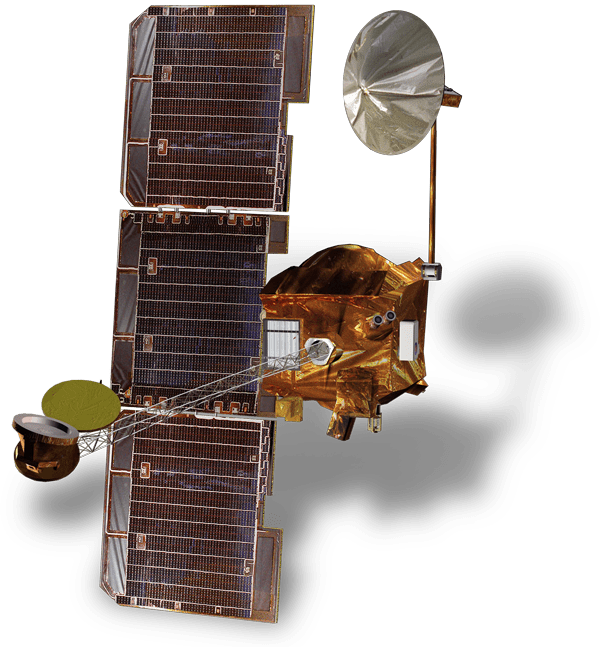
Image (Source): The Mars Odyssey orbiter. (NASA)

On this day in 2001, NASA’s Mars Odyssey orbiter was launched towards Mars to map and search the Red Planet for water. The mission itself took its name from Arthur C. Clarke’s novel 2001: A Space Odyssey.

The Mars Odyssey successfully discovered Martian water. Project Scientist Jeffrey Plaut of NASA’s Jet Propulsion Laboratory in Southern California, which leads the Odyssey mission, stated that “Before Odyssey, we didn’t know where this water was stored on the planet…We detected it for the first time from orbit and later confirmed it was there using the Phoenix lander.”

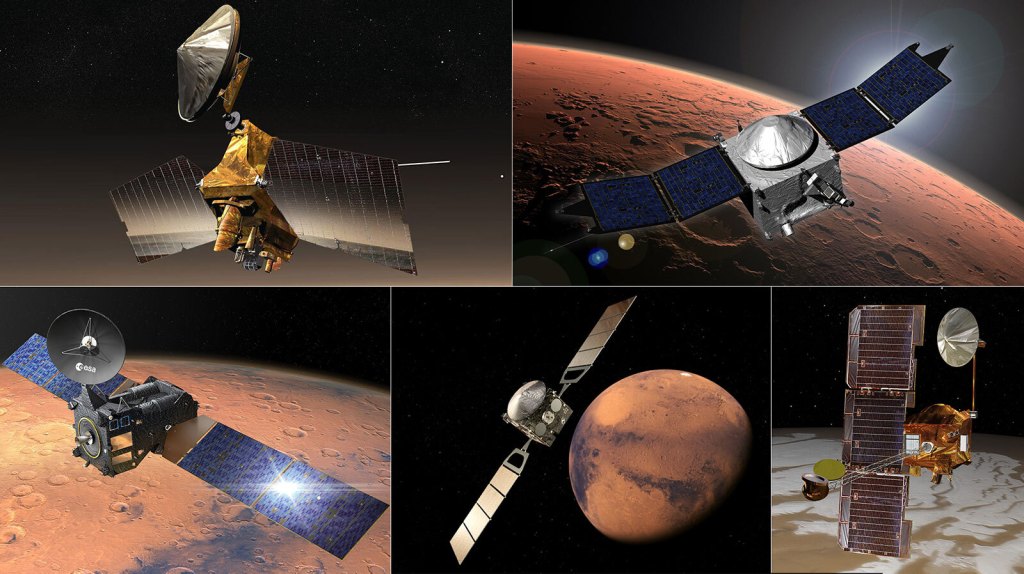
In addition to conducting its own studies, the Mars Odyssey was also used as a space satellite relaying data between Earth and Mars from other scientific missions, such as NASA’s Spirit and Opportunity rovers. The orbiter is part of what is called the Mars Relay Network, currently consisting of five orbiters (see below).

The Mars Odyssey is now the oldest oldest spacecraft still working at the Red Planet. It should be able to continue its work through 2025. You can find more information about the mission from this NASA site.

Image (Credit): Five spacecraft currently in orbit about the Red Planet make up the Mars Relay Network to transmit commands from Earth to surface missions and receive science data back from them. Clockwise from top left: NASA’s Mars Reconnaissance Orbiter (MRO), Mars Atmospheric and Volatile EvolutioN (MAVEN), Mars Odyssey, and the European Space Agency’s (ESA’s) Mars Express and Trace Gas Orbiter (TGO). (NASA/JPL-Caltech, ESA)

Space Quote: Good Feelings in Orbit

Image (Credit): NASA Astronaut Mark Vande Hei aboard the International Space Station. (NASA)

“They were, are and will continue to be very dear friends of mine. We support each other throughout everything. And I never had any concerns about my ability to continue working with them – very good professionals and technically competent and wonderful human beings.”

-NASA astronaut Mark Vande Hei, who returned to Earth from the International Space Station (ISS) last week, regarding his US and Russian crew mates, as quoted in the Washington Post. As a result of his latest ISS mission, Mr. Vande Hei has now spent more time in space on a single mission than any other US astronaut.

Where is the International Space Station?

Image (Credit): The International Space Station. (NASA)

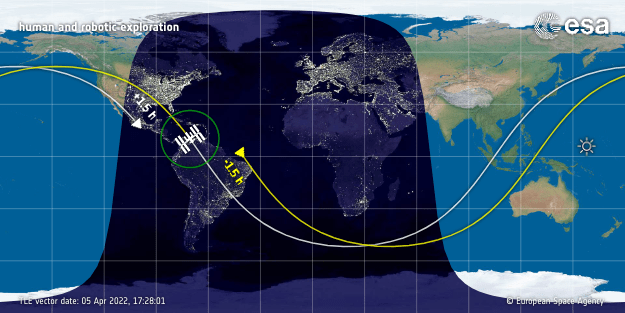
If you are standing outside in your yard looking for the International Space Station (ISS) at dawn or dusk (which is necessary to see the sun’s reflection on the station), this NASA site called Spot the Station may help. The site provides a global tracking map created by the European Space Agency (ESA) showing the current location of the ISS as well as its spot 90 minutes ago and 90 into the future.

NASA notes that the ISS circles the Earth every 90 minutes, traveling at about 17,500 miles per hour. While you experience one sunrise per day, an astronaut on the ISS will experience 16 sunrises each day.

You can find more ISS facts and figures here.

Image (Credit): ISS global tracking map. (ESA)